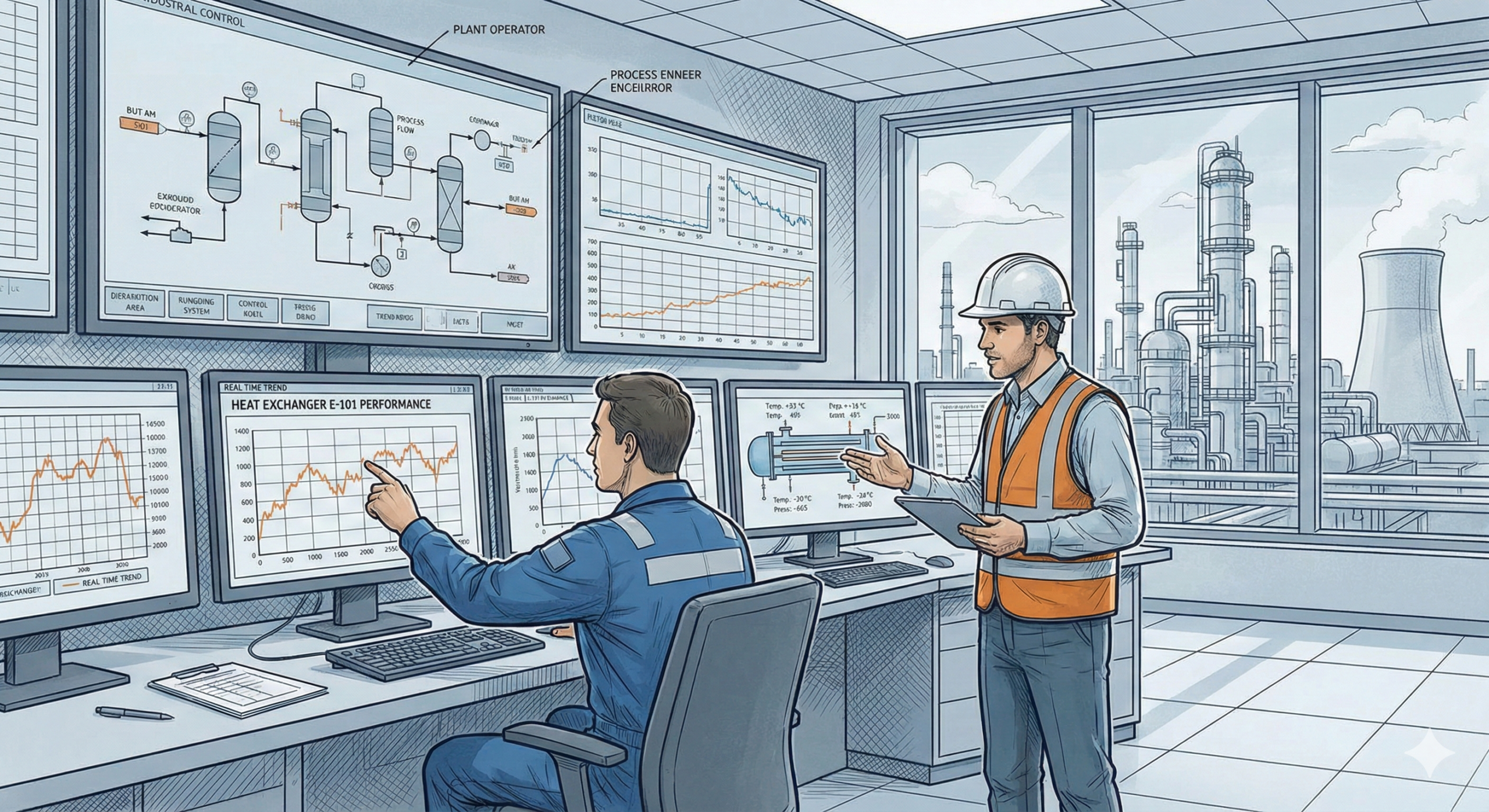
In a process plant, both operators and engineers work with the same equipment:
- heat exchangers
- heaters and coolers
- condensers
- reboilers
- utility systems
Both groups observe temperatures, flows, and pressures every day.
Both are responsible for keeping the plant running.
Yet there is a fundamental difference in how they understand what they see.
Operators focus on what is happening.
Engineers try to understand why it is happening.
And the bridge between these two ways of thinking is often heat transfer knowledge.
This article explains why understanding heat transfer changes how plant problems are interpreted, why it shapes decision-making, and how it gradually separates routine operation from engineering judgment.
Table of Contents
Operators See Symptoms First
Operators live closest to the process.
They notice:
- temperature drifting from setpoint
- steam demand increasing
- cooling water flow rising
- longer time to reach steady conditions
Their focus is practical and immediate:
- adjust the valve
- increase utility
- stabilize the unit
This approach keeps the plant running.
It is essential and valuable.
But it is focused on the present moment.
Engineers Look for the Cause Behind the Symptom
Engineers observing the same situation tend to ask different questions:
- Why is more steam needed now?
- Why did this cooler work better last month?
- Why does performance change with season?
- Why does cleaning temporarily improve everything?
Heat transfer knowledge allows engineers to see patterns:
- fouling building slowly
- U decreasing over time
- temperature driving force shrinking
- margin disappearing
So instead of only adjusting conditions, they start understanding the process behind them.
Temperature Is the First Clue
To an operator, temperature is a control variable.
To an engineer, temperature is a signal.
For example:
- A rising outlet temperature may mean insufficient cooling.
- But it may also mean fouling, poor flow distribution, or reduced heat transfer coefficient.
The reading is the same.
The interpretation is different.
Heat transfer knowledge turns temperature from a number into a story.
Utility Demand Tells a Deeper Story
When more steam is required to maintain the same outlet temperature, operators naturally respond by opening the valve.
This keeps the process stable.
But an engineer may recognize:
- increasing steam demand often means declining heat transfer performance
- deposits may be building
- resistance may be rising
So one group solves the immediate issue.
The other sees the long-term trend.
Both roles are important — but they serve different purposes.
Heat Transfer Explains “Why It Used to Work”
One of the most common phrases heard in plants is:
“This exchanger used to work better earlier.”
Without heat transfer understanding, this sounds like a vague observation.
With it, it becomes logical:
- fouling has increased
- surfaces have aged
- flow patterns have shifted
- utilities have changed
Heat transfer explains why performance slowly drifts over time.
Operators Stabilize. Engineers Anticipate.
Operators are trained to:
- respond quickly
- maintain control
- prevent process upset
Engineers are trained to:
- study trends
- anticipate limitations
- plan improvements
Heat transfer knowledge supports anticipation.
It helps answer questions like:
- When will this exchanger become a bottleneck?
- Why is summer operation always harder?
- Why does performance improve after shutdown?
This forward-looking view defines engineering thinking.
Understanding Heat Flow Changes How Equipment Is Seen
Without thermal knowledge, a heat exchanger looks like:
- a piece of equipment with inlet and outlet temperatures.
With thermal knowledge, it becomes:
- a system with resistances, driving forces, fouling behavior, and limits.
The same hardware appears completely different once heat flow is understood.
Troubleshooting Becomes More Structured
When something goes wrong, operators often act based on experience:
- increase flow
- adjust temperature
- change utility
This is effective for immediate recovery.
But engineers approach troubleshooting by asking:
- Has U changed?
- Has fouling increased?
- Has the driving force reduced?
- Is flow distribution uneven?
Heat transfer knowledge provides a framework for diagnosis, not just reaction.
Why Some Problems Repeat for Years
Plants sometimes struggle with the same thermal issues:
- exchangers frequently cleaned
- seasonal performance drops
- repeated throughput limits
Without deeper understanding, each problem feels separate.
With heat transfer insight, patterns become visible:
- resistance growing slowly
- margin consumed gradually
- systems operating closer to limits each year
This is where engineering thinking begins to differ from routine operation.
Experience Builds Intuition Around Heat Transfer
Over time, people who understand heat transfer begin to sense problems early.
They notice small signs:
- valves opening wider than usual
- temperature approach tightening
- utility demand creeping up
These signs may look normal to others.
But to someone thinking thermally, they indicate future constraints.
This intuition comes from understanding how heat actually moves in the plant.
Why Heat Transfer Knowledge Supports Better Decisions
When plants plan changes, decisions often involve:
- increasing throughput
- modifying utilities
- adding exchangers
- extending cleaning intervals
Heat transfer understanding helps predict:
- whether the system can handle more load
- where bottlenecks will appear
- how performance will change over time
Without this knowledge, decisions rely more on trial and error.
Owner Perspective: The Value of Deeper Understanding
From an ownership viewpoint, the difference is not about hierarchy.
It is about decision quality.
People who understand heat transfer can:
- identify limits early
- reduce unnecessary energy loss caused by declining thermal performance
- plan maintenance better
- avoid repeated capital spending
This knowledge turns daily observations into strategic insight.
Learning Heat Transfer Changes How a Plant Is Seen
As people begin to understand thermal behavior, their view of the plant changes.
They start noticing:
- where heat is gained
- where heat is lost
- where resistance is building
- where margins are shrinking
The plant becomes a connected energy system, not just a collection of equipment.
This Is Not About Role — It Is About Perspective
The goal is not to divide operators and engineers.
In many excellent plants:
- operators develop deep thermal intuition
- engineers learn from field experience
- knowledge flows both ways
What matters is perspective.
Understanding heat transfer moves thinking from:
- reacting to symptoms
to - understanding causes.
Final Perspective
Every plant runs on heat movement.
Temperatures change.
Energy flows.
Resistance builds.
Some people see these as routine numbers to control.
Others see them as signals that reveal what is happening inside the process.
That shift in understanding does not come from position or title.
It comes from learning how heat transfer really works.
And over time, that knowledge naturally separates routine operation from deeper engineering insight — not by authority, but by the ability to see the process in a different way.
Explore the complete series in the Heat Transfer Engineering Hub.
A practicing chemical engineer with 17+ years of experience in process design, project execution, commissioning, and plant operations. Focused on practical engineering judgment beyond textbook explanations.