
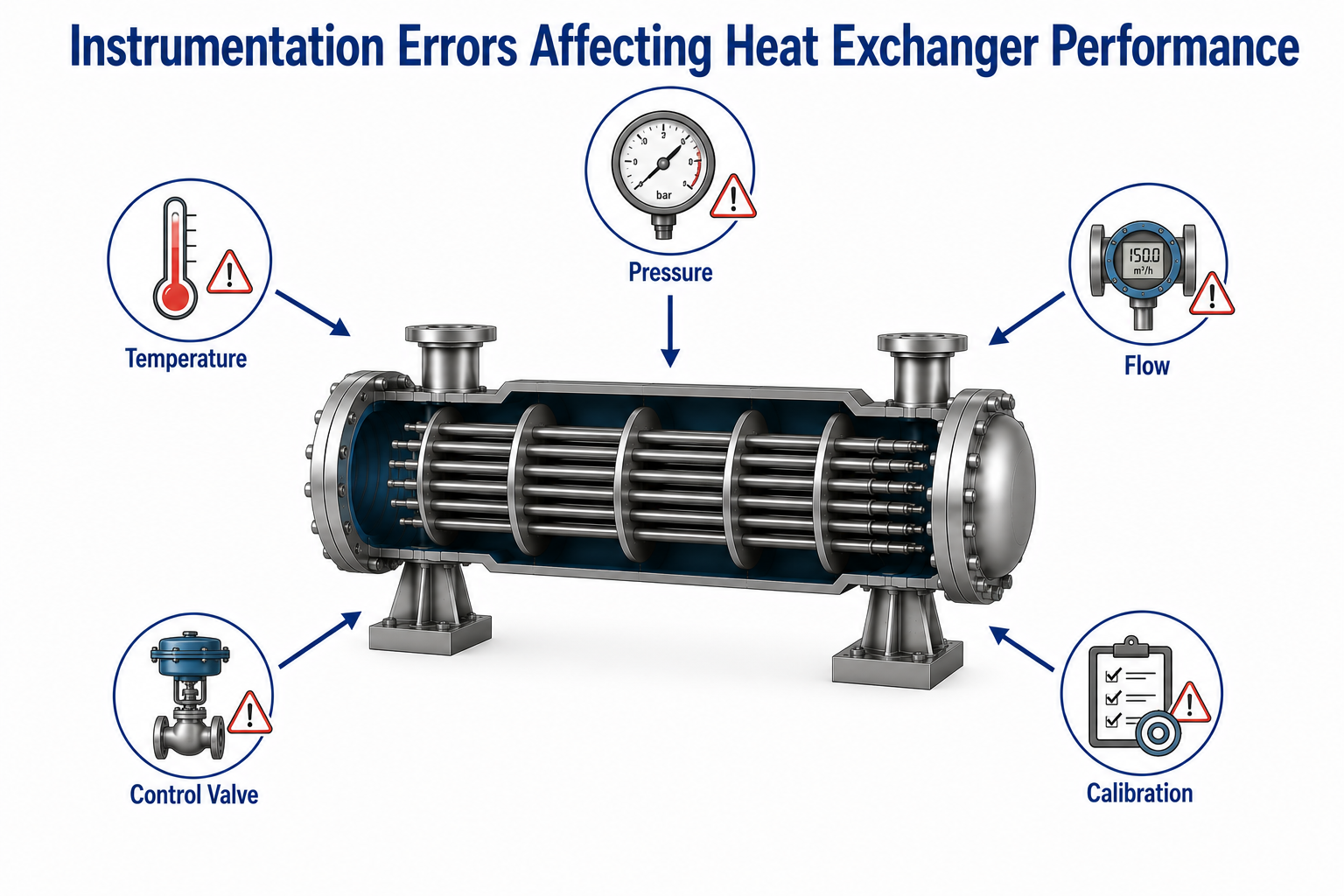
Heat exchangers depend on accurate instrumentation as much as they depend on sound thermal and mechanical design. Engineers evaluate heat duty, pressure drop, exchanger effectiveness, fouling, and utility consumption using measured process data. When temperature, pressure, or flow measurements become inaccurate, the exchanger itself may be blamed for problems that do not actually exist. Understanding common instrumentation errors helps engineers distinguish between genuine performance deterioration and misleading operating data, preventing unnecessary maintenance, equipment replacement, and production losses.
When a heat exchanger appears to be underperforming, the first instinct is often to inspect the equipment.
Engineers may suspect:
- fouling,
- tube leakage,
- reduced heat transfer area,
- excessive pressure drop,
- inadequate utility supply.
However, one important question is frequently overlooked:
“Can we trust the measurements?”
Every performance calculation depends on instrumentation.
The overall heat transfer coefficient cannot be calculated accurately if temperature measurements are incorrect.
Pressure drop trends become meaningless if transmitters drift.
Flow imbalance cannot be identified if flowmeters provide inaccurate readings.
Many heat exchangers have been unnecessarily cleaned, modified, or even replaced because engineers diagnosed equipment problems using unreliable operating data.
Experienced engineers therefore verify instrumentation before investigating the exchanger itself.
Table of Contents
Why Instrumentation Is Critical for Heat Exchanger Performance
Heat exchanger performance is determined from measured data rather than direct observation.
Engineers rely on instrumentation to determine:
- inlet temperatures,
- outlet temperatures,
- process flow rates,
- utility flow,
- differential pressure,
- operating pressure,
- control valve position.
These measurements form the basis for calculating:
- heat duty,
- exchanger effectiveness,
- overall heat transfer coefficient,
- energy consumption,
- fouling trends.
If the measurements are incorrect, every subsequent engineering conclusion may also be incorrect.
Error 1: Inaccurate Temperature Measurement
Temperature is the most important parameter in evaluating heat exchanger performance.
Common causes of temperature error include:
- sensor calibration drift,
- improper sensor installation,
- damaged thermowells,
- poor thermal contact,
- incorrect sensor location,
- ageing temperature elements.
Even small temperature errors can produce significant errors in calculated heat duty.
For example, a difference of only a few degrees may incorrectly suggest that the exchanger has lost performance.
Good Engineering Practice
Periodically calibrate temperature sensors and verify their installation before diagnosing exchanger problems.
Error 2: Flow Measurement Errors
Heat duty calculations are only as accurate as the measured flow rate.
Flow measurement errors may result from:
- incorrect meter sizing,
- sensor fouling,
- calibration drift,
- air entrainment,
- unstable flow conditions,
- partially filled pipelines.
An incorrect flow reading directly affects calculated heat transfer.
Engineers may mistakenly conclude that the exchanger is underperforming when the actual error lies in the flow measurement.
Good Engineering Practice
Verify flowmeter accuracy whenever exchanger performance appears inconsistent with operating observations.
Error 3: Pressure Transmitter Drift
Pressure measurements provide valuable information about hydraulic performance.
Pressure transmitter errors may cause engineers to misinterpret:
- fouling,
- tube blockage,
- pump performance,
- process restrictions.
An apparent increase in differential pressure may simply result from transmitter calibration drift rather than actual hydraulic deterioration.
Good Engineering Practice
Compare transmitter readings with calibrated reference instruments during routine maintenance.
Error 4: Incorrect Differential Pressure Measurement
Differential pressure is one of the earliest indicators of developing exchanger problems.
Common measurement issues include:
- blocked impulse lines,
- trapped air,
- liquid accumulation,
- transmitter zero shift,
- incorrect tapping locations.
These errors may produce misleading pressure drop trends.
Good Engineering Practice
Inspect impulse lines regularly and ensure transmitters are properly zeroed after maintenance.
Error 5: Poor Sensor Location
Even accurate instruments produce misleading data when installed at the wrong location.
Examples include:
- temperature sensors placed too close to nozzles,
- insufficient mixing before measurement,
- pressure taps located in disturbed flow regions,
- flowmeters installed without adequate straight pipe lengths.
Improper installation reduces measurement quality even when the instruments themselves function correctly.
Good Engineering Practice
Follow recommended installation practices during both design and commissioning.
Error 6: Control Valve Feedback Problems
The control system may create apparent exchanger problems that originate in valve performance.
Examples include:
- sticking valves,
- incorrect position feedback,
- actuator hysteresis,
- valve sizing errors,
- excessive dead band.
Operators may observe unstable outlet temperatures even though the exchanger itself performs normally.
Good Engineering Practice
Investigate valve performance whenever temperature control becomes unstable.
Error 7: Instrument Calibration Drift Over Time
Instrumentation gradually loses accuracy throughout its service life.
Calibration drift may occur because of:
- ageing electronics,
- vibration,
- thermal cycling,
- corrosion,
- environmental exposure.
Gradual drift often goes unnoticed because measurements continue changing slowly over time.
Good Engineering Practice
Implement scheduled calibration programs rather than waiting for obvious measurement failures.
Error 8: Data Acquisition and Communication Errors
Modern control systems introduce additional sources of measurement error.
Examples include:
- incorrect signal scaling,
- communication failures,
- software configuration errors,
- historian inaccuracies,
- engineering unit conversion mistakes.
The field instrument may function correctly while the displayed value remains incorrect.
Good Engineering Practice
Verify both field instrumentation and control system configuration during troubleshooting.
Error 9: Relying on a Single Measurement
One instrument should rarely determine major engineering decisions.
For example, declining outlet temperature should be evaluated together with:
- process flow,
- utility flow,
- pressure drop,
- inlet temperatures,
- production rate.
Multiple measurements provide a more reliable picture of exchanger performance than any single parameter.
Good Engineering Practice
Always validate important conclusions using several independent operating variables.
Error 10: Ignoring Long-Term Performance Trends
Individual readings rarely reveal developing performance problems.
Heat exchangers gradually change over months or years.
Trend analysis helps distinguish between:
- temporary operating fluctuations,
- instrumentation drift,
- genuine performance deterioration,
- seasonal operating effects.
Without historical data, engineers may incorrectly interpret normal process variation as equipment failure.
Good Engineering Practice
Maintain long-term operating records and review trends rather than isolated measurements.
A Systematic Approach to Verifying Instrumentation
Before concluding that the heat exchanger has failed, verify the quality of the operating data.
A practical verification sequence includes:
- Confirm temperature sensor calibration.
- Verify flowmeter accuracy.
- Check differential pressure measurements.
- Review control valve operation.
- Confirm transmitter scaling in the control system.
- Compare current data with historical operating trends.
- Validate measurements using portable reference instruments where practical.
This systematic approach often prevents unnecessary maintenance and incorrect engineering decisions.
Common Misunderstandings About Instrumentation
Many troubleshooting efforts become ineffective because measurement quality is assumed rather than verified.
“Digital Instruments Are Always Accurate”
Digital displays improve readability but do not eliminate calibration drift, installation errors, or configuration problems.
“A Stable Reading Means the Instrument Is Correct”
An instrument may provide a stable yet consistently incorrect value if calibration has drifted.
“The Heat Exchanger Must Be Fouled”
Poor thermal performance should never be attributed to fouling until instrumentation accuracy has been verified.
“One Temperature Reading Is Enough”
Reliable heat exchanger evaluation requires multiple operating measurements rather than a single process variable.
Operator Perspective
Operators are often the first to notice inconsistencies between plant behavior and displayed instrument readings.
Examples include:
- outlet temperatures that appear incorrect,
- unexpected valve movement,
- inconsistent pressure trends,
- utility consumption that does not match indicated heat duty.
Reporting these inconsistencies early allows engineers to identify instrumentation problems before unnecessary maintenance is performed.
Owner Perspective
For plant owners, reliable instrumentation protects both operational efficiency and maintenance budgets.
Accurate measurements help:
- prevent unnecessary exchanger cleaning,
- avoid premature equipment replacement,
- improve energy efficiency,
- optimize maintenance scheduling,
- support reliable production planning,
- reduce lifecycle operating costs.
Investment in instrumentation reliability often produces returns far greater than its maintenance cost.
Final Perspective
A heat exchanger can only be evaluated as accurately as the measurements used to assess it.
Temperature, pressure, flow, and control data form the foundation of every thermal calculation, maintenance decision, and performance assessment.
When these measurements become unreliable, engineers risk solving problems that do not exist while overlooking the ones that do.
Experienced engineers therefore develop a simple habit before beginning any troubleshooting exercise:
First verify the data, then evaluate the equipment.
This disciplined approach prevents unnecessary maintenance, improves diagnostic accuracy, and ensures that engineering decisions are based on facts rather than assumptions.
Ultimately, reliable instrumentation is not merely a support system for heat exchangers—it is an essential part of their successful operation throughout the life of the process plant.
Explore the complete series in the Heat Exchanger Engineering Hub.

A practicing chemical engineer with 17+ years of experience in process design, project execution, commissioning, and plant operations. Focused on practical engineering judgment beyond textbook explanations.