Troubleshooting a heat exchanger is rarely as simple as identifying one defective component or replacing damaged equipment. Most performance problems develop gradually through the interaction of thermal, hydraulic, mechanical, operational, and instrumentation factors. When troubleshooting focuses on symptoms instead of causes, engineers often repeat the same maintenance activities without permanently solving the problem. A systematic troubleshooting approach enables engineers to identify the true source of performance deterioration, minimize downtime, and improve long-term equipment reliability.
Every operating plant eventually encounters a heat exchanger that no longer performs as expected.
The symptoms are familiar:
- outlet temperature is lower than expected,
- steam consumption continues increasing,
- cooling becomes less effective,
- pressure drop rises,
- production capacity declines.
The natural response is to ask:
“What is wrong with the heat exchanger?”
Unfortunately, this question often leads troubleshooting in the wrong direction.
Many investigations begin with assumptions instead of evidence.
The exchanger is cleaned before measurements are verified.
Tube bundles are replaced before operating conditions are reviewed.
Utilities are blamed before process changes are evaluated.
When the underlying problem remains unresolved, the same failures return repeatedly.
Experienced engineers approach troubleshooting differently.
Instead of searching immediately for a defective component, they first seek to understand how the entire process system has changed.
Successful troubleshooting is therefore not about finding faults—it is about understanding cause-and-effect relationships throughout the plant.
Table of Contents
Why Heat Exchanger Problems Are Difficult to Diagnose
Most exchanger problems produce similar symptoms even though their causes are completely different.
For example, poor outlet temperature may result from:
- fouling,
- insufficient utility supply,
- reduced flow rate,
- incorrect process conditions,
- instrumentation errors,
- bypass leakage,
- mechanical damage.
Similarly, excessive pressure drop may indicate:
- deposit formation,
- blocked tubes,
- valve restrictions,
- flow measurement errors,
- temporary strainers,
- process changes.
The same symptom may therefore have several possible causes.
Without systematic investigation, troubleshooting often becomes trial and error.
Mistake 1: Assuming the Heat Exchanger Is the Problem
The apparent equipment problem may actually originate elsewhere in the process.
Examples include:
- inadequate cooling tower performance,
- reduced steam pressure,
- pump deterioration,
- upstream process instability,
- downstream restrictions,
- utility interruptions.
Replacing or modifying the exchanger will not solve these problems.
Good Engineering Practice
Always evaluate the complete process system before focusing on the exchanger itself.
Mistake 2: Troubleshooting Without Reliable Data
Engineering decisions are only as good as the measurements supporting them.
Before investigating equipment performance, verify:
- temperature measurements,
- flow rates,
- pressure readings,
- differential pressure,
- control valve operation,
- instrumentation calibration.
Many unnecessary maintenance activities result from incorrect operating data.
Good Engineering Practice
Validate instrumentation before diagnosing equipment failure.
Mistake 3: Focusing on One Symptom
A single operating parameter rarely explains the complete problem.
For example:
Increasing steam consumption should also be evaluated together with:
- outlet temperature,
- pressure drop,
- process flow,
- utility conditions,
- historical operating trends.
Considering multiple operating variables provides a much clearer understanding of exchanger performance.
Good Engineering Practice
Never base major engineering decisions on one measurement alone.
Mistake 4: Assuming Fouling Is Always Responsible
Fouling is common, but it is not the only cause of poor performance.
Other possible causes include:
- utility limitations,
- process modifications,
- hydraulic imbalance,
- tube leakage,
- bypass flow,
- instrumentation errors,
- control system problems.
Cleaning the exchanger may temporarily improve performance while leaving the actual problem unresolved.
Good Engineering Practice
Confirm the failure mechanism before scheduling maintenance.
Mistake 5: Ignoring the Original Design Basis
Troubleshooting becomes difficult when current operation is compared only with today’s expectations rather than the original design conditions.
Review:
- design flow rates,
- utility conditions,
- fluid properties,
- production capacity,
- fouling assumptions.
Many exchangers perform exactly as designed but operate under conditions that have changed significantly since commissioning.
Good Engineering Practice
Compare current operating conditions with the original design basis before concluding that the exchanger has failed.
Mistake 6: Looking Only at the Heat Exchanger
Heat exchangers function as part of an integrated process system.
Successful troubleshooting often requires evaluating:
- pumps,
- reactors,
- distillation columns,
- compressors,
- cooling towers,
- boilers,
- piping systems,
- control loops.
The exchanger may simply be responding to conditions created elsewhere.
Good Engineering Practice
Adopt a system-wide perspective during troubleshooting.
Mistake 7: Replacing Components Without Root Cause Analysis
Repairing damaged equipment does not necessarily eliminate the reason it failed.
Examples include:
- replacing leaking tubes without investigating vibration,
- replacing gaskets without reviewing thermal cycling,
- cleaning repeatedly without identifying the source of fouling.
Without understanding the failure mechanism, the same problems frequently recur.
Good Engineering Practice
Identify the root cause before selecting corrective action.
Mistake 8: Ignoring Historical Operating Trends
Current operating conditions rarely tell the complete story.
Trend analysis may reveal:
- gradual fouling,
- seasonal utility variation,
- increasing pressure drop,
- declining heat duty,
- recurring operational disturbances.
Historical data often explains problems that appear confusing when viewed only at one point in time.
Good Engineering Practice
Review long-term operating trends before drawing conclusions.
Mistake 9: Treating Every Plant the Same
Successful troubleshooting always considers the specific process service.
A refinery crude preheater, an API reactor cooler, a pharmaceutical purified water heater, and a food processing exchanger experience very different operating challenges.
Troubleshooting should reflect:
- fluid characteristics,
- operating philosophy,
- production pattern,
- cleaning practices,
- utility availability.
Applying generic solutions frequently produces disappointing results.
Good Engineering Practice
Adapt troubleshooting methods to the actual process service.
Mistake 10: Ending the Investigation Too Early
Restoring operation is not the same as solving the problem.
After corrective action:
- verify heat duty,
- monitor pressure drop,
- review energy consumption,
- observe long-term trends,
- document findings,
- update operating procedures where necessary.
Without verification, engineers cannot confirm whether the real problem has been eliminated.
Good Engineering Practice
Continue monitoring after repairs to confirm sustained improvement.
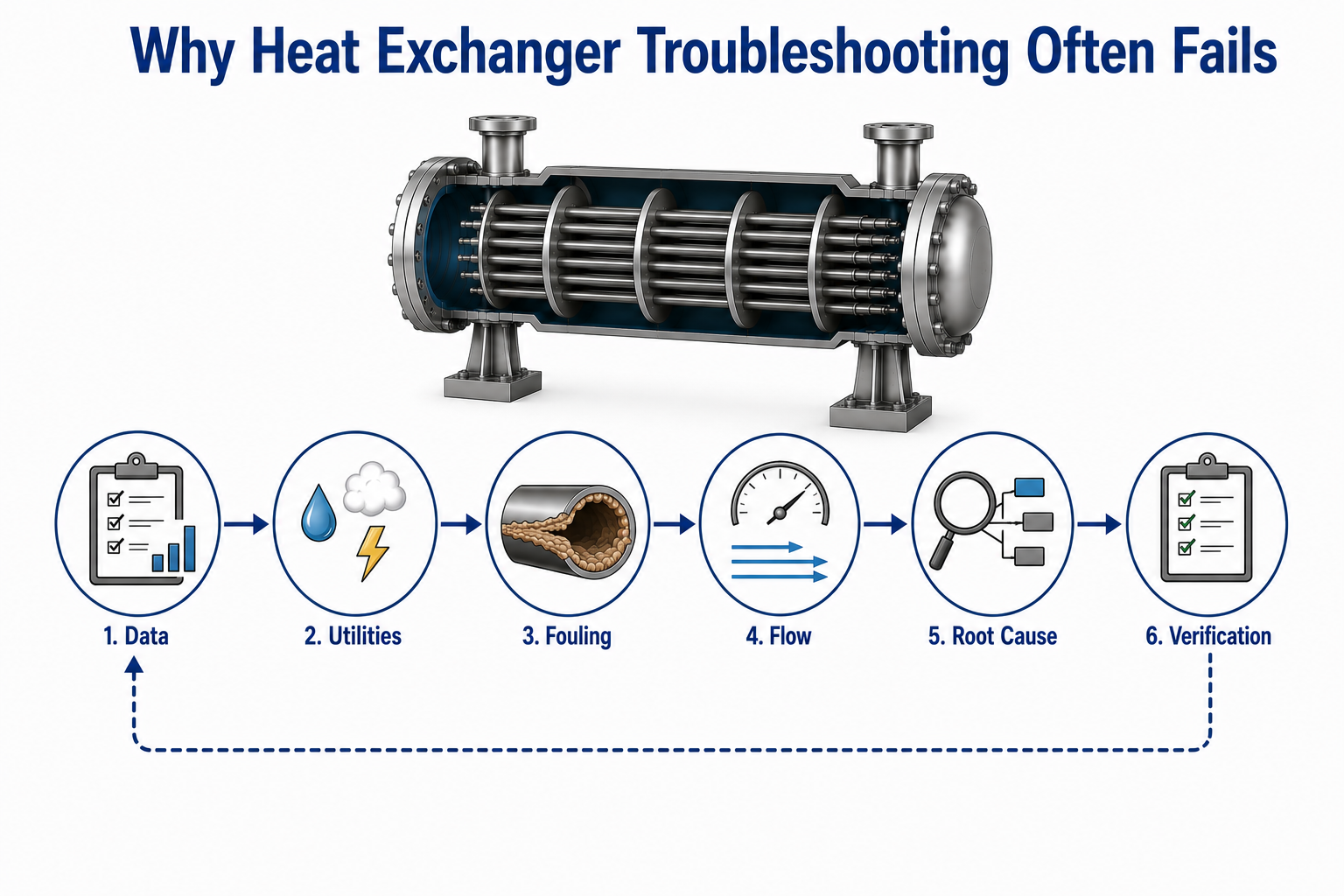
A Practical Heat Exchanger Troubleshooting Sequence
Systematic investigation consistently produces better results than trial-and-error maintenance.
A practical troubleshooting approach includes:
- Confirm that instrumentation is accurate.
- Review current operating conditions.
- Compare operation with the original design basis.
- Evaluate utilities and supporting equipment.
- Review pressure drop and temperature trends.
- Inspect for fouling, leakage, or mechanical damage.
- Identify the root cause before selecting corrective action.
- Verify performance after repairs or modifications.
- Document lessons learned for future reference.
Following the same structured sequence reduces unnecessary maintenance and improves troubleshooting consistency.
Characteristics of Successful Troubleshooting Teams
Reliable troubleshooting depends as much on teamwork as on technical knowledge.
The most successful investigations involve collaboration between:
- process engineers,
- operations personnel,
- mechanical engineers,
- instrumentation specialists,
- maintenance teams,
- reliability engineers.
Each discipline contributes a different perspective.
Combining these perspectives usually produces a more accurate diagnosis than working independently.
Common Misunderstandings About Troubleshooting
Many recurring exchanger problems result from incorrect troubleshooting philosophy rather than technical limitations.
“The First Suspected Cause Is Usually Correct”
Initial assumptions are often influenced by previous experiences and may overlook more likely explanations.
Evidence should guide every investigation.
“Cleaning Proves Fouling Was the Problem”
Performance improvement after cleaning does not necessarily prove fouling was the only cause.
Other operating conditions may also have changed during maintenance.
“Replacing the Exchanger Guarantees Better Performance”
If the underlying process conditions remain unchanged, a new exchanger may develop exactly the same problems.
“Troubleshooting Ends When Production Returns”
Successful troubleshooting ends only after:
- stable operation is confirmed,
- performance has been verified,
- root causes have been addressed,
- preventive actions have been implemented.
Operator Perspective
Operators are often the first to recognize subtle changes in exchanger performance.
Observations such as:
- gradual increases in steam demand,
- changing outlet temperatures,
- unusual valve positions,
- abnormal vibration,
- increasing differential pressure,
provide valuable clues long before formal engineering analysis begins.
Encouraging operators to report these changes early significantly improves troubleshooting success.
Owner Perspective
For plant owners, effective troubleshooting reduces both operating costs and business risk.
Systematic investigations help:
- minimize unnecessary maintenance,
- reduce production losses,
- improve energy efficiency,
- extend equipment life,
- avoid repeated failures,
- strengthen engineering standards.
The greatest financial benefit comes not from repairing equipment quickly, but from preventing the same problems from returning.
Final Perspective
Heat exchanger troubleshooting rarely fails because engineers lack technical knowledge.
It fails because investigations begin with assumptions instead of evidence, focus on symptoms instead of causes, or examine individual equipment instead of the complete process system.
The most effective engineers recognize that every performance problem is part of a larger engineering story.
They verify measurements before trusting data.
They compare current operation with the original design basis.
They evaluate utilities, operating practices, maintenance history, and process changes before selecting corrective actions.
Most importantly, they understand that solving today’s problem is only part of the objective.
The real measure of successful troubleshooting is ensuring that the same problem does not return tomorrow.
By applying a disciplined, systematic, and evidence-based approach, engineers transform troubleshooting from a reactive maintenance activity into a continuous process of learning, reliability improvement, and operational excellence.
Explore the complete series in the Heat Exchanger Engineering Hub.
Why Heat Exchanger Troubleshooting Often Fails
Troubleshooting a heat exchanger is rarely as simple as identifying one defective component or replacing damaged equipment. Most performance problems develop gradually through the interaction of thermal, hydraulic, mechanical, operational, and instrumentation factors. When troubleshooting focuses on symptoms instead of causes, engineers often repeat the same maintenance activities without permanently solving the problem. A systematic troubleshooting approach enables engineers to identify the true source of performance deterioration, minimize downtime, and improve long-term equipment reliability.
Every operating plant eventually encounters a heat exchanger that no longer performs as expected.
The symptoms are familiar:
- outlet temperature is lower than expected,
- steam consumption continues increasing,
- cooling becomes less effective,
- pressure drop rises,
- production capacity declines.
The natural response is to ask:
“What is wrong with the heat exchanger?”
Unfortunately, this question often leads troubleshooting in the wrong direction.
Many investigations begin with assumptions instead of evidence.
The exchanger is cleaned before measurements are verified.
Tube bundles are replaced before operating conditions are reviewed.
Utilities are blamed before process changes are evaluated.
When the underlying problem remains unresolved, the same failures return repeatedly.
Experienced engineers approach troubleshooting differently.
Instead of searching immediately for a defective component, they first seek to understand how the entire process system has changed.
Successful troubleshooting is therefore not about finding faults—it is about understanding cause-and-effect relationships throughout the plant.
Why Heat Exchanger Problems Are Difficult to Diagnose
Most exchanger problems produce similar symptoms even though their causes are completely different.
For example, poor outlet temperature may result from:
- fouling,
- insufficient utility supply,
- reduced flow rate,
- incorrect process conditions,
- instrumentation errors,
- bypass leakage,
- mechanical damage.
Similarly, excessive pressure drop may indicate:
- deposit formation,
- blocked tubes,
- valve restrictions,
- flow measurement errors,
- temporary strainers,
- process changes.
The same symptom may therefore have several possible causes.
Without systematic investigation, troubleshooting often becomes trial and error.
Mistake 1: Assuming the Heat Exchanger Is the Problem
The apparent equipment problem may actually originate elsewhere in the process.
Examples include:
- inadequate cooling tower performance,
- reduced steam pressure,
- pump deterioration,
- upstream process instability,
- downstream restrictions,
- utility interruptions.
Replacing or modifying the exchanger will not solve these problems.
Good Engineering Practice
Always evaluate the complete process system before focusing on the exchanger itself.
Mistake 2: Troubleshooting Without Reliable Data
Engineering decisions are only as good as the measurements supporting them.
Before investigating equipment performance, verify:
- temperature measurements,
- flow rates,
- pressure readings,
- differential pressure,
- control valve operation,
- instrumentation calibration.
Many unnecessary maintenance activities result from incorrect operating data.
Good Engineering Practice
Validate instrumentation before diagnosing equipment failure.
Mistake 3: Focusing on One Symptom
A single operating parameter rarely explains the complete problem.
For example:
Increasing steam consumption should also be evaluated together with:
- outlet temperature,
- pressure drop,
- process flow,
- utility conditions,
- historical operating trends.
Considering multiple operating variables provides a much clearer understanding of exchanger performance.
Good Engineering Practice
Never base major engineering decisions on one measurement alone.
Mistake 4: Assuming Fouling Is Always Responsible
Fouling is common, but it is not the only cause of poor performance.
Other possible causes include:
- utility limitations,
- process modifications,
- hydraulic imbalance,
- tube leakage,
- bypass flow,
- instrumentation errors,
- control system problems.
Cleaning the exchanger may temporarily improve performance while leaving the actual problem unresolved.
Good Engineering Practice
Confirm the failure mechanism before scheduling maintenance.
Mistake 5: Ignoring the Original Design Basis
Troubleshooting becomes difficult when current operation is compared only with today’s expectations rather than the original design conditions.
Review:
- design flow rates,
- utility conditions,
- fluid properties,
- production capacity,
- fouling assumptions.
Many exchangers perform exactly as designed but operate under conditions that have changed significantly since commissioning.
Good Engineering Practice
Compare current operating conditions with the original design basis before concluding that the exchanger has failed.
Mistake 6: Looking Only at the Heat Exchanger
Heat exchangers function as part of an integrated process system.
Successful troubleshooting often requires evaluating:
- pumps,
- reactors,
- distillation columns,
- compressors,
- cooling towers,
- boilers,
- piping systems,
- control loops.
The exchanger may simply be responding to conditions created elsewhere.
Good Engineering Practice
Adopt a system-wide perspective during troubleshooting.
Mistake 7: Replacing Components Without Root Cause Analysis
Repairing damaged equipment does not necessarily eliminate the reason it failed.
Examples include:
- replacing leaking tubes without investigating vibration,
- replacing gaskets without reviewing thermal cycling,
- cleaning repeatedly without identifying the source of fouling.
Without understanding the failure mechanism, the same problems frequently recur.
Good Engineering Practice
Identify the root cause before selecting corrective action.
Mistake 8: Ignoring Historical Operating Trends
Current operating conditions rarely tell the complete story.
Trend analysis may reveal:
- gradual fouling,
- seasonal utility variation,
- increasing pressure drop,
- declining heat duty,
- recurring operational disturbances.
Historical data often explains problems that appear confusing when viewed only at one point in time.
Good Engineering Practice
Review long-term operating trends before drawing conclusions.
Mistake 9: Treating Every Plant the Same
Successful troubleshooting always considers the specific process service.
A refinery crude preheater, an API reactor cooler, a pharmaceutical purified water heater, and a food processing exchanger experience very different operating challenges.
Troubleshooting should reflect:
- fluid characteristics,
- operating philosophy,
- production pattern,
- cleaning practices,
- utility availability.
Applying generic solutions frequently produces disappointing results.
Good Engineering Practice
Adapt troubleshooting methods to the actual process service.
Mistake 10: Ending the Investigation Too Early
Restoring operation is not the same as solving the problem.
After corrective action:
- verify heat duty,
- monitor pressure drop,
- review energy consumption,
- observe long-term trends,
- document findings,
- update operating procedures where necessary.
Without verification, engineers cannot confirm whether the real problem has been eliminated.
Good Engineering Practice
Continue monitoring after repairs to confirm sustained improvement.
A Practical Heat Exchanger Troubleshooting Sequence
Systematic investigation consistently produces better results than trial-and-error maintenance.
A practical troubleshooting approach includes:
- Confirm that instrumentation is accurate.
- Review current operating conditions.
- Compare operation with the original design basis.
- Evaluate utilities and supporting equipment.
- Review pressure drop and temperature trends.
- Inspect for fouling, leakage, or mechanical damage.
- Identify the root cause before selecting corrective action.
- Verify performance after repairs or modifications.
- Document lessons learned for future reference.
Following the same structured sequence reduces unnecessary maintenance and improves troubleshooting consistency.
Characteristics of Successful Troubleshooting Teams
Reliable troubleshooting depends as much on teamwork as on technical knowledge.
The most successful investigations involve collaboration between:
- process engineers,
- operations personnel,
- mechanical engineers,
- instrumentation specialists,
- maintenance teams,
- reliability engineers.
Each discipline contributes a different perspective.
Combining these perspectives usually produces a more accurate diagnosis than working independently.
Common Misunderstandings About Troubleshooting
Many recurring exchanger problems result from incorrect troubleshooting philosophy rather than technical limitations.
“The First Suspected Cause Is Usually Correct”
Initial assumptions are often influenced by previous experiences and may overlook more likely explanations.
Evidence should guide every investigation.
“Cleaning Proves Fouling Was the Problem”
Performance improvement after cleaning does not necessarily prove fouling was the only cause.
Other operating conditions may also have changed during maintenance.
“Replacing the Exchanger Guarantees Better Performance”
If the underlying process conditions remain unchanged, a new exchanger may develop exactly the same problems.
“Troubleshooting Ends When Production Returns”
Successful troubleshooting ends only after:
- stable operation is confirmed,
- performance has been verified,
- root causes have been addressed,
- preventive actions have been implemented.
Operator Perspective
Operators are often the first to recognize subtle changes in exchanger performance.
Observations such as:
- gradual increases in steam demand,
- changing outlet temperatures,
- unusual valve positions,
- abnormal vibration,
- increasing differential pressure,
provide valuable clues long before formal engineering analysis begins.
Encouraging operators to report these changes early significantly improves troubleshooting success.
Owner Perspective
For plant owners, effective troubleshooting reduces both operating costs and business risk.
Systematic investigations help:
- minimize unnecessary maintenance,
- reduce production losses,
- improve energy efficiency,
- extend equipment life,
- avoid repeated failures,
- strengthen engineering standards.
The greatest financial benefit comes not from repairing equipment quickly, but from preventing the same problems from returning.
Final Perspective
Heat exchanger troubleshooting rarely fails because engineers lack technical knowledge.
It fails because investigations begin with assumptions instead of evidence, focus on symptoms instead of causes, or examine individual equipment instead of the complete process system.
The most effective engineers recognize that every performance problem is part of a larger engineering story.
They verify measurements before trusting data.
They compare current operation with the original design basis.
They evaluate utilities, operating practices, maintenance history, and process changes before selecting corrective actions.
Most importantly, they understand that solving today’s problem is only part of the objective.
The real measure of successful troubleshooting is ensuring that the same problem does not return tomorrow.
By applying a disciplined, systematic, and evidence-based approach, engineers transform troubleshooting from a reactive maintenance activity into a continuous process of learning, reliability improvement, and operational excellence.
Explore the complete series in the Heat Exchanger Engineering Hub.

A practicing chemical engineer with 17+ years of experience in process design, project execution, commissioning, and plant operations. Focused on practical engineering judgment beyond textbook explanations.