Field Symptoms of Excess Pressure Drop in Heat Exchangers
Excess pressure drop rarely appears as a single alarm in the control room. Instead, it reveals itself through a combination of operational symptoms such as declining flow, rising pump power,…
A heat exchanger that performed perfectly when the plant was commissioned may become a hydraulic bottleneck during a revamp. In most plant expansion projects, heat transfer is only part of…
Most hydraulic problems in heat exchangers are not caused by complex calculations—they are caused by incorrect engineering decisions made during design. An exchanger may satisfy every thermal requirement on paper…
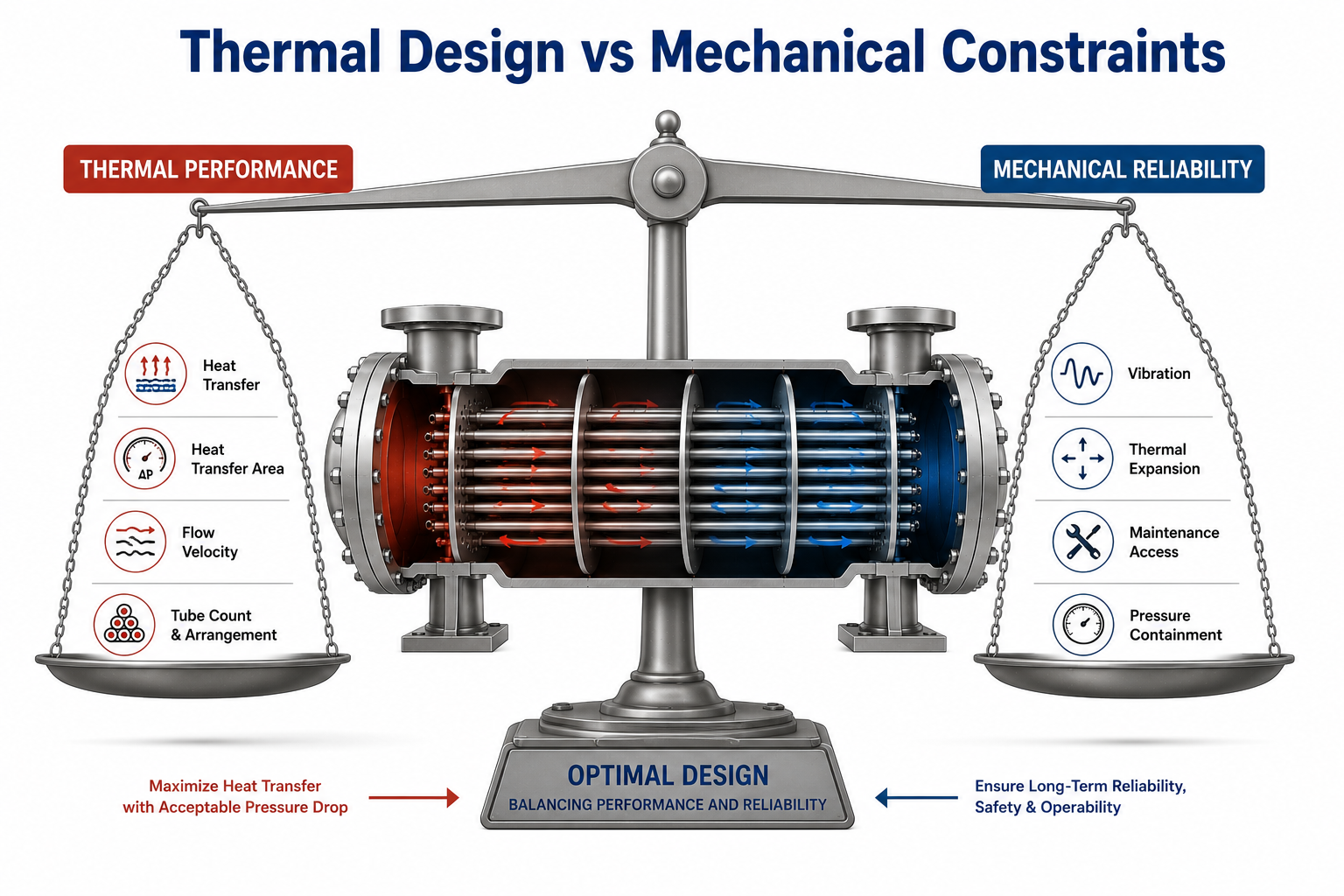
Every heat exchanger designer faces the same engineering challenge: improving heat transfer almost always increases pressure drop, while reducing pressure drop usually weakens heat transfer. The objective is not to…
Fluid velocity is one of the most influential design parameters in a heat exchanger. Higher velocity generally improves heat transfer and reduces fouling, but beyond a certain point it also…
Baffles are among the most important internal components of a shell-and-tube heat exchanger. They improve shell-side heat transfer by directing fluid across the tube bundle, but they also create additional…
Every shell-and-tube heat exchanger has two separate hydraulic systems—the tube side and the shell side. Although both contribute to the exchanger’s overall performance, they behave very differently, are influenced by…
A heat exchanger is expected to transfer heat efficiently, but it must also allow fluids to flow through it without excessive resistance. If pressure drop exceeds the allowable limit, even…
A heat exchanger is considered successful only when it achieves both the required heat transfer and an acceptable pressure drop. Optimizing one while ignoring the other often leads to higher…
Most heat exchanger thermal design problems do not arise because engineers cannot perform the calculations. They arise because perfectly correct calculations are applied with incorrect assumptions, unrealistic expectations, or incomplete…