
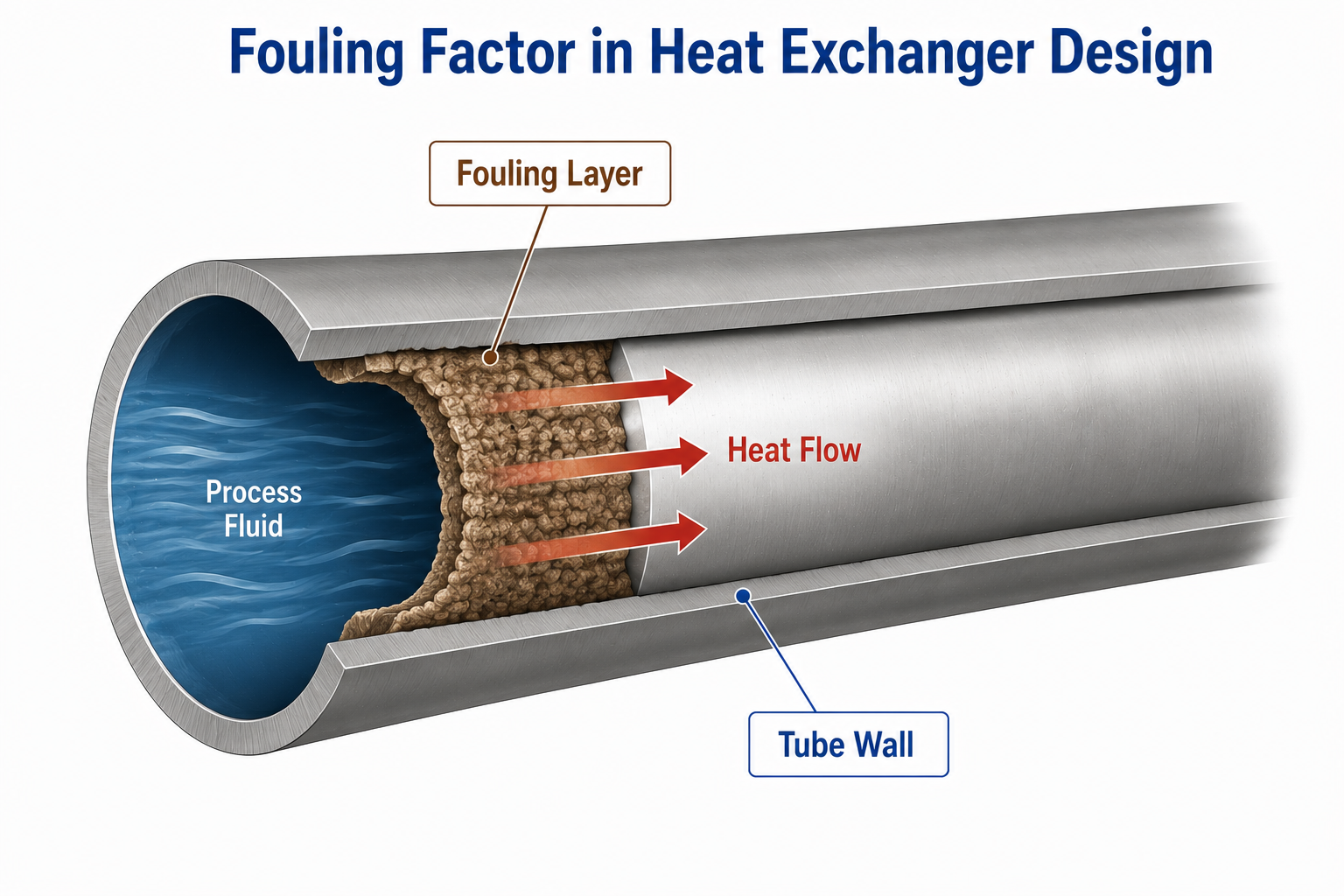
Every shell-and-tube heat exchanger is designed with the expectation that its heat transfer surfaces will gradually become less efficient during operation. Rather than assuming permanently clean conditions, engineers include a fouling factor in thermal design calculations to account for the additional thermal resistance created by future deposits. Contrary to common belief, the fouling factor is not a prediction of how much fouling will occur. It is a practical design allowance based on operating experience, intended to help the exchanger continue meeting its required duty after reasonable fouling has developed.
One of the first questions new engineers ask during heat exchanger design is:
“Why are we designing for something that hasn’t happened yet?”
After all, the exchanger is completely clean when it leaves the factory.
The answer lies in decades of operating experience.
Engineers know that no industrial heat exchanger remains perfectly clean forever.
Whether handling:
- cooling water,
- crude oil,
- process chemicals,
- steam,
- condensate,
deposits will gradually accumulate on the heat transfer surfaces.
If the exchanger were designed only for clean conditions, its thermal performance would begin declining almost immediately after commissioning.
To prevent this, thermal designers intentionally include an additional thermal resistance known as the fouling factor.
This small design allowance helps ensure that the exchanger can continue achieving its required heat duty even after normal fouling develops.
Understanding what the fouling factor truly represents is important because it is frequently misunderstood.
It is not a safety factor.
It is not an arbitrary design margin.
Nor does it predict exactly how dirty an exchanger will become.
Instead, it reflects practical engineering experience about how real process plants operate over time.
Table of Contents
What Is the Fouling Factor?
The fouling factor represents the additional thermal resistance expected to develop due to surface deposits during normal operation.
As fouling accumulates, it creates an insulating layer between the process fluid and the heat transfer surface.
This additional layer makes heat flow more difficult.
The fouling factor quantifies this extra thermal resistance so that it can be incorporated into thermal design calculations.
Rather than designing only for today’s clean surface, engineers design for tomorrow’s expected operating condition.
Why Is a Fouling Factor Needed?
Without accounting for fouling, many exchangers would gradually fail to meet their required thermal duty.
When an exchanger is clean:
- heat transfer is highest,
- overall heat transfer coefficient is maximum,
- required heat transfer area is relatively small.
As fouling develops:
- thermal resistance increases,
- overall heat transfer coefficient decreases,
- available heat duty gradually falls.
By incorporating a fouling factor during design, engineers compensate for this expected reduction in performance.
The exchanger therefore remains capable of meeting its design duty for a longer operating period before cleaning becomes necessary.
Fouling Factor Represents Thermal Resistance—Not Deposit Thickness
A thicker deposit does not always produce a proportionally larger fouling factor.
Many people imagine the fouling factor as a measurement of deposit thickness.
In reality, it represents the deposit’s ability to resist heat flow.
Two fouling layers of identical thickness may have very different thermal effects.
For example:
- a porous biological film,
- a dense mineral scale,
- a carbonaceous deposit,
can all produce different thermal resistances despite having similar physical thickness.
The fouling factor therefore reflects heat transfer behaviour rather than simply the amount of deposited material.
How Fouling Factor Influences Thermal Design
Including a fouling factor reduces the calculated overall heat transfer coefficient.
The overall heat transfer coefficient, commonly called the U-value, includes all thermal resistances between the hot and cold fluids.
When a fouling factor is introduced:
- total thermal resistance increases,
- calculated U-value decreases,
- additional heat transfer area becomes necessary.
Consequently, the exchanger is intentionally designed slightly larger than would be required under perfectly clean conditions.
This additional area is often referred to as the fouling allowance or fouling margin, topics explored in the next support article.
Fouling Factor Is Based on Experience, Not Exact Prediction
No engineer can accurately predict future fouling under every operating condition.
Fouling depends on numerous variables, including:
- fluid composition,
- water quality,
- operating temperature,
- velocity,
- maintenance practices,
- operating hours,
- process stability.
Because these variables change throughout the life of the plant, the exact fouling rate cannot be calculated with certainty.
Instead, engineers use fouling factors developed from:
- industry standards,
- historical operating data,
- company experience,
- similar services.
The value therefore represents informed engineering judgement rather than precise mathematical prediction.
Different Services Require Different Fouling Factors
Not all process fluids foul at the same rate.
For example:
Cooling water service may require one design allowance.
Crude oil exchangers often require a larger allowance because of:
- wax,
- asphaltenes,
- suspended solids,
- coke formation.
Highly purified process streams may require much smaller allowances because deposits develop slowly.
Selecting an appropriate fouling factor therefore depends on understanding the specific process service rather than applying a universal value.
Fouling Factor Does Not Eliminate Fouling
Designing for fouling does not prevent deposits from forming.
A common misconception is that adding a fouling factor somehow solves the fouling problem.
It does not.
Deposits will still accumulate.
Cleaning will still become necessary.
The fouling factor simply allows the exchanger to tolerate a reasonable amount of fouling before performance falls below design requirements.
It is therefore a design accommodation rather than a preventive measure.
Excessively Large Fouling Factors Can Create Problems
Overestimating fouling is just as undesirable as underestimating it.
Choosing an unnecessarily large fouling factor increases:
- required heat transfer area,
- equipment size,
- shell diameter,
- material usage,
- fabrication cost.
An oversized exchanger may also experience:
- lower operating velocities,
- increased capital expenditure,
- greater plot space requirements.
Good engineering therefore requires selecting a realistic fouling factor rather than assuming the worst possible operating condition.
Fouling Factor Must Reflect Expected Operating Practice
Maintenance philosophy influences the appropriate design allowance.
Two identical plants may require different fouling factors if they operate differently.
For example:
A facility that performs regular preventive cleaning may tolerate a smaller design allowance.
Another facility with long operating campaigns between shutdowns may require a larger allowance.
Material selection, water treatment, filtration, and process control also influence long-term fouling behaviour.
The chosen fouling factor should therefore reflect how the exchanger is expected to be operated and maintained.
Fouling Factor Is Only One Part of Fouling Management
Successful fouling control extends beyond thermal design calculations.
Engineers also reduce fouling through:
- appropriate fluid velocity,
- removable tube bundles,
- cleaning access,
- water treatment,
- filtration,
- process control,
- scheduled maintenance.
The fouling factor complements these measures but cannot replace them.
Long-term exchanger performance depends on both good design and good operation.
Common Misunderstandings About Fouling Factor
Because the term sounds straightforward, it is often interpreted incorrectly.
“Fouling Factor Predicts Future Fouling”
It does not predict exactly how much fouling will occur.
It simply provides a reasonable design allowance based on expected operating experience.
“Larger Fouling Factors Produce Better Designs”
An excessively conservative fouling factor may lead to:
- unnecessary oversizing,
- higher capital cost,
- lower operating efficiency.
Engineering judgement is more valuable than excessive conservatism.
“Every Heat Exchanger Uses the Same Fouling Factor”
Different services, industries, and maintenance philosophies require different design allowances.
No single value is suitable for every application.
“Once Fouling Factor Is Included, Cleaning Is Unnecessary”
Eventually, deposits exceed the design allowance.
Cleaning remains an essential part of heat exchanger maintenance throughout its operating life.
Operator Perspective
Operators rarely think about the fouling factor directly, but they experience its benefits every day.
A properly selected fouling factor allows the exchanger to maintain acceptable performance for longer periods before cleaning becomes necessary.
This results in:
- fewer production interruptions,
- more stable operating temperatures,
- improved utility efficiency,
- longer operating campaigns.
Owner Perspective
Selecting an appropriate fouling factor balances capital investment against long-term operating performance.
For plant owners, the correct fouling factor helps achieve:
- reliable thermal performance,
- reasonable equipment size,
- controlled maintenance frequency,
- lower lifecycle cost,
- improved energy efficiency.
Choosing too little allowance increases operating problems, while choosing too much increases unnecessary capital expenditure.
The objective is not maximum conservatism but optimum lifecycle value.
Final Perspective
The fouling factor is one of the most practical concepts in heat exchanger design because it acknowledges an unavoidable reality: industrial equipment will not remain perfectly clean throughout its service life.
Rather than attempting to predict the exact amount of future fouling, engineers use the fouling factor as a realistic thermal design allowance based on operating experience.
When selected appropriately, it enables a heat exchanger to continue delivering reliable performance despite the gradual accumulation of deposits.
In the end, the fouling factor is not a measure of pessimism.
It is a reflection of sound engineering judgement—recognizing that successful heat exchanger design must account not only for ideal conditions on the day of commissioning but also for the realities of years of continuous plant operation.
Explore the complete series in the Heat Exchanger Engineering Hub.

A practicing chemical engineer with 17+ years of experience in process design, project execution, commissioning, and plant operations. Focused on practical engineering judgment beyond textbook explanations.