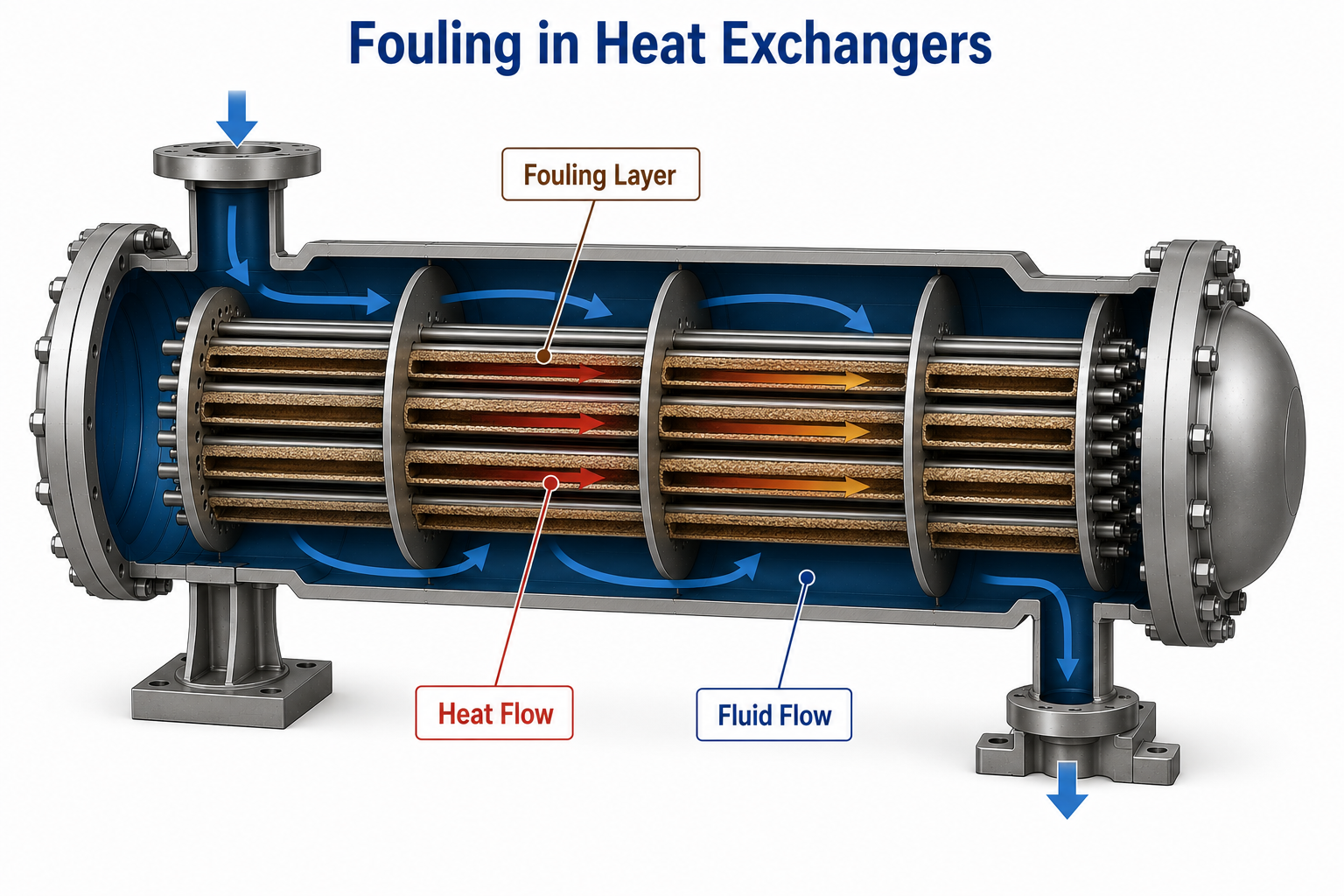
A shell-and-tube heat exchanger may leave the factory in perfect condition, delivering the exact heat duty predicted during design. Yet, over time, many exchangers gradually lose efficiency, consume more energy, experience higher pressure drops, and require frequent maintenance. The reason is rarely a flaw in the thermal calculations—it is fouling. Because fouling develops gradually under real operating conditions, it is one of the primary reasons why actual exchanger performance diverges from design assumptions. Understanding fouling is therefore essential for designing, operating, and maintaining reliable heat exchangers throughout their service life.
Every heat exchanger is designed using carefully calculated assumptions.
Engineers determine:
- process temperatures,
- flow rates,
- fluid properties,
- heat transfer coefficients,
- pressure drop limits,
- required heat transfer area.
These calculations often predict excellent performance.
When the exchanger is commissioned, those predictions are usually achieved.
However, months or years later, plant engineers begin noticing familiar symptoms:
- outlet temperatures drift away from design values,
- steam consumption gradually increases,
- cooling water demand rises,
- pressure drop becomes higher than expected,
- cleaning shutdowns become more frequent.
The exchanger itself has not changed.
The process has.
Minute layers of unwanted deposits begin forming on the heat transfer surfaces.
Although these deposits may initially be almost invisible, they slowly act as thermal insulation while simultaneously restricting fluid flow.
This gradual deterioration is known as fouling, and it is one of the most persistent operational challenges faced in process plants.
Unlike sudden equipment failures, fouling develops silently.
It rarely triggers alarms in its early stages, yet its long-term consequences affect energy efficiency, production capacity, maintenance costs, and equipment reliability.
Understanding fouling requires engineers to move beyond ideal design calculations and appreciate how real industrial processes behave over years of continuous operation.
Table of Contents
What Is Fouling in a Heat Exchanger?
Fouling is the gradual accumulation of unwanted material on heat transfer surfaces that reduces thermal performance and increases flow resistance.
These deposits may originate from:
- suspended solids,
- dissolved minerals,
- corrosion products,
- biological growth,
- polymerized chemicals,
- process residues,
- coke formation,
- scale.
Regardless of their source, fouling creates an additional layer between the hot and cold fluids.
This layer interferes with efficient heat transfer while simultaneously reducing the available flow area.
As a result, the exchanger becomes progressively less efficient even though its mechanical construction remains unchanged.
Why Clean Design Calculations Do Not Last Forever
Thermal design calculations represent ideal operating conditions that rarely remain unchanged throughout the exchanger’s life.
When engineers perform thermal design, they generally assume:
- clean heat transfer surfaces,
- specified fluid properties,
- stable operating conditions,
- predictable flow distribution.
In actual plant operation:
- feed quality changes,
- utilities fluctuate,
- operating loads vary,
- contaminants enter the system,
- maintenance intervals differ.
These real-world conditions gradually modify the exchanger’s behaviour.
The original thermal calculations remain technically correct—they simply describe the exchanger before fouling develops.
How Fouling Reduces Heat Transfer
Even a thin fouling layer acts as an insulating barrier between the process fluids.
Efficient heat transfer requires direct thermal contact through the exchanger wall.
When deposits accumulate:
- thermal resistance increases,
- overall heat transfer coefficient decreases,
- heat duty gradually falls.
Consequently:
- products may leave hotter than intended,
- cooling becomes less effective,
- heating requires more steam,
- utility consumption increases.
The exchanger still functions, but it transfers less heat than originally designed.
Fouling Also Increases Pressure Drop
Deposits reduce the effective flow area available to the process fluid.
As fouling grows:
- flow passages become narrower,
- fluid velocity changes,
- flow resistance increases.
The result is higher pressure drop across the exchanger.
This may require:
- greater pumping power,
- increased compressor energy,
- reduced plant throughput,
- earlier maintenance shutdowns.
Fouling therefore affects both thermal and hydraulic performance simultaneously.
Fouling Is Not the Same in Every Process
Different process services develop different fouling mechanisms.
For example:
Cooling water systems often experience:
- mineral scaling,
- biological growth,
- suspended solids.
Crude oil exchangers may develop:
- wax deposits,
- asphaltenes,
- coke formation.
API process exchangers may experience:
- polymer deposits,
- reaction by-products,
- catalyst fines.
Steam condensers may accumulate:
- corrosion products,
- dissolved salts,
- water-side scale.
Each service requires its own fouling prevention and maintenance strategy.
Why Fouling Is Difficult to Predict
Fouling depends on operating behaviour as much as equipment design.
The rate at which deposits form depends upon many interacting variables, including:
- fluid composition,
- temperature,
- velocity,
- operating time,
- surface condition,
- maintenance practices,
- water quality,
- process stability.
Many of these factors change throughout the life of the plant.
As a result, no engineer can predict fouling with complete accuracy.
Designers therefore rely on practical operating experience rather than purely theoretical calculations.
Engineers Anticipate Fouling During Design
Modern heat exchangers are intentionally designed with future fouling in mind.
Rather than assuming the exchanger will remain perfectly clean forever, engineers include allowances such as:
- fouling factors,
- additional heat transfer area,
- maintenance access,
- removable tube bundles,
- cleaning provisions.
These features help the exchanger continue meeting process requirements even after deposits begin forming.
Design therefore accounts for expected deterioration rather than assuming permanent ideal conditions.
Fouling Is a Lifecycle Problem, Not Just a Maintenance Issue
The effects of fouling extend far beyond periodic cleaning.
As fouling develops, plants may experience:
- increased fuel consumption,
- higher utility costs,
- greater greenhouse gas emissions,
- reduced production capacity,
- more frequent shutdowns,
- accelerated equipment wear,
- lower process efficiency.
The economic impact often exceeds the direct maintenance cost by a considerable margin.
For many facilities, the largest cost of fouling is the energy that is wasted every day.
Good Operation Can Slow Fouling
Operating practices significantly influence how quickly deposits develop.
While fouling cannot usually be eliminated completely, operators can often reduce its rate through:
- maintaining appropriate flow velocities,
- controlling water quality,
- avoiding unnecessary temperature extremes,
- minimizing stagnant conditions,
- following recommended cleaning schedules,
- monitoring exchanger performance.
Operational discipline complements good mechanical design.
Fouling Is Closely Connected to Earlier Design Decisions
Many design choices influence how susceptible an exchanger becomes to fouling.
For example:
Higher fluid velocity may:
- reduce fouling,
- improve heat transfer,
but it may also:
- increase pressure drop,
- raise erosion risk.
Selecting removable tube bundles improves cleaning but increases mechanical complexity.
Choosing wider tube spacing may reduce plugging but slightly reduce compactness.
These examples illustrate that fouling cannot be considered independently of thermal and mechanical design.
Balancing Fouling Against Other Design Objectives
Heat exchanger design always involves engineering compromises.
Designers continually balance:
- thermal performance,
- pressure drop,
- fouling tendency,
- mechanical reliability,
- maintenance accessibility,
- fabrication cost,
- lifecycle economics.
Optimizing only one objective often reduces performance in another.
The best exchanger is therefore not the cleanest exchanger or the least expensive exchanger.
It is the exchanger that provides reliable performance throughout its intended operating life.
Common Misunderstandings About Fouling
Many engineers encounter fouling every day but still misunderstand its engineering significance.
“Fouling Only Reduces Heat Transfer”
Fouling also increases:
- pressure drop,
- pumping costs,
- maintenance frequency,
- production losses.
Its effects extend throughout the entire process plant.
“Cleaning Completely Solves Fouling”
Cleaning restores performance temporarily.
Unless the underlying causes are addressed, fouling simply begins accumulating again.
“Only Dirty Fluids Cause Fouling”
Even relatively clean process streams can produce:
- scaling,
- corrosion products,
- chemical deposits,
- biological films.
No industrial service is entirely immune.
“Fouling Is Purely an Operations Problem”
Operations influence fouling, but so do:
- equipment design,
- material selection,
- process conditions,
- maintenance philosophy.
Managing fouling requires collaboration across multiple engineering disciplines.
Operator Perspective
Operators experience the effects of fouling long before engineers review performance reports.
Gradually increasing utility consumption, higher pressure drops, declining process temperatures, and more frequent cleaning requirements often provide the earliest warning signs.
Consistent performance monitoring enables operators to identify fouling before it becomes a major production problem.
Owner Perspective
For plant owners, fouling represents one of the largest hidden operating costs associated with heat exchangers.
Effective fouling management provides:
- lower energy consumption,
- improved production efficiency,
- fewer unplanned shutdowns,
- reduced maintenance expenditure,
- longer equipment life,
- better return on capital investment.
Although fouling cannot be eliminated entirely, understanding and managing it significantly improves long-term plant profitability.
Final Perspective
Every heat exchanger is designed under carefully controlled assumptions.
Real process plants, however, rarely operate under perfectly controlled conditions for years at a time.
Deposits gradually form, thermal resistance increases, pressure losses rise, and equipment slowly drifts away from its original design performance.
This gradual decline is not evidence of poor engineering.
It is a natural consequence of operating industrial equipment in complex, ever-changing process environments.
The most successful heat exchanger designs are therefore not those that assume perfectly clean operation forever.
They are the ones that acknowledge fouling as inevitable, anticipate its effects during design, and provide practical ways to manage it throughout the equipment’s lifecycle.
Explore the complete series in the Heat Exchanger Engineering Hub.
A practicing chemical engineer with 17+ years of experience in process design, project execution, commissioning, and plant operations. Focused on practical engineering judgment beyond textbook explanations.