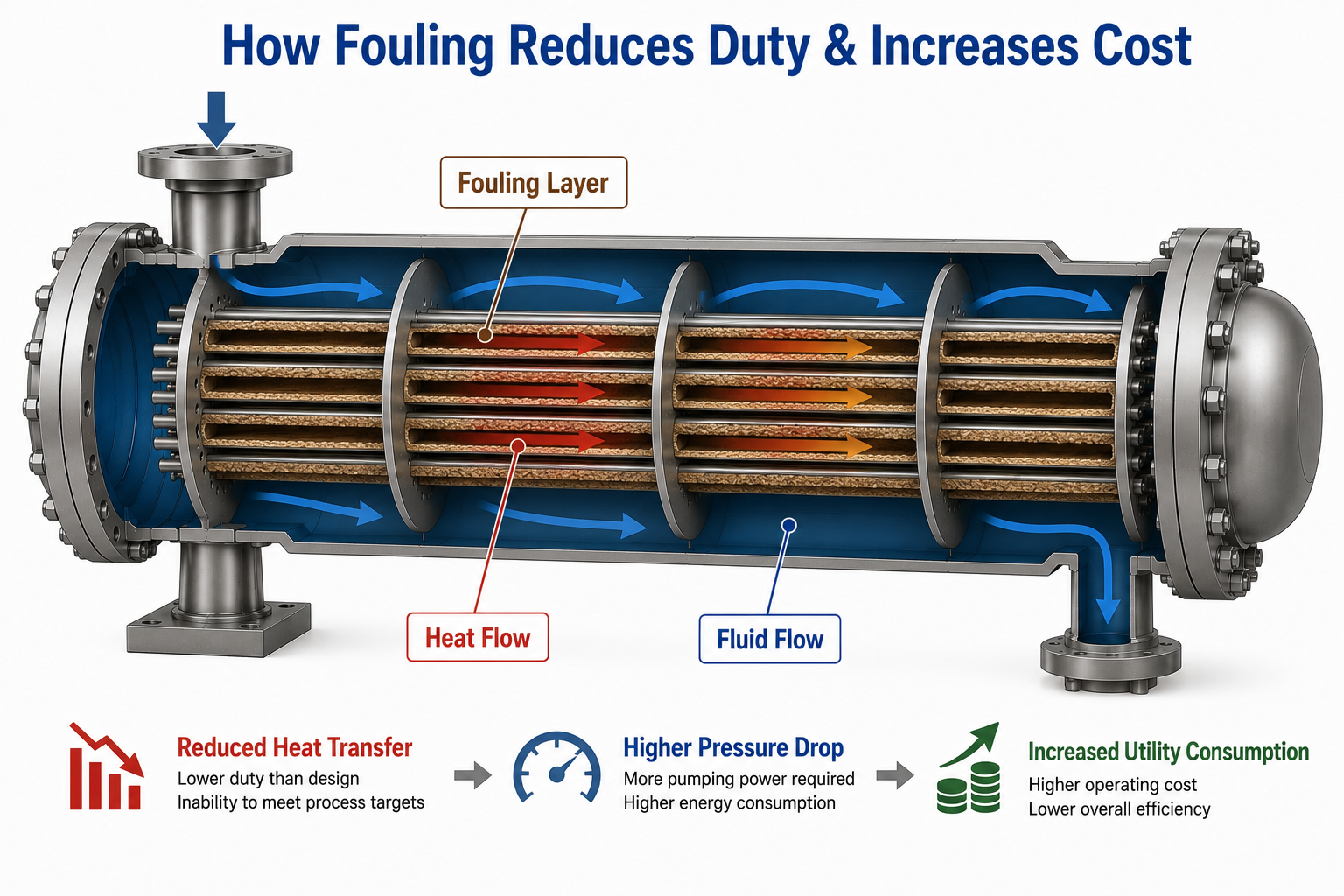
Unlike sudden equipment failures, fouling develops gradually and often goes unnoticed until plant performance has already declined significantly. As deposits accumulate inside a heat exchanger, heat transfer efficiency decreases, pressure drop increases, energy consumption rises, and maintenance costs escalate. Although the exchanger continues operating, it quietly consumes more utilities while delivering less useful heat transfer. This silent deterioration makes fouling one of the most expensive long-term challenges in process plant operation.
When a new heat exchanger is commissioned, it typically performs exactly as predicted during thermal design.
It delivers:
- the required heat duty,
- expected outlet temperatures,
- acceptable pressure drop,
- efficient energy utilization.
Everything appears normal.
Weeks pass.
Then months.
Eventually, years.
Without attracting much attention, the exchanger begins requiring:
- slightly more steam,
- slightly more cooling water,
- slightly higher pumping energy.
At first, these changes are almost impossible to notice.
No alarms activate.
Production continues.
Operators simply make small adjustments to maintain process conditions.
However, these seemingly minor adjustments hide a much larger engineering problem.
As fouling gradually develops, the exchanger transfers less heat while consuming more energy.
The loss is so gradual that many plants only recognize the problem when:
- production capacity declines,
- utility costs increase,
- cleaning becomes unavoidable.
This gradual deterioration explains why fouling is often called a silent efficiency killer.
Table of Contents
Fouling Begins Long Before Performance Problems Become Obvious
Deposits usually start forming soon after commissioning, even though performance initially remains acceptable.
Most industrial process streams contain small quantities of:
- suspended solids,
- dissolved minerals,
- corrosion products,
- biological material,
- heavy hydrocarbons,
- reaction by-products.
These materials slowly adhere to the heat transfer surfaces.
Initially:
- deposit thickness is extremely small,
- thermal performance changes are almost negligible.
As operating time increases, however, these deposits continue growing until their effect becomes measurable.
The exchanger appears to be operating normally while its efficiency slowly declines.
Deposits Reduce Heat Transfer Efficiency
Every fouling layer creates an additional barrier that heat must pass through.
In a clean exchanger:
- heat flows efficiently through the tube wall,
- thermal resistance remains low,
- overall heat transfer coefficient is high.
As fouling develops:
- thermal resistance increases,
- heat flow becomes more difficult,
- overall heat transfer coefficient decreases.
The exchanger therefore transfers less heat between the process fluids.
To compensate, the plant often consumes additional utilities without immediately recognizing the underlying cause.
Process Temperatures Gradually Drift Away from Design
Reduced heat transfer eventually affects process performance.
As exchanger efficiency declines:
Heating services may experience:
- lower outlet temperatures,
- slower heating rates,
- incomplete process heating.
Cooling services may experience:
- higher outlet temperatures,
- reduced cooling effectiveness,
- increased process temperatures.
Operators frequently compensate by adjusting utility flow rates instead of immediately cleaning the exchanger.
These adjustments maintain production but increase operating costs.
Utility Consumption Increases
Maintaining the same process duty requires additional energy as fouling develops.
To overcome reduced heat transfer, plants often increase:
- steam consumption,
- hot oil circulation,
- cooling water flow,
- chilled water demand,
- refrigeration load.
The exchanger continues operating, but it requires more energy to perform the same task.
This increased utility demand often becomes one of the largest hidden costs associated with fouling.
Fouling Also Increases Pressure Drop
Deposits reduce the available flow area inside the exchanger.
As fouling accumulates:
- tubes become partially restricted,
- shell-side flow passages narrow,
- hydraulic resistance increases.
Consequently:
- pump discharge pressure rises,
- pumping power increases,
- compressor energy may increase,
- flow rates may decrease.
The exchanger therefore becomes both thermally and hydraulically less efficient.
Higher Pressure Drop Can Reduce Plant Capacity
Hydraulic limitations may restrict production before thermal limitations do.
Many engineers focus primarily on heat transfer losses.
However, excessive pressure drop can become the first limiting factor.
Higher pressure losses may result in:
- reduced circulation,
- lower throughput,
- pump limitations,
- compressor limitations,
- unstable operation.
In some plants, production must be reduced simply because the exchanger no longer allows sufficient process flow.
Fouling Increases Maintenance Costs
As performance deteriorates, cleaning becomes more frequent.
Additional maintenance activities may include:
- mechanical tube cleaning,
- chemical cleaning,
- hydrojet cleaning,
- bundle removal,
- tube inspection,
- tube plugging.
Each maintenance activity involves:
- labour,
- equipment,
- spare parts,
- shutdown time.
The direct cleaning cost is often only a small portion of the total economic impact.
Production Losses Often Exceed Cleaning Costs
The greatest financial impact usually occurs while the exchanger remains in service.
When fouling reduces heat transfer:
- batch cycles become longer,
- energy costs rise,
- product quality may become inconsistent,
- plant throughput decreases.
These operational losses continue every day until the exchanger is cleaned.
In many industries, lost production is significantly more expensive than the maintenance itself.
Energy Losses Continue Every Hour
Fouling increases energy consumption continuously, not just during maintenance periods.
A fouled exchanger consumes excess utilities every hour it operates.
Over months of continuous operation, this may result in:
- higher fuel consumption,
- increased electricity demand,
- greater steam generation,
- additional cooling water usage.
Even small efficiency losses become substantial when accumulated across an entire year of operation.
Environmental Impact Also Increases
Poor heat transfer efficiency affects more than operating costs.
Higher utility consumption often results in:
- increased fuel usage,
- higher greenhouse gas emissions,
- greater water consumption,
- increased cooling tower load,
- reduced overall plant sustainability.
Managing fouling therefore contributes to both economic and environmental performance.
Small Performance Losses Become Significant Over Time
The gradual nature of fouling makes its economic impact easy to underestimate.
Consider a typical progression:
Initially:
- performance reduction is barely noticeable.
Months later:
- utility demand begins increasing.
Eventually:
- maintenance frequency rises,
- operating flexibility decreases,
- production losses become measurable.
Because these changes occur slowly, they are often accepted as “normal ageing” rather than recognized as correctable fouling.
Monitoring Helps Detect Fouling Early
Performance monitoring identifies fouling before it becomes a major operational problem.
Engineers commonly monitor:
- outlet temperatures,
- heat duty,
- pressure drop,
- utility consumption,
- flow rates,
- exchanger effectiveness.
Gradual deterioration across these parameters often indicates fouling development long before complete cleaning becomes necessary.
Early detection allows maintenance to be planned rather than forced by declining production.
Managing Fouling Is More Economical Than Ignoring It
The objective is not to eliminate fouling completely but to control its consequences.
Effective fouling management includes:
- appropriate design allowances,
- water treatment,
- filtration,
- operating discipline,
- scheduled cleaning,
- performance monitoring.
These measures help maintain efficient operation while minimizing unnecessary maintenance and energy consumption.
Common Misunderstandings About Fouling Costs
The true cost of fouling extends far beyond cleaning expenses.
“Cleaning Cost Is the Main Expense”
Cleaning is often one of the smallest costs.
Lost production and increased utility consumption usually have a much greater financial impact.
“If Production Continues, Fouling Is Not Serious”
The exchanger may still meet production requirements while silently consuming significantly more energy.
Operational continuity does not necessarily indicate efficient performance.
“Only Severe Fouling Matters”
Even moderate fouling gradually increases:
- utility consumption,
- pumping energy,
- maintenance requirements.
Small inefficiencies become significant over years of operation.
“Fouling Only Affects Heat Transfer”
Fouling simultaneously influences:
- heat duty,
- pressure drop,
- operating flexibility,
- maintenance frequency,
- lifecycle cost.
Its impact extends throughout the entire process plant.
Operator Perspective
Operators usually observe fouling through changing operating conditions rather than visible deposits.
Typical indications include:
- increasing steam demand,
- higher cooling water usage,
- declining outlet temperatures,
- rising pressure drop,
- more frequent process adjustments.
Recognizing these gradual changes helps prevent unexpected performance deterioration.
Owner Perspective
For plant owners, fouling is a continuous operating expense rather than an occasional maintenance issue.
Effective fouling management delivers:
- lower utility costs,
- reduced maintenance expenditure,
- improved production availability,
- lower emissions,
- greater equipment reliability,
- improved profitability.
The financial benefits accumulate throughout the entire operating life of the exchanger.
Final Perspective
Fouling is rarely dramatic.
It does not usually produce sudden failures or immediate shutdowns.
Instead, it quietly reduces thermal efficiency, increases hydraulic resistance, raises utility consumption, and gradually erodes plant profitability.
Because these changes occur slowly, they are often accepted as unavoidable rather than recognized as manageable engineering challenges.
The most successful plants do not wait until fouling becomes severe.
They monitor exchanger performance, understand how fouling affects both heat transfer and operating cost, and intervene at the point where cleaning restores far more value than it costs.
Ultimately, the true danger of fouling lies not in the deposits themselves, but in how easily their gradual impact can remain unnoticed while costs continue to accumulate every day.
Explore the complete series in the Heat Exchanger Engineering Hub.
A practicing chemical engineer with 17+ years of experience in process design, project execution, commissioning, and plant operations. Focused on practical engineering judgment beyond textbook explanations.