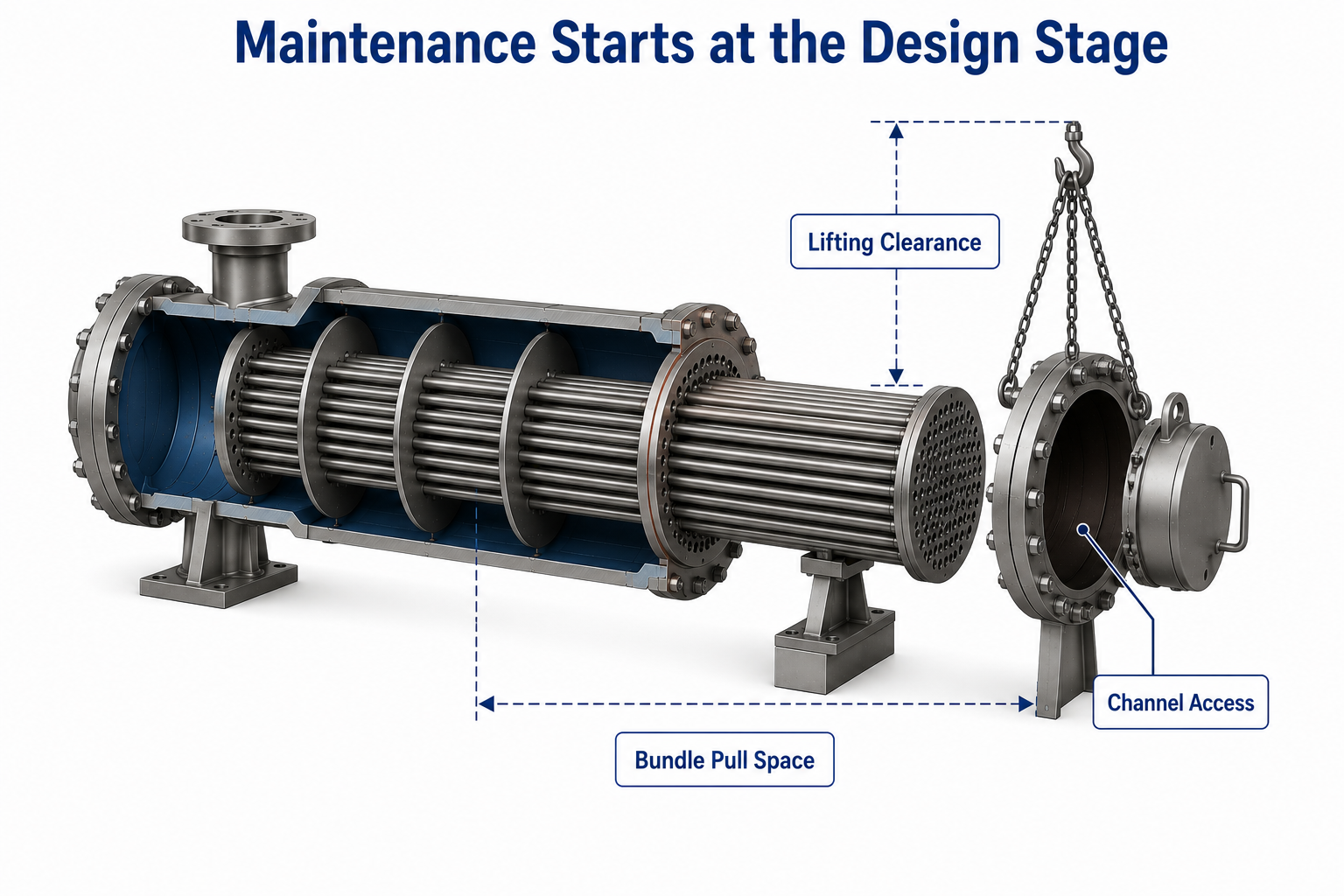
A shell-and-tube heat exchanger spends most of its life in operation, but its true maintainability is determined long before it is commissioned. Decisions made during the design stage—such as exchanger orientation, tube bundle accessibility, nozzle arrangement, cleaning provisions, and maintenance clearances—directly influence inspection time, shutdown duration, repair costs, and long-term plant reliability. Good maintenance is not created during a turnaround; it is engineered into the equipment from the beginning.
When engineers design a heat exchanger, the primary focus is often on:
- achieving the required heat duty,
- meeting pressure drop limits,
- selecting materials,
- determining mechanical construction.
These are all essential objectives.
However, every shell-and-tube heat exchanger will eventually require:
- inspection,
- cleaning,
- tube plugging,
- gasket replacement,
- repairs,
- and sometimes complete retubing.
If maintenance considerations are ignored during design, even a thermally perfect exchanger can become one of the most expensive and time-consuming pieces of equipment in the plant.
Experienced engineers understand a simple principle:
Maintenance begins on the drawing board, not during the shutdown.
Designing for maintenance is therefore not an afterthought—it is a fundamental part of mechanical design.
Table of Contents
Every Heat Exchanger Will Eventually Need Maintenance
No heat exchanger remains maintenance-free throughout its operating life.
Regardless of process conditions, exchangers gradually experience:
- fouling,
- corrosion,
- erosion,
- gasket ageing,
- vibration-related wear,
- mechanical fatigue.
Over time, these issues require maintenance activities such as:
- tube cleaning,
- tube inspection,
- tube plugging,
- hydrotesting,
- gasket replacement,
- bundle removal.
The question is never whether maintenance will be required.
The real question is:
How easy will that maintenance be?
The answer depends largely on decisions made before the exchanger is manufactured.
Maintenance Accessibility Is a Design Requirement
Equipment that cannot be accessed safely cannot be maintained efficiently.
An exchanger may be mechanically sound, but poor accessibility can dramatically increase maintenance time.
Engineers should ensure adequate access for:
- channel cover removal,
- tube bundle extraction,
- flange opening,
- inspection activities,
- lifting equipment,
- cleaning tools.
Restricted access often results in:
- longer shutdowns,
- higher labour costs,
- increased safety risks,
- delayed maintenance.
Accessibility should therefore be treated as a design criterion rather than a site constraint.
Tube Bundle Removal Requires Planning
Removing a tube bundle demands far more space than many new engineers expect.
One of the most common maintenance operations is tube bundle removal.
To perform this safely, sufficient clearance must exist in front of the exchanger.
The required space should accommodate:
- full tube bundle length,
- lifting equipment,
- maintenance personnel,
- temporary supports,
- cleaning operations.
If this clearance is unavailable:
- nearby equipment may require dismantling,
- piping may need removal,
- shutdown duration increases significantly.
A few metres of additional layout space during design can save several days during every major turnaround.
Equipment Layout Affects Future Maintenance
The location of the exchanger influences maintenance throughout its entire life.
When arranging equipment, designers should consider:
- overhead lifting access,
- crane reach,
- operator access,
- maintenance platforms,
- escape routes,
- surrounding equipment.
Installing an exchanger in a congested area may reduce initial plot space but often creates long-term maintenance difficulties.
Good plant layout balances compactness with maintainability.
Channel and Bonnet Accessibility Matter
Routine maintenance frequently begins at the channel end of the exchanger.
Channel covers may need to be opened for:
- tube inspection,
- mechanical cleaning,
- hydrotesting,
- tube plugging.
Designers should therefore avoid placing:
- structural steel,
- pipe racks,
- platforms,
- cable trays,
where they obstruct channel cover removal.
Easy access reduces maintenance time and improves worker safety.
Nozzle Orientation Can Simplify or Complicate Maintenance
Good nozzle arrangement improves both operation and maintenance.
Nozzle orientation affects:
- piping flexibility,
- venting,
- draining,
- cleaning,
- dismantling.
Poor nozzle placement may create:
- trapped liquids,
- difficult venting,
- inaccessible flanges,
- piping interference during maintenance.
Proper orientation makes routine inspection considerably easier.
Cleaning Method Should Influence Design
Different fouling mechanisms require different maintenance strategies.
Engineers should first understand:
- where fouling is expected,
- how deposits will be removed,
- how often cleaning will occur.
For example:
Tube-side fouling often allows:
- mechanical brushing,
- hydrojet cleaning,
- chemical cleaning.
Shell-side fouling may require:
- bundle removal,
- direct manual cleaning,
- high-pressure water cleaning.
The exchanger construction should support the anticipated cleaning method.
Mechanical Construction Determines Maintenance Effort
Different exchanger constructions provide different levels of maintenance accessibility.
Consider the three common constructions:
Fixed Tubesheet
Advantages:
- simpler construction,
- lower cost.
Limitations:
- shell-side cleaning is difficult,
- bundle cannot be removed independently.
Floating Head
Advantages:
- complete bundle removal,
- easier shell-side inspection,
- improved cleaning access.
Limitations:
- higher mechanical complexity,
- more components requiring maintenance.
U-Tube
Advantages:
- bundle removal possible,
- good thermal expansion capability.
Limitations:
- tube bends are difficult to clean mechanically,
- damaged tubes are harder to replace.
Construction selection therefore directly affects maintenance strategy.
Lifting Arrangements Should Be Considered Early
Heavy components cannot be removed safely without proper lifting provisions.
Major maintenance may require lifting:
- channel covers,
- floating heads,
- tube bundles,
- shell covers.
Engineers should ensure:
- adequate lifting clearance,
- lifting lugs where necessary,
- crane accessibility,
- safe working space.
Ignoring lifting requirements often leads to unsafe maintenance practices or expensive temporary lifting arrangements.
Inspection Requirements Influence Mechanical Design
Design should support both routine and statutory inspections.
Heat exchangers require periodic inspection to assess:
- corrosion,
- erosion,
- tube condition,
- weld integrity,
- pressure boundary performance.
Mechanical design should therefore facilitate:
- visual inspection,
- non-destructive testing,
- hydrostatic testing,
- thickness measurements.
Inspection accessibility reduces both maintenance cost and plant downtime.
Maintainability Reduces Lifecycle Cost
A small increase in capital cost often produces substantial long-term savings.
Design features that improve maintenance may include:
- removable bundles,
- improved access,
- additional maintenance clearance,
- better lifting arrangements,
- convenient nozzle locations.
These features may slightly increase the purchase cost.
However, they often reduce:
- shutdown duration,
- maintenance labour,
- production losses,
- safety risks,
- lifecycle cost.
For plants expected to operate for decades, these savings are significant.
Maintenance Should Involve Multiple Disciplines
Good maintainability results from collaboration between engineering disciplines.
Effective maintenance planning involves input from:
- process engineers,
- mechanical engineers,
- piping engineers,
- operations personnel,
- maintenance teams.
Operators often identify practical issues that are not apparent during design reviews.
Including maintenance personnel early frequently improves equipment accessibility and reduces future operational challenges.
Common Mistakes That Reduce Maintainability
Many maintenance problems originate from seemingly minor design decisions.
Common examples include:
- insufficient bundle pull space,
- blocked channel covers,
- inaccessible drain valves,
- poor vent locations,
- no provision for lifting equipment,
- piping routed across maintenance areas,
- inadequate maintenance platforms.
Most of these issues are inexpensive to correct during design but costly to modify after installation.
Common Misunderstandings About Maintenance Design
Maintenance is often underestimated because it occurs long after commissioning.
“Maintenance Can Be Solved Later”
Once the exchanger is installed, many accessibility issues become permanent.
Good maintenance begins during design.
“Maintenance Is the Plant’s Responsibility”
Plant personnel perform maintenance.
Design engineers determine how difficult that maintenance will be.
“Lower Capital Cost Means Better Design”
Reducing construction cost by sacrificing accessibility often increases maintenance expenditure for decades.
“Thermal Design Is More Important Than Maintenance”
Both are essential.
A thermally efficient exchanger that cannot be maintained reliably eventually loses its operational value.
Operator Perspective
Operators appreciate equipment that can be maintained quickly and safely.
Good maintenance design provides:
- easier inspections,
- shorter shutdowns,
- safer working conditions,
- faster troubleshooting,
- more reliable operation.
These benefits improve overall plant productivity.
Owner Perspective
Maintainability directly influences profitability over the exchanger’s entire lifecycle.
For plant owners, designing for maintenance results in:
- lower maintenance costs,
- higher equipment availability,
- reduced production losses,
- improved worker safety,
- longer equipment life,
- lower total ownership cost.
The financial return from good maintenance design often exceeds the initial investment many times over.
Final Perspective
Every shell-and-tube heat exchanger will eventually require maintenance.
Whether that maintenance takes a few hours or several days depends largely on decisions made before the equipment is ever built.
Adequate maintenance clearances, accessible components, removable tube bundles, proper lifting arrangements, and practical equipment layouts are not conveniences—they are engineering decisions that determine the exchanger’s long-term value.
The most successful heat exchangers are not simply those that transfer heat efficiently on the day they are commissioned.
They are the ones that continue to operate safely, can be inspected easily, can be repaired efficiently, and return to service quickly throughout decades of industrial operation.
Explore the complete series in the Heat Exchanger Engineering Hub.

A practicing chemical engineer with 17+ years of experience in process design, project execution, commissioning, and plant operations. Focused on practical engineering judgment beyond textbook explanations.