
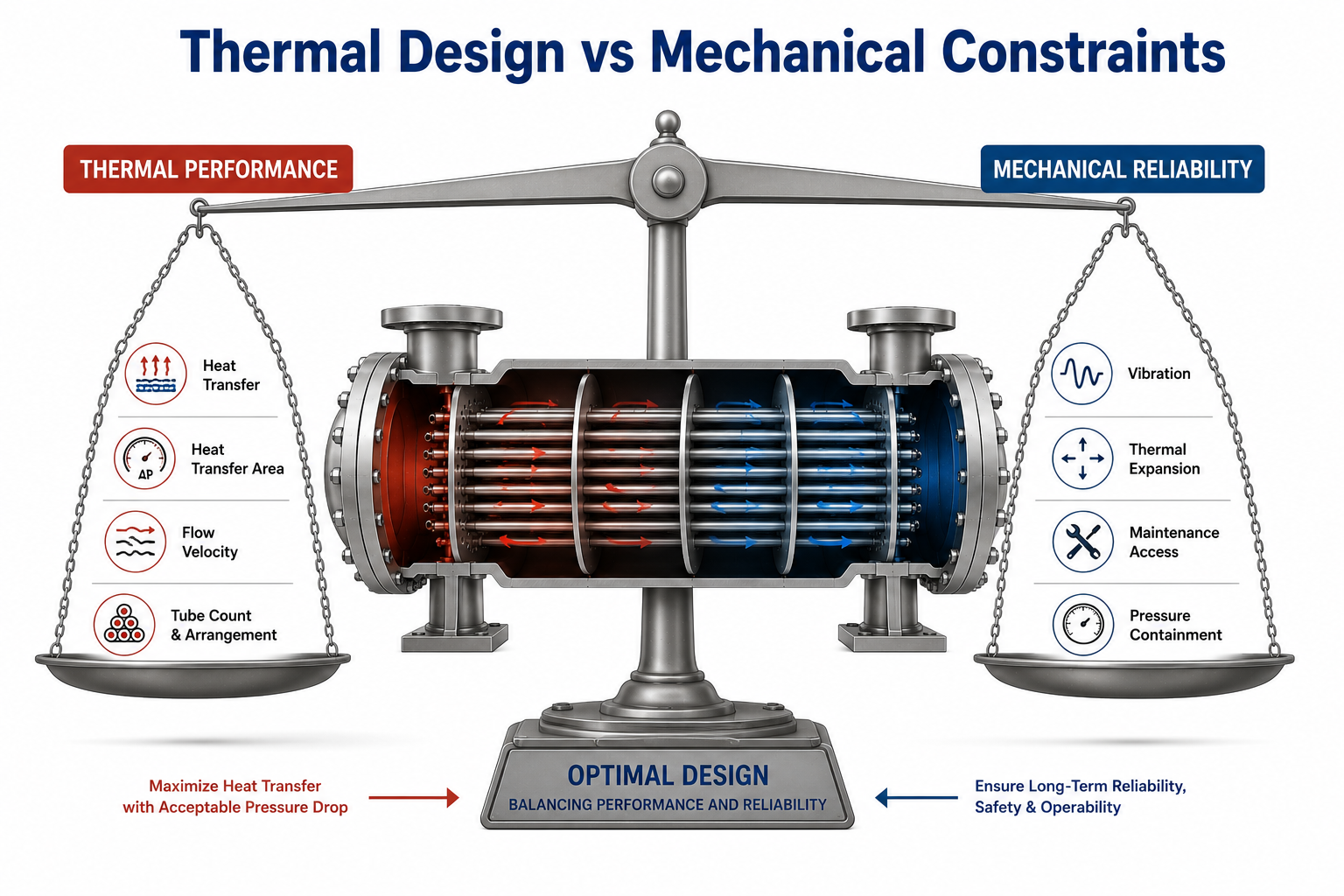
The thermally optimum heat exchanger is not always the mechanically practical one. While thermal design aims to maximize heat transfer and minimize energy consumption, every improvement must also satisfy mechanical requirements such as pressure containment, vibration resistance, thermal expansion, fabrication, maintenance, and structural integrity. Successful heat exchanger design is therefore a balance between thermal performance and mechanical feasibility—not the pursuit of thermal efficiency alone.
When learning heat exchanger design, engineers often focus on improving thermal performance.
Typical design objectives include:
- increasing heat transfer area,
- improving the overall heat transfer coefficient,
- reducing approach temperature,
- increasing exchanger effectiveness,
- recovering more energy.
From a purely thermal perspective, these improvements appear desirable.
However, experienced engineers know that every thermal improvement has mechanical consequences.
Increasing tube length may improve heat transfer but increase vibration.
Reducing baffle spacing may increase shell-side heat transfer but also increase pressure drop and mechanical loading.
Higher fluid velocity improves turbulence but accelerates erosion and tube wear.
This is why industrial heat exchanger design is never based on thermal calculations alone.
The final exchanger is always a compromise between thermal performance, hydraulic performance, mechanical reliability, maintenance requirements, fabrication practicality, and economic viability.
Understanding these trade-offs helps process engineers appreciate why the exchanger finally installed in a plant often differs from the thermally “best” design produced during the initial calculations.
Table of Contents
Thermal Design Seeks Maximum Performance
The objective of thermal design is to achieve the required heat duty as efficiently as possible.
Thermal engineers typically attempt to:
- maximize heat transfer,
- minimize utility consumption,
- reduce exchanger size,
- improve energy recovery,
- achieve desired outlet temperatures.
To accomplish these goals, they may consider:
- increasing heat transfer area,
- reducing temperature approach,
- increasing fluid velocity,
- modifying tube arrangement,
- changing baffle spacing.
From a thermal standpoint, these decisions often improve exchanger performance.
From a mechanical standpoint, however, they may introduce entirely new challenges.
Every Thermal Decision Creates Mechanical Consequences
Mechanical limitations begin influencing exchanger design long before fabrication starts.
A heat exchanger is expected to:
- transfer heat efficiently,
- operate safely under pressure,
- survive thermal expansion,
- resist vibration,
- allow maintenance,
- operate reliably for decades.
Therefore, every thermal improvement must also satisfy mechanical requirements.
Rather than asking,
“Can this improve heat transfer?”
experienced engineers ask,
“Can this improve heat transfer without compromising mechanical reliability?”
This difference separates theoretical optimization from practical engineering.
Longer Tubes Improve Heat Transfer—but Increase Mechanical Challenges
Increasing heat transfer area is rarely a free improvement.
Longer tubes provide:
- larger heat transfer area,
- higher thermal effectiveness,
- lower required shell diameter in some cases.
However, they also create:
- greater tube deflection,
- higher vibration risk,
- increased thermal expansion,
- heavier tube bundles,
- more difficult fabrication,
- greater bundle removal challenges.
Beyond a certain point, the mechanical disadvantages outweigh the thermal benefits.
This is why exchanger dimensions are never selected using thermal calculations alone.
Higher Fluid Velocity Improves Heat Transfer—but Increases Tube Damage
The same turbulence that improves heat transfer may also reduce equipment life.
Increasing fluid velocity generally:
- increases turbulence,
- improves the heat transfer coefficient,
- reduces fouling tendency.
Unfortunately, higher velocity also increases:
- erosion,
- flow-induced vibration,
- tube wear,
- pressure drop,
- pumping power.
The thermally optimum velocity is often mechanically unacceptable.
Engineers therefore select operating velocities that balance performance with long-term reliability.
Closer Baffle Spacing Is Not Always Better
Baffles improve heat transfer, but excessive use creates new limitations.
Reducing baffle spacing increases shell-side turbulence.
Thermally, this often provides:
- higher shell-side heat transfer,
- better flow distribution,
- improved exchanger effectiveness.
Mechanically, closer baffles may also:
- increase shell-side pressure drop,
- increase fabrication complexity,
- increase bundle weight,
- create higher forces on support components.
Consequently, baffle spacing is selected through optimization rather than maximization.
Larger Heat Transfer Area Does Not Guarantee a Better Design
More surface area often means more cost, more weight, and more maintenance.
A simple thermal solution to insufficient heat duty is to increase the heat transfer area.
However, adding more tubes also increases:
- exchanger size,
- equipment weight,
- support requirements,
- fabrication cost,
- maintenance effort,
- foundation loading.
The goal is not to maximize area.
It is to provide sufficient area while maintaining practical mechanical construction.
Thermal Expansion Often Limits Thermal Optimization
Large temperature differences improve heat recovery but increase mechanical stress.
Thermally, engineers often prefer:
- larger temperature differences,
- greater energy recovery,
- tighter temperature approaches.
Mechanically, these same conditions increase:
- differential expansion,
- thermal stress,
- tubesheet loading,
- fatigue risk.
This is one reason why exchanger construction must often change as operating temperatures increase.
Sometimes the mechanically acceptable solution is less thermally efficient but significantly more reliable.
Material Selection Is a Balance Between Thermal and Mechanical Requirements
The best thermal material is not always the best mechanical material.
Materials with excellent thermal conductivity may have limitations related to:
- strength,
- corrosion resistance,
- weldability,
- fatigue behaviour,
- cost,
- thermal expansion characteristics.
Similarly, stronger materials may:
- reduce thermal conductivity,
- increase fabrication difficulty,
- increase equipment cost.
Material selection therefore requires balancing multiple engineering objectives rather than optimizing a single property.
Fabrication Limits Influence Thermal Design
Not every thermally attractive design can be manufactured economically.
Thermal calculations may recommend:
- extremely long tubes,
- very large shells,
- complex tube layouts,
- unusual geometries.
Mechanical engineers must then determine whether these designs can be:
- fabricated,
- transported,
- installed,
- inspected,
- maintained.
Practical manufacturing limitations often require modifications to the original thermal design.
Good engineering recognizes these constraints early rather than discovering them during fabrication.
Maintenance Requirements Can Override Thermal Perfection
The easiest exchanger to operate is not always the one with the highest thermal efficiency.
Suppose a thermally optimized exchanger requires:
- complete plant shutdown,
- extensive dismantling,
- difficult cleaning,
- limited inspection access.
Although thermally efficient, it may perform poorly over its lifecycle.
A slightly less efficient exchanger that allows:
- rapid tube bundle removal,
- easier cleaning,
- shorter shutdowns,
- lower maintenance costs,
may provide significantly greater value to the plant owner.
This is why maintainability is considered during mechanical design rather than after installation.
Cost Optimization Is Different from Thermal Optimization
Engineering aims for the lowest lifecycle cost, not the highest thermal efficiency.
Improving thermal performance often increases:
- capital cost,
- equipment complexity,
- fabrication effort,
- maintenance requirements.
At some point, additional thermal improvement produces only marginal operational savings while substantially increasing investment.
Experienced engineers therefore optimize:
- lifecycle cost,
- reliability,
- availability,
- maintainability,
rather than thermal performance alone.
Mechanical Design Protects Long-Term Performance
A mechanically reliable exchanger maintains its thermal performance for many years.
An exchanger that:
- vibrates,
- leaks,
- suffers repeated tube failures,
- becomes difficult to maintain,
gradually loses its thermal effectiveness regardless of its original design calculations.
Mechanical reliability therefore protects thermal performance throughout the equipment’s operating life.
In practice, the two disciplines are inseparable.
Common Misunderstandings About Thermal Optimization
Many design errors occur because thermal performance is considered independently of mechanical reality.
“Higher Heat Transfer Is Always Better”
Only if the exchanger remains:
- mechanically reliable,
- economically practical,
- maintainable.
“Mechanical Engineers Reduce Thermal Performance”
Mechanical engineers do not reduce performance.
They ensure the exchanger can survive long enough to deliver it.
“Pressure Drop Is the Only Mechanical Limitation”
Mechanical design also considers:
- thermal expansion,
- vibration,
- fabrication,
- maintenance,
- structural integrity,
- fatigue.
“The Thermally Best Design Is Always Selected”
The final design is almost always a compromise between multiple engineering objectives.
Pure thermal optimization rarely produces the best industrial solution.
Operator Perspective
Operators value stable, reliable equipment more than theoretical efficiency.
From an operational viewpoint, a successful exchanger is one that:
- consistently meets process requirements,
- requires minimal maintenance,
- operates without vibration,
- remains easy to inspect and clean.
Slightly lower thermal efficiency is often acceptable if reliability improves significantly.
Owner Perspective
Plant owners evaluate exchangers over decades, not during design calculations.
A mechanically balanced design provides:
- longer equipment life,
- fewer shutdowns,
- lower maintenance costs,
- improved production availability,
- lower lifecycle expenditure.
These long-term benefits often outweigh small improvements in thermal performance.
Final Perspective
Heat exchanger design is not a competition to achieve the highest heat transfer coefficient or the largest heat transfer area.
It is the process of finding the best engineering balance.
Every improvement in thermal performance must be evaluated against its mechanical consequences.
The exchanger that delivers the greatest value is not necessarily the one with the highest thermal efficiency.
It is the one that transfers the required heat safely, operates reliably, remains maintainable, and continues performing year after year under real plant conditions.
That is why mechanical constraints do not restrict good thermal design—they make it practical.
Explore the complete series in the Heat Exchanger Engineering Hub.

A practicing chemical engineer with 17+ years of experience in process design, project execution, commissioning, and plant operations. Focused on practical engineering judgment beyond textbook explanations.