
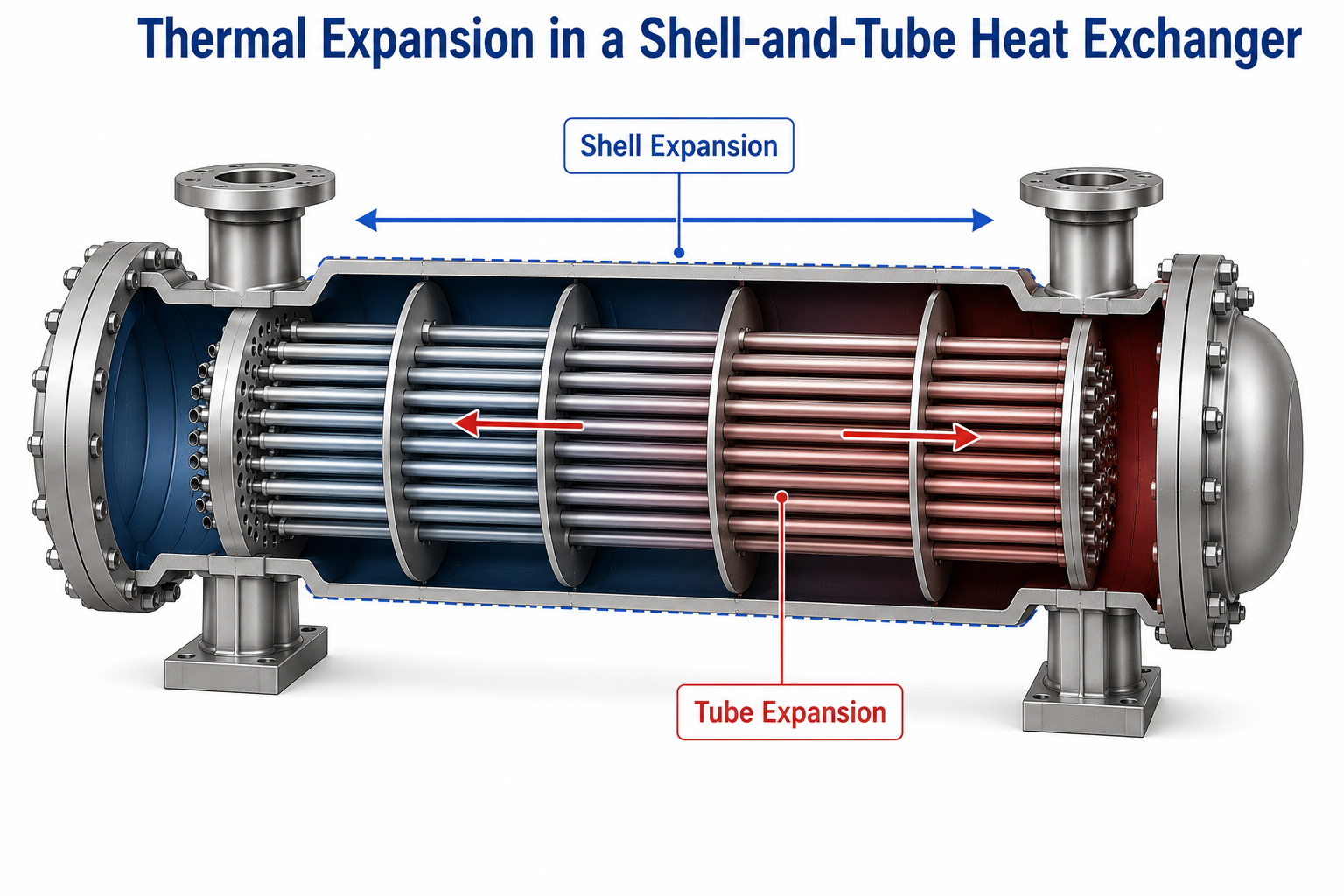
Heat transfer causes temperature changes, and temperature changes cause expansion. While thermal engineers often focus on heat duty and temperature profiles, every degree of temperature change also creates mechanical movement inside a shell-and-tube heat exchanger. If that movement is not properly accommodated, thermal expansion can generate enormous stresses, leading to tube failures, leaking joints, distorted components, and premature equipment failure.
Heat exchangers are designed to transfer heat from one fluid to another.
From a process engineering perspective, this appears straightforward.
A hot fluid loses heat.
A cold fluid gains heat.
Temperatures change until the required heat duty is achieved.
However, another process occurs simultaneously inside the exchanger.
As the shell and tubes heat up, they expand.
As they cool down, they contract.
These movements may seem insignificant, often measuring only a few millimetres.
Yet because the shell, tubes, tubesheets, and supports are mechanically connected, even small differences in expansion can create extremely large stresses.
These stresses are invisible during normal operation.
Operators do not see them.
Control systems do not measure them.
Thermal design software rarely highlights them.
Nevertheless, thermal expansion remains one of the most important mechanical considerations in shell-and-tube heat exchanger design.
It is the reason why floating heads, U-tubes, and expansion joints exist. It influences material selection, mechanical configuration, and long-term reliability.
Understanding thermal expansion helps process engineers appreciate why a thermally perfect heat exchanger can still fail mechanically if differential movement is ignored.
Table of Contents
Every Heated Component Expands
Thermal expansion is a natural consequence of increasing temperature.
When metals are heated, their atoms vibrate more vigorously, causing the material to increase slightly in length.
Inside a shell-and-tube heat exchanger:
- tubes expand,
- shell expands,
- tubesheets deform,
- channel covers move,
- support structures experience additional loading.
None of these movements can be prevented.
The only engineering decision is how to accommodate them safely.
This makes thermal expansion a design consideration rather than an operating problem.
The Problem Is Differential Expansion
The greatest mechanical challenge is not expansion itself but unequal expansion between connected components.
Suppose both the shell and tubes experience exactly the same temperature increase.
They would expand by nearly the same amount, producing relatively little mechanical stress.
Industrial heat exchangers rarely operate under such ideal conditions.
Instead:
- one fluid is hotter,
- the other is colder,
- heating rates differ,
- cooling rates differ.
As a result:
- tubes may become much hotter than the shell,
- shell may expand more slowly,
- connected components attempt to move by different amounts.
Since these components are mechanically connected, the difference in movement creates internal stress.
This phenomenon is known as differential thermal expansion.
Why Thermal Stress Develops
When expansion is restrained, mechanical stress replaces free movement.
Imagine a long steel rod resting freely on supports.
As it heats, it simply becomes slightly longer.
Now imagine welding both ends of the rod so that it cannot move.
Heating now attempts to increase its length.
Since movement is prevented, internal stress develops instead.
A shell-and-tube heat exchanger behaves similarly.
If thermal expansion is restrained by rigid construction, the resulting stresses are transferred into:
- tubes,
- tubesheets,
- shell,
- welds,
- flanges,
- gaskets.
Repeated thermal cycles gradually increase the risk of mechanical damage.
The Shell and Tube Rarely Heat at the Same Rate
Different fluids create different temperature histories inside the exchanger.
During startup:
The process fluid may reach operating temperature quickly.
The utility fluid may warm much more slowly.
Consequently:
- tubes may expand before the shell,
- shell may lag behind,
- stresses develop during transient operation.
A similar situation occurs during shutdown.
Rapid cooling of one side while the other remains hot creates another period of unequal expansion.
Many thermal expansion problems therefore occur during startups and shutdowns rather than steady-state operation.
Fixed Tubesheet Exchangers Are Most Sensitive
Rigid construction provides strength but limits freedom of movement.
In a fixed tubesheet exchanger:
- both ends of the tube bundle are rigidly attached,
- shell and tubes cannot move independently.
Large temperature differences therefore generate:
- higher thermal stress,
- tubesheet loading,
- shell distortion,
- fatigue risk.
This does not mean fixed tubesheet exchangers are unsuitable.
It simply means they should be selected where thermal expansion remains within acceptable limits.
Floating Head Exchangers Accommodate Expansion Naturally
Allowing controlled movement reduces thermal stress significantly.
A floating head exchanger permits one end of the tube bundle to move relative to the shell.
As temperatures change:
- tubes expand,
- floating head moves,
- stresses remain much lower.
This mechanical flexibility makes floating head exchangers suitable for:
- large temperature differences,
- repeated thermal cycling,
- demanding operating conditions.
The additional construction complexity exists primarily to solve the thermal expansion problem.
U-Tube Exchangers Use Flexibility Instead of Movement
The curved tubes absorb expansion without requiring a movable tubesheet.
In a U-tube exchanger:
- each tube bends naturally,
- thermal expansion occurs through elastic deformation,
- differential movement produces relatively little stress.
This simple mechanical solution eliminates many expansion problems.
However, it introduces other considerations such as:
- more difficult tube cleaning,
- limited tube replacement options,
- restrictions on tube layout.
Every construction therefore represents a different engineering compromise.
Expansion Joints Solve Specific Problems
Sometimes the shell is allowed to expand instead of the tube bundle.
For certain services, engineers may install an expansion joint in the shell.
The expansion joint:
- absorbs shell movement,
- reduces thermal stress,
- protects the tubesheet.
Expansion joints are particularly useful where:
- thermal expansion is significant,
- fixed tubesheet construction remains desirable,
- operating conditions justify the additional cost.
They are not universal solutions but specialized mechanical components selected for specific applications.
Thermal Expansion Influences Material Selection
Different materials expand at different rates.
Material selection is not based only on:
- corrosion resistance,
- pressure,
- strength.
Engineers must also consider thermal expansion characteristics.
For example:
If tubes and shell are manufactured from different materials:
- each material expands differently,
- thermal stress distribution changes,
- mechanical design becomes more complex.
Understanding these interactions helps engineers avoid unexpected problems in mixed-material exchangers.
Cyclic Operation Increases Expansion Fatigue
Repeated expansion and contraction gradually weaken mechanical components.
Many industrial heat exchangers do not operate continuously at constant temperature.
Instead they experience:
- startups,
- shutdowns,
- batch processing,
- cleaning cycles,
- production changes.
Every cycle creates:
- expansion,
- contraction,
- repeated stress.
Over many years, these cyclic loads may contribute to:
- fatigue cracking,
- tube joint leakage,
- gasket deterioration,
- weld failures.
Mechanical design therefore considers not only maximum temperature but also operating frequency.
Thermal Expansion Affects More Than the Heat Exchanger
Connected piping and supports also experience expansion forces.
The exchanger does not operate in isolation.
It is connected to:
- process piping,
- supports,
- nozzles,
- foundations.
As the exchanger expands:
- piping loads change,
- nozzle forces develop,
- support reactions increase.
These interactions are considered during piping flexibility analysis and mechanical design.
Ignoring them may damage both the exchanger and the surrounding piping system.
Common Misunderstandings About Thermal Expansion
Many engineers underestimate thermal expansion because the physical movement appears small.
“Expansion Is Only a Few Millimetres”
The movement itself may be small.
The stress generated when movement is restrained can be extremely large.
“Steady Operation Eliminates Expansion Problems”
Most expansion-related stresses occur during:
- startup,
- shutdown,
- temperature changes,
- cyclic operation.
Steady-state operation is often less demanding.
“Only High-Temperature Services Require Expansion Analysis”
Even moderate temperature differences may create significant differential expansion in long tube bundles.
Every exchanger should be evaluated according to its operating conditions rather than temperature alone.
“Thermal Expansion Is a Mechanical Engineer’s Problem”
Mechanical engineers perform the detailed calculations.
However, process engineers influence thermal expansion through decisions involving:
- operating temperatures,
- exchanger selection,
- utility conditions,
- process configuration.
Understanding expansion improves multidisciplinary decision-making.
Operator Perspective
Thermal expansion problems often appear gradually rather than suddenly.
Possible operating symptoms include:
- recurring gasket leakage,
- unexplained tube failures,
- nozzle leaks,
- distorted supports,
- increasing maintenance frequency.
These problems may develop over years before the underlying expansion issue is identified.
Owner Perspective
Managing thermal expansion protects long-term equipment reliability.
Proper mechanical design reduces:
- maintenance costs,
- fatigue failures,
- production interruptions,
- repair frequency,
- lifecycle expenses.
Although thermal expansion cannot be eliminated, its effects can be controlled through appropriate exchanger construction and mechanical design.
Final Perspective
Thermal expansion is one of the most powerful mechanical forces acting inside a shell-and-tube heat exchanger.
It cannot be seen during normal operation, yet it continuously influences the behaviour of every major component.
When properly accommodated through suitable construction, thermal expansion becomes a routine part of safe operation.
When ignored, it can gradually damage tubes, tubesheets, welds, gaskets, and piping connections—even when every thermal calculation is correct.
The best heat exchanger designs recognize that transferring heat inevitably creates movement, and successful mechanical design begins by giving that movement a safe place to occur.
Explore the complete series in the Heat Exchanger Engineering Hub.

A practicing chemical engineer with 17+ years of experience in process design, project execution, commissioning, and plant operations. Focused on practical engineering judgment beyond textbook explanations.