
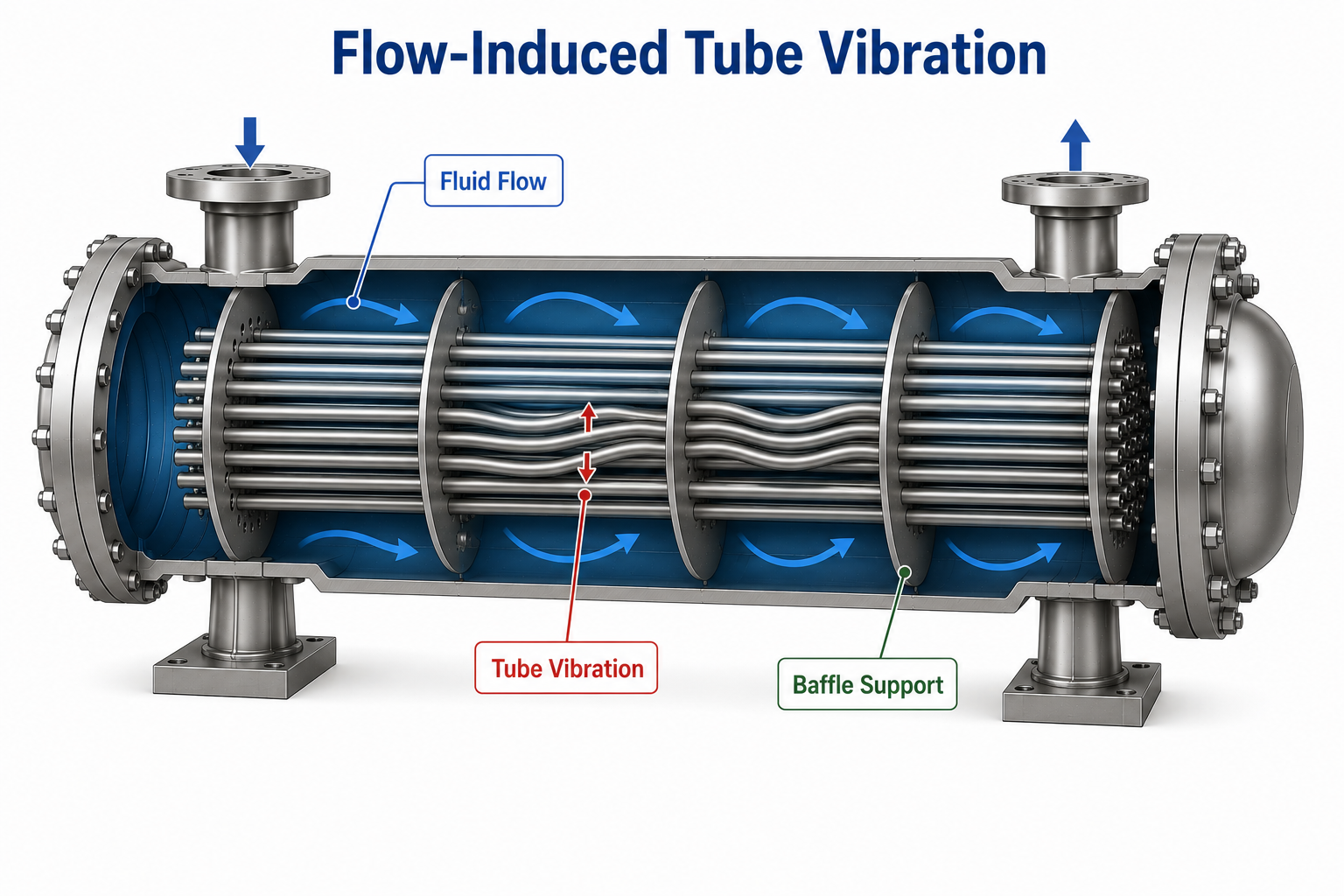
Not all heat exchanger tube failures are caused by corrosion, erosion, or excessive pressure. In many cases, the root cause is vibration generated by the flowing fluid itself. Flow-induced vibration is a hidden mechanical phenomenon that develops gradually, often without obvious warning, until repeated tube movement leads to wear, fatigue cracks, tube leakage, or catastrophic failure. Understanding how vibration develops helps engineers design heat exchangers that remain mechanically reliable throughout decades of operation.
When engineers think about heat exchanger reliability, they often focus on:
- corrosion,
- fouling,
- thermal expansion,
- pressure containment.
These are certainly major design considerations.
However, another failure mechanism quietly affects shell-and-tube heat exchangers across many industries.
The process fluid itself can generate forces strong enough to make the tubes vibrate continuously.
Initially, the movement may be microscopic.
The exchanger continues to meet its thermal duty.
Pressure remains normal.
No alarms are activated.
Yet every vibration cycle applies a small mechanical load to the tubes.
After millions of repeated cycles, this seemingly harmless movement can produce:
- fatigue cracks,
- tube wear,
- leaking tube joints,
- damaged baffles,
- unexpected shutdowns.
This is why flow-induced vibration is one of the most important mechanical considerations during shell-and-tube heat exchanger design.
It is far easier to prevent vibration during design than to repair its consequences after years of operation.
Table of Contents
What Is Flow-Induced Vibration?
Flow-induced vibration occurs when moving fluid generates repeated forces that cause exchanger tubes to oscillate.
Whenever fluid flows across or through tubes, it exerts dynamic forces on their surfaces.
Under normal conditions these forces are small.
If operating conditions become favourable for vibration, however, these forces may repeatedly deflect the tubes.
The tube behaves much like a flexible beam.
Instead of remaining stationary, it begins moving back and forth.
Although the movement may be extremely small, the repeated loading gradually damages the metal.
The danger lies not in one large movement but in millions of tiny movements occurring over the equipment’s operating life.
Why Tubes Are Vulnerable to Vibration
Heat exchanger tubes are intentionally slender to maximize heat transfer, but slender components are naturally more flexible.
Compared with the shell, tubes have:
- relatively small diameter,
- thin walls,
- long unsupported spans.
These characteristics improve thermal performance by providing a large heat transfer area.
Mechanically, however, they also make the tubes more susceptible to vibration.
To control this flexibility, engineers install:
- baffles,
- support plates,
- tie rods,
- spacers.
These components reduce unsupported tube length and limit excessive movement.
How Flow Creates Vibration
Moving fluid continuously interacts with the tube surfaces.
As fluid passes across the tube bundle:
- pressure changes develop,
- small eddies form behind the tubes,
- alternating flow patterns create fluctuating forces.
Most of the time these forces remain harmless.
However, if flow velocity increases or the exchanger geometry becomes unfavourable, the repeated forces may become strong enough to excite tube vibration.
The result is continuous cyclic loading throughout operation.
High Flow Velocity Is a Common Cause
Increasing fluid velocity improves heat transfer but also increases vibration risk.
Higher velocity generally provides:
- greater turbulence,
- improved heat transfer,
- reduced fouling.
At the same time it also increases:
- dynamic fluid forces,
- tube movement,
- mechanical loading,
- fatigue potential.
This illustrates one of the most important engineering compromises in heat exchanger design.
The thermally optimum flow velocity is not always the mechanically safest velocity.
Unsupported Tube Length Has a Major Influence
Longer unsupported tube spans are more likely to vibrate.
Between two adjacent baffles, each tube behaves like a beam.
If baffle spacing becomes excessive:
- tube stiffness decreases,
- deflection increases,
- vibration amplitude grows.
Reducing unsupported length significantly improves mechanical stability.
This is one reason why baffle spacing is selected using both thermal and mechanical considerations.
Repeated Vibration Causes Fatigue Failure
Most vibration failures develop through fatigue rather than overload.
Individual vibration cycles usually produce stresses well below the material’s ultimate strength.
The problem is repetition.
A heat exchanger operating continuously may experience millions of vibration cycles every day.
Over time these repeated stresses may initiate microscopic cracks.
These cracks gradually grow until:
- tubes begin leaking,
- cracks propagate,
- complete tube failure occurs.
The exchanger may appear to fail suddenly, even though the damage has been developing for years.
Tube-to-Baffle Wear Is Another Common Failure Mechanism
Vibration does not always crack the tube—it may gradually wear it away.
As tubes vibrate inside the baffle holes:
- repeated contact occurs,
- friction develops,
- metal slowly wears away.
This process is often called fretting wear.
Eventually:
- tube wall thickness decreases,
- leakage develops,
- tube replacement becomes necessary.
Proper tube support greatly reduces this type of damage.
Thermal Expansion Can Increase Vibration Problems
Mechanical phenomena rarely occur independently.
Thermal expansion changes the internal stress state of the exchanger.
As tubes expand:
- support conditions change,
- clearances change,
- vibration characteristics may also change.
This is another reason why thermal and mechanical design must always be considered together.
Mechanical Design Helps Prevent Vibration
Good vibration control begins during exchanger design.
Engineers reduce vibration risk by carefully selecting:
- tube diameter,
- tube length,
- baffle spacing,
- support plate arrangement,
- tube pitch,
- operating velocity,
- exchanger construction.
No single design feature eliminates vibration.
Reliable operation results from balancing all these factors together.
Operating Conditions Also Influence Vibration
An exchanger designed for one operating condition may behave differently under another.
Flow-induced vibration can become more severe when:
- production rates increase,
- process conditions change,
- utility flow increases,
- fluids are replaced,
- operating temperatures change.
This explains why vibration problems sometimes appear years after commissioning when plant operating conditions no longer match the original design basis.
Warning Signs of Flow-Induced Vibration
The earliest symptoms are often subtle and easily overlooked.
Possible indications include:
- recurring tube leaks,
- unexpected tube failures,
- unusual vibration or noise,
- tube wear near baffles,
- repeated failures in similar locations,
- unexplained maintenance frequency.
Identifying these symptoms early can prevent more extensive damage.
Preventing Vibration Is More Economical Than Repairing It
Mechanical reliability is largely determined during design.
Once an exchanger is fabricated, major design changes become expensive.
Preventive design measures are therefore far more economical than repeated repairs.
Proper design reduces:
- fatigue failures,
- maintenance frequency,
- production interruptions,
- replacement costs,
- safety risks.
This reinforces the importance of integrating mechanical analysis into thermal design.
Common Misunderstandings About Flow-Induced Vibration
Because vibration is often invisible, it is frequently underestimated.
“If the Exchanger Is Quiet, There Is No Vibration”
Many damaging vibration modes cannot be detected by hearing or casual observation.
Microscopic tube movement can still produce fatigue over time.
“Only High-Velocity Services Experience Vibration”
High velocity increases risk, but vibration also depends on:
- tube support,
- geometry,
- fluid properties,
- operating conditions.
Velocity alone does not determine vibration behaviour.
“Tube Failure Means Corrosion”
Many leaking tubes initially appear to have suffered corrosion.
Detailed inspection often reveals fatigue cracks or wear caused by vibration.
Understanding the failure mechanism is essential before selecting corrective actions.
“Adding More Tubes Improves Performance”
Increasing tube count without considering mechanical support may increase vibration risk.
Mechanical integrity must always accompany thermal optimization.
Operator Perspective
Operators are often the first to notice subtle changes in exchanger behaviour.
Repeated tube failures, unexplained maintenance, or unusual operating noise may indicate vibration problems rather than process upsets.
Reporting these observations early allows engineers to investigate the underlying mechanical causes before significant damage develops.
Owner Perspective
Preventing vibration protects both reliability and profitability.
A vibration-resistant design provides:
- longer tube life,
- fewer unplanned shutdowns,
- lower maintenance costs,
- improved production availability,
- reduced lifecycle expenditure.
The modest additional effort invested during design often prevents years of recurring maintenance.
Final Perspective
Flow-induced vibration is one of the least visible yet most destructive failure mechanisms in shell-and-tube heat exchangers.
Unlike corrosion or overpressure, it often develops silently through millions of repeated loading cycles until fatigue or wear eventually causes tube failure.
The most effective solution is not frequent repair but thoughtful design.
By carefully balancing fluid velocity, tube support, mechanical construction, and operating conditions, engineers can prevent vibration before the exchanger is ever built.
In the end, a heat exchanger is not judged only by how efficiently it transfers heat, but by how reliably it continues doing so year after year without unexpected mechanical failure.
Explore the complete series in the Heat Exchanger Engineering Hub.

A practicing chemical engineer with 17+ years of experience in process design, project execution, commissioning, and plant operations. Focused on practical engineering judgment beyond textbook explanations.