
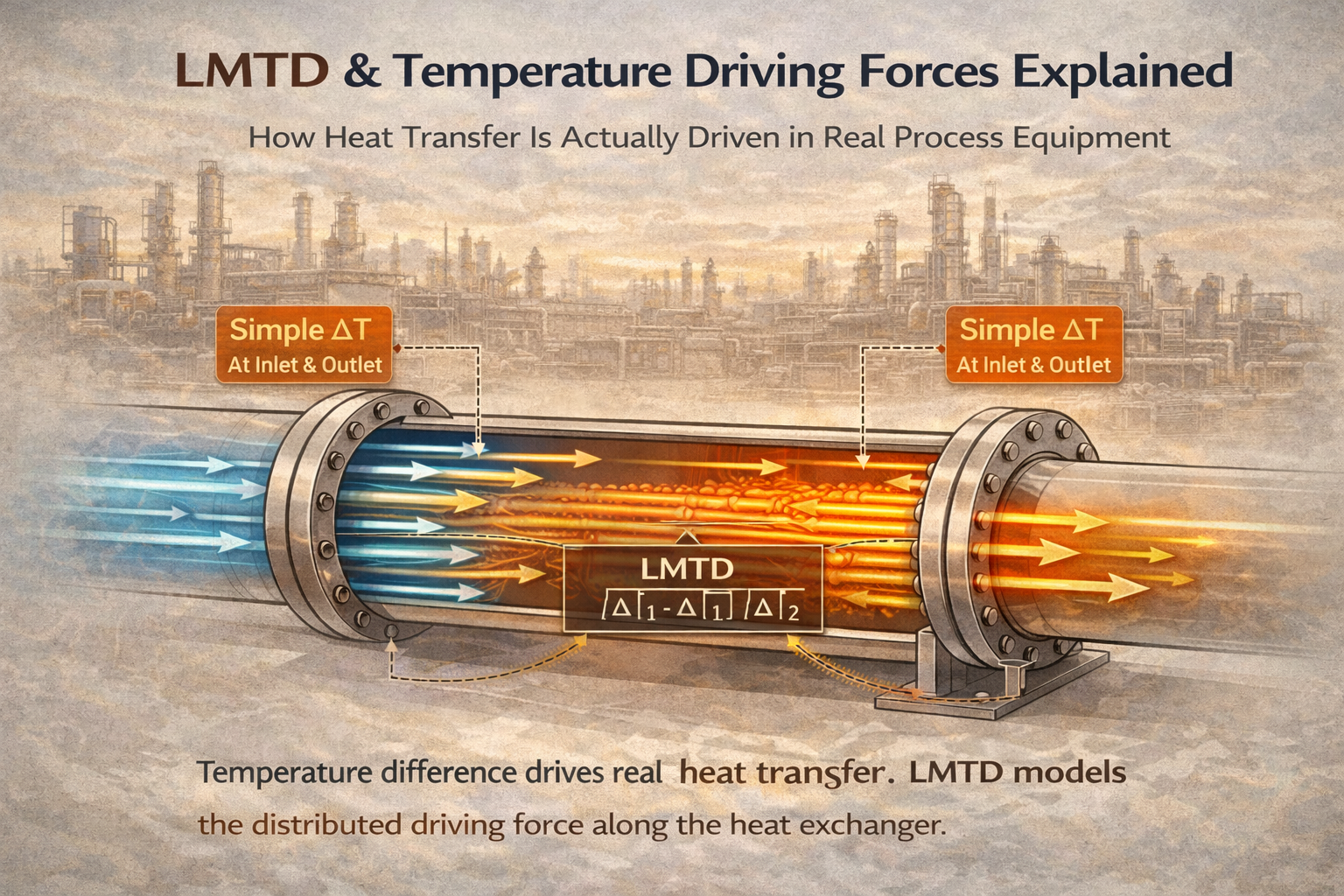
Every heat transfer calculation in process plants ultimately depends on one thing:
temperature driving force.
No matter how large the exchanger, how good the material, or how high the utility flow, heat transfer cannot occur unless a temperature difference exists.
LMTD — the Log Mean Temperature Difference — is the most widely used way of representing that driving force. It appears simple, familiar, and mathematical.
Yet in real plants, LMTD is one of the most misunderstood concepts in heat transfer.
This article explains what LMTD really represents, why it exists, how it connects to physical driving forces, and why misusing it leads to exchanger underperformance, control problems, and failed debottlenecking efforts.
Table of Contents
Temperature Difference Is the True Driving Force
Heat transfer does not respond to equations.
It responds to local temperature difference.
At every point in a heat exchanger:
- one fluid is hotter,
- one fluid is colder,
- heat flows locally according to that local difference.
This difference:
- changes along the exchanger length,
- changes with flow arrangement,
- collapses near pinch points,
- spikes near inlets.
There is no single temperature difference that represents the whole exchanger. This is exactly why simple ΔT calculations become unreliable in real exchanger analysis.
LMTD exists to approximate this distributed driving force in a usable form.
Why Simple ΔT Fails Immediately
A simple temperature difference (hot in – cold out, or hot out – cold in) assumes:
- temperature difference is constant,
- heat transfer rate is uniform,
- driving force does not change with position.
None of these are true in real exchangers.
Using a simple ΔT:
- overestimates driving force in some regions,
- underestimates it in others,
- hides pinch points,
- gives false confidence about margin.
Simple ΔT is not wrong mathematically — it is physically incomplete.
What LMTD Actually Represents
LMTD is not an “average temperature difference” in the intuitive sense.
It is a logarithmic weighting of temperature difference that reflects:
- high driving force regions contributing more heat,
- low driving force regions limiting performance.
LMTD mathematically accounts for the fact that:
- most heat transfer occurs where ΔT is high,
- overall performance is constrained where ΔT is low.
This makes LMTD a better representation of effective driving force than any simple average. But this representation remains accurate only when exchanger behavior follows smooth thermal profiles.
LMTD Is a Model of Spatial Reality
In real exchangers:
- temperature difference is highest at one end,
- lowest at the other,
- continuously varying in between.
LMTD compresses this spatial variation into a single value that preserves:
- total heat transfer rate,
- correct weighting of local driving forces.
This is why LMTD works well for:
- steady-state design,
- single-phase heat exchange,
- well-behaved flow arrangements.
But it is still a model, not the physical process itself.
Why Flow Arrangement Changes LMTD
Counter-current, co-current, and cross-flow exchangers have different temperature profiles.
As a result:
- the same inlet and outlet temperatures produce different local ΔT distributions,
- different effective driving forces exist,
- different exchanger sizes are required.
LMTD captures this difference naturally.
This is why:
- counter-current exchangers are usually more efficient,
- co-current exchangers struggle near outlet,
- cross-flow exchangers require correction factors.
Real exchangers therefore require additional correction because practical flow geometry rarely remains ideal.
LMTD is sensitive to how fluids meet, not just how hot or cold they are.
LMTD Does Not Create Heat Transfer Capability
A critical misconception is treating LMTD as something that can be “adjusted” operationally.
LMTD does not create heat transfer.
It only describes available driving force.
If LMTD is small:
- no amount of area will fix local pinch limitations,
- increasing flow may worsen approach,
- utilities may saturate.
If LMTD collapses locally:
- heat transfer stops there first,
- control becomes unstable,
- fouling accelerates.
Plants fail at minimum local ΔT, not at average LMTD. At extreme conditions, this local collapse can even progress toward temperature cross.
Why LMTD Is a Design Tool, Not a Guarantee
Designers use LMTD to size exchangers under assumed conditions:
- clean surfaces,
- steady flow,
- expected temperatures.
Operation introduces:
- fouling,
- flow maldistribution,
- seasonal changes,
- partial loads.
All of these distort local temperature profiles. This is one reason exchanger rating and real operating prediction often require approaches beyond simple LMTD sizing.
As conditions drift:
- true effective driving force deviates from design LMTD,
- margins shrink,
- performance becomes fragile.
This is why exchangers that “met design” struggle years later.
Driving Force Collapse Is the Real Limitation
Most exchanger problems are not area problems.
They are driving force problems.
Common symptoms:
- outlet temperature stuck near approach limit,
- large utility consumption for small duty increase,
- sensitivity to minor fouling,
- control oscillation near limits.
All of these indicate local driving force collapse.
LMTD hides where collapse occurs unless profiles are examined.
LMTD and Temperature Pinch Are Linked
Temperature pinch is the location where:
- hot and cold streams approach each other closely,
- local ΔT becomes minimal,
- heat transfer resistance explodes.
LMTD averages over the entire exchanger, but pinch governs capacity.
This explains why:
- exchangers appear oversized but underperform,
- small fouling causes sudden loss of duty,
- debottlenecking fails without changing approach temperatures.
Design must respect pinch, not just LMTD.
Owner Perspective: Why LMTD Misuse Costs Money
From an ownership standpoint, misunderstanding LMTD leads to:
- oversized exchangers that still bottleneck,
- repeated cleaning without root cause removal,
- excessive utility consumption,
- failed revamps and expansions.
Plants pay for:
- false confidence,
- hidden pinch points,
- misunderstood margins.
Correct understanding of driving force prevents these losses.
Final Perspective
LMTD is not a formula to memorize.
It is a compact description of how temperature driving force is distributed inside equipment.
Used correctly, it:
- enables sound design,
- highlights efficiency advantages,
- supports realistic sizing.
Used blindly, it:
- hides local limitations,
- masks pinch points,
- creates fragile systems.
Understanding LMTD is not about mathematics.
It is about respecting how heat actually moves through process equipment.
And that understanding is essential for anyone responsible for reliable heat exchanger performance in real plants.
LMTD helps represent distributed temperature driving force, but understanding it properly requires seeing how the concept develops from real exchanger behavior step by step.
Before applying LMTD confidently, engineers must first understand why temperature difference changes continuously through equipment and why simple averaging fails.
This article builds LMTD from physical exchanger behavior rather than equations alone, helping engineers understand what the logarithmic mean truly represents inside real heat exchangers.
Explore the complete series in the Heat Transfer Engineering Hub.

A practicing chemical engineer with 17+ years of experience in process design, project execution, commissioning, and plant operations. Focused on practical engineering judgment beyond textbook explanations.