
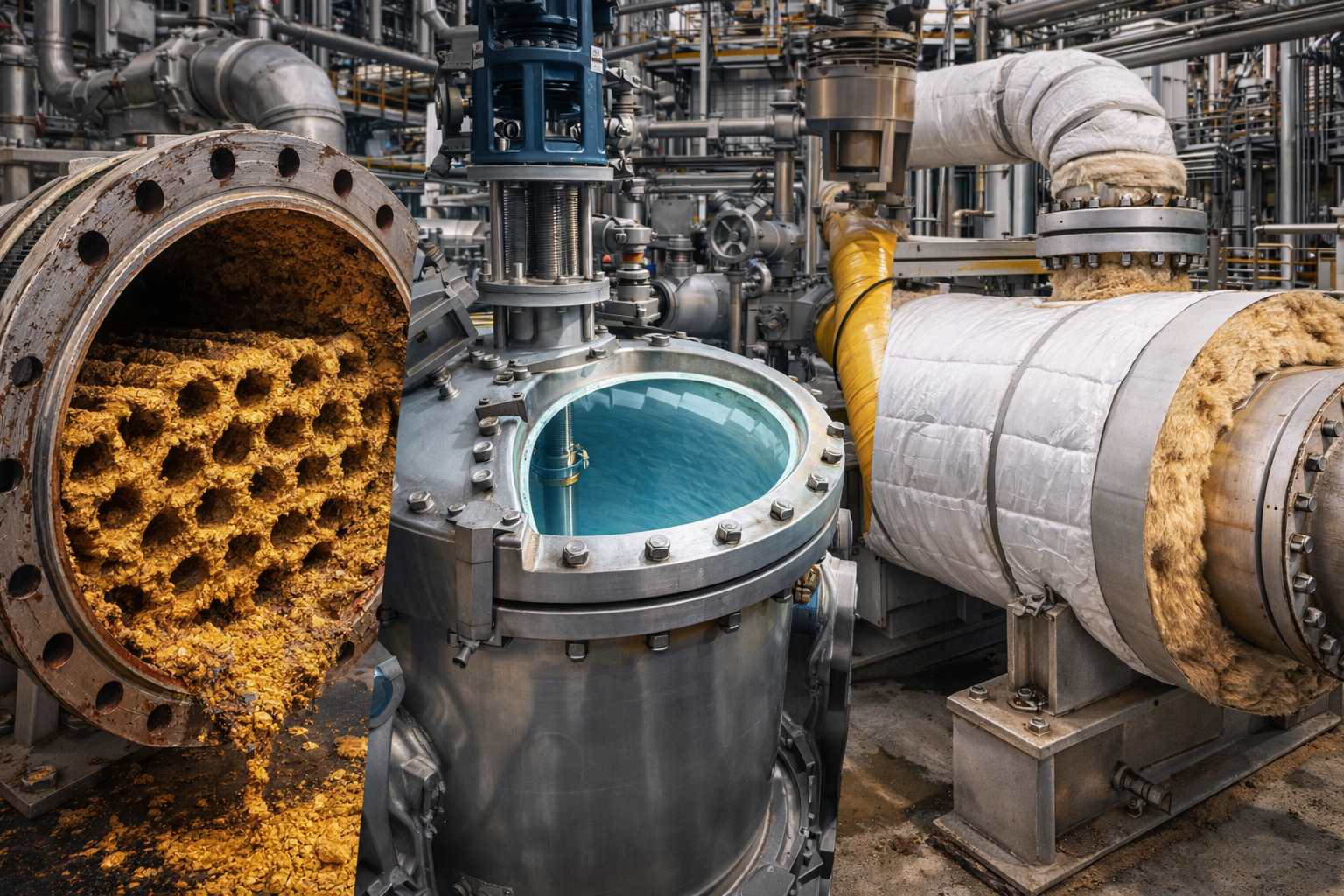
In process plants, heat transfer is often associated with flowing fluids, heaters, and exchangers. When nothing is moving, it is easy to assume that heat transfer has stopped or become insignificant.
This assumption is incorrect.
Even in completely static conditions, heat continues to move through solid materials by conduction. In many real plant situations, this quiet movement of heat explains temperature changes that appear unexpected or unexplained.
This article explains conduction using real plant examples, showing where it occurs, how it behaves, and why it matters operationally.
Table of Contents
Conduction in Simple Terms
Conduction is the transfer of heat through a solid due to a temperature difference.
If one side of a solid object is hotter than the other, heat will flow through the material until temperatures move toward equilibrium as described in the fundamentals of conduction in process equipment.
In process plants, the solids involved are usually metals:
- carbon steel,
- stainless steel,
- alloy steels,
- copper alloys in some utilities.
Because these materials conduct heat well, conduction becomes unavoidable wherever temperature differences exist.
Example 1: Heat Loss Through Vessel Shells
Consider a reactor operating at elevated temperature.
Inside the vessel, the process fluid is hot.
Outside, ambient air is cooler.
Heat flows:
- from the hot fluid to the inner wall,
- through the vessel shell by conduction,
- from the outer wall to the surrounding air.
Even with insulation, conduction through the shell remains the first step in this process.
Operational observations:
- vessel skin temperature rises during operation,
- heat loss increases as insulation degrades,
- shutdown cooldown time depends on shell thickness.
These behaviors are governed primarily by conduction through the vessel wall.
Example 2: Heat Transfer Through Heat Exchanger Tube Walls
In shell-and-tube exchangers, conduction is an intentional step.
Heat moves:
- from hot fluid to tube wall (convection),
- through the tube wall (conduction),
- from tube wall to cold fluid (convection).
While convection often receives more attention, the tube wall conduction:
- sets a thermal resistance within the metal wall
- becomes significant for thick tubes,
- matters more when fouling is low.
In high-performance exchangers, even small changes in tube material or wall thickness influence overall duty.
Example 3: Piping That Cools or Heats Even Without Flow
Long pipelines often show temperature changes even when isolated.
A hot pipeline left idle will cool.
A cold pipeline left idle will warm.
This occurs because:
- heat conducts through the pipe wall,
- heat transfers radially to ambient air,
- heat also conducts axially along the pipe length.
Operators often notice:
- warm sections spreading along a line,
- cold spots disappearing over time,
- temperature equalization across connected piping.
All of this is explained by conditions where conduction becomes the dominant heat transfer mechanism.
Example 4: Nozzles and Flanges Acting as Thermal Bridges
Insulated equipment frequently loses heat at nozzles and flanges.
These components:
- interrupt insulation continuity,
- provide thicker metal paths,
- connect to other equipment or piping where imperfect metal contact can create additional resistance.
Heat conducts through these metal sections and escapes more easily.
Practical consequences include:
- localized hot spots,
- condensation on downstream piping,
- higher-than-expected heat loss,
- insulation damage around flanges.
These are classic conduction effects that are often overlooked in design.
Example 5: Supports and Structural Steel Transferring Heat
Equipment does not float in space.
It rests on:
- skirts,
- saddles,
- lugs,
- structural beams.
These supports connect hot equipment to cooler foundations and structures.
Heat conducts through these paths continuously, sometimes limited by the conductivity of the metal itself.
This explains:
- warm foundations near hot equipment,
- temperature gradients in support steel,
- heat loss even when equipment is well insulated.
In large equipment, support conduction can represent a non-trivial portion of total heat loss.
Example 6: Idle Equipment Influenced by Nearby Hot Units
In compact plants, equipment is often closely spaced.
A hot unit operating near an idle unit can warm it over time.
Heat transfers by:
- radiation across the gap,
- conduction through shared structures,
- conduction through common piping.
Operators may find idle equipment warmer than expected, affecting startup conditions.
This is not leakage or control failure.
It is conduction through connected solids.
Example 7: Conduction During Startup and Shutdown
During startup:
- hot fluids enter cold equipment,
- metal walls absorb heat,
- temperature spreads gradually through thickness.
During shutdown:
- hot metal releases stored energy,
- temperature gradients persist,
- cooling takes time.
These processes are governed by conduction within the metal.
Rapid temperature changes create:
- thermal stress,
- distortion,
- cracking risk.
Controlled ramp rates are based on conduction limits, not fluid temperatures alone.
Example 8: Cold Spots and Condensation in Piping
Cold spots in piping often appear where:
- insulation is missing,
- metal thickness changes,
- supports are present.
These spots cool faster due to enhanced conduction to the environment.
Consequences include:
- condensation,
- corrosion under insulation,
- product quality issues.
Understanding conduction paths helps identify and mitigate these risks.
Why These Examples Matter
Each example illustrates a common theme:
Conduction operates quietly, continuously, and independently of flow.
Ignoring it leads to:
- misinterpreted temperature readings,
- repeated insulation failures,
- unexplained energy losses,
- avoidable mechanical damage.
Recognizing conduction allows:
- better troubleshooting,
- more realistic expectations,
- improved equipment life.
Final Perspective
Conduction does not require motion, control, or intention.
It occurs wherever solid materials connect regions at different temperatures.
The plant examples discussed here are not exceptions.
They are normal behavior.
Understanding these everyday conduction effects turns confusion into clarity and helps plants operate more predictably.
This knowledge is not advanced.
It is essential.
The plant examples above show how conduction quietly moves heat through equipment even when fluids are not flowing.
In some situations, conduction does not just participate in heat transfer—it becomes the controlling mechanism that determines how equipment heats up or cools down.
When Conduction Dominates in Process Equipment
This article explains the operating conditions and equipment features under which conduction becomes the dominant heat transfer mechanism in real process equipment.
Explore the complete series in the Heat Transfer Engineering Hub.

A practicing chemical engineer with 17+ years of experience in process design, project execution, commissioning, and plant operations. Focused on practical engineering judgment beyond textbook explanations.