
Fouling almost never announces itself clearly.
By the time a heat exchanger is officially labeled “fouled,” the plant has usually been compensating for it quietly for weeks or even months. Most early indicators are subtle, indirect, and easy to dismiss as normal operating variation.
This article explains the early signs of fouling that operators commonly ignore, why they are overlooked, and how recognizing them early prevents sudden performance loss and emergency cleaning.
Table of Contents
Fouling Speaks Softly at First
Early fouling does not:
- trigger alarms,
- cause immediate throughput loss,
- produce obvious temperature failure.
Instead, it shows up as small operational shifts that feel harmless in isolation.
Because nothing appears broken, these signs are normalized — and ignored.
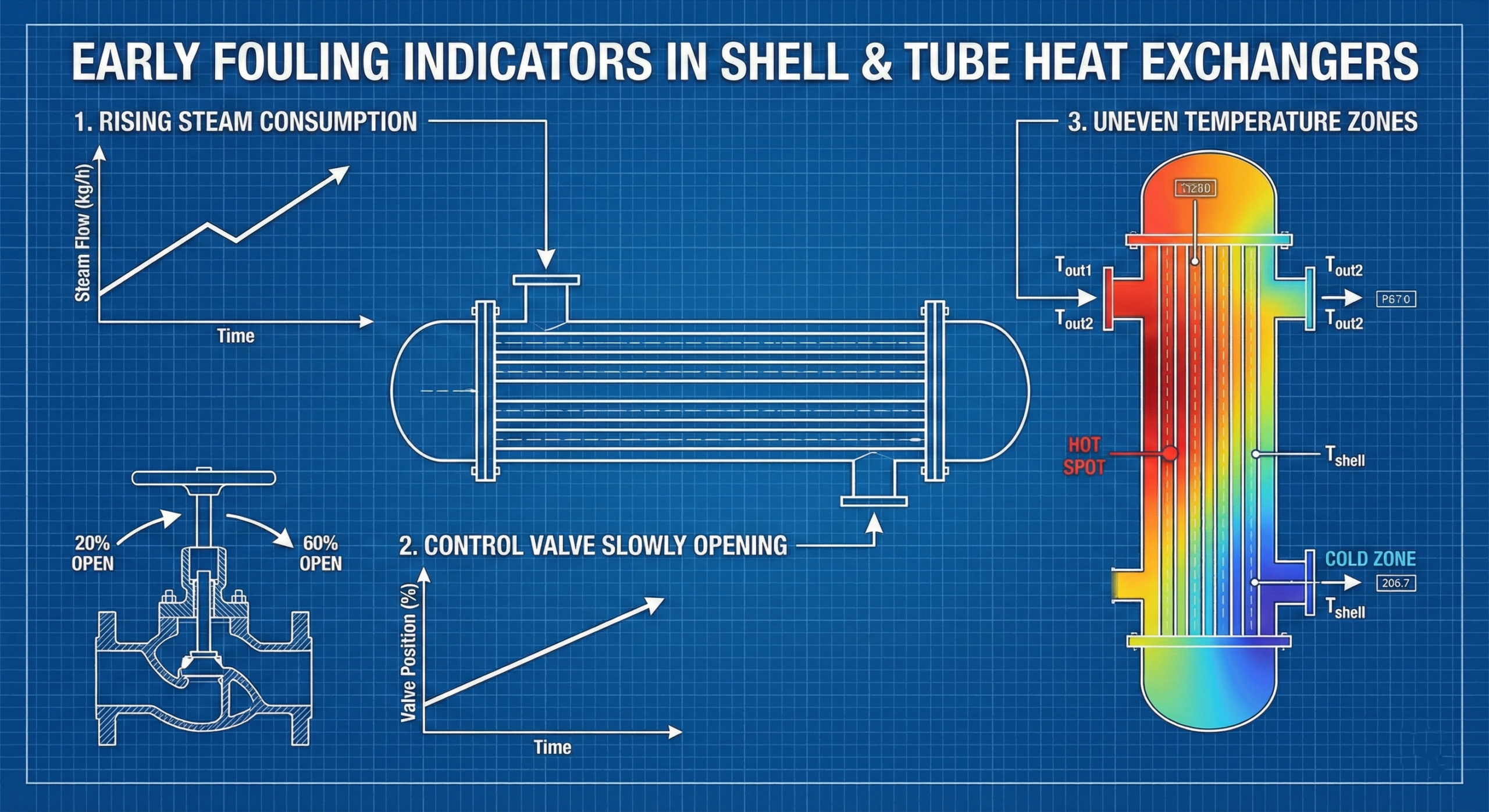
Gradual Increase in Utility Consumption
One of the earliest indicators of fouling is a slow rise in utility usage:
- more steam to achieve the same outlet temperature,
- higher cooling water flow to hold setpoint,
- valves opening wider over time.
Because the exchanger still meets duty, this increase is often attributed to:
- ambient conditions,
- feed variability,
- normal fluctuation.
In reality, this is fouling consuming temperature driving force.
Temperature Control Valves Creeping Open
Operators rarely notice a control valve moving from:
- 45% open last month,
- to 55% today,
- to 65% next month.
Each change seems minor.
But this gradual drift indicates:
- rising thermal resistance,
- declining effective U,
- shrinking margin.
When the valve finally reaches its limit, fouling appears to “suddenly” become severe.
It was never sudden.
Slower Response to Load Changes
As fouling develops:
- heat transfer response becomes sluggish,
- temperature takes longer to stabilize after disturbances,
- control loops feel “heavy.”
This is often blamed on:
- controller tuning,
- sensor lag,
- operator technique.
In reality, fouling increases thermal inertia and reduces effective driving force, slowing system response.
Narrowing Control Margin Without Obvious Failure
Another ignored sign is loss of operating comfort.
Symptoms include:
- tighter operating windows,
- less flexibility to handle feed swings,
- operators staying closer to limits “just in case.”
The exchanger still works — but no longer forgivingly.
Loss of margin always precedes loss of capacity.
Higher Sensitivity to Small Disturbances
A lightly fouled exchanger reacts strongly to small changes:
- slight flow reduction causes temperature deviation,
- small feed changes create noticeable instability,
- utility fluctuations propagate more visibly.
This increased sensitivity is often mistaken for upstream problems.
In fact, fouling amplifies disturbances by removing thermal buffering.
Rising Energy Cost Without Throughput Loss
Plants often track throughput carefully but overlook energy intensity.
Fouling causes:
- energy cost per unit production to rise,
- fuel or electricity consumption to creep upward,
- utility KPIs to worsen quietly.
Because production targets are met, these changes receive little attention — until costs accumulate significantly.
Uneven Temperature Profiles Along Equipment
Early fouling is rarely uniform.
It creates:
- hotter metal zones,
- localized cold spots,
- uneven outlet temperature patterns.
These effects are subtle and often unnoticed unless specifically monitored.
Uneven profiles indicate localized fouling and early maldistribution.
More Frequent Operator Intervention
As fouling grows:
- automatic control struggles more,
- operators intervene manually,
- “watchfulness” increases.
This human compensation hides the problem.
Plants normalize extra attention — without realizing it is a symptom of degradation.
Declining Performance After Cleaning Cycles
Another overlooked sign is reduced recovery after cleaning.
When fouling becomes aggressive:
- cleaning restores performance less completely,
- benefits fade faster,
- intervals shorten.
This indicates:
- surface damage,
- roughness increase,
- fouling acceleration.
Ignoring this trend leads to frequent cleaning with diminishing returns.
Why These Signs Are Commonly Ignored
These early indicators are ignored because:
- they develop slowly,
- they are reversible at first,
- they do not stop production.
Humans respond to failures — not trends.
Fouling is a trend problem.
Why Waiting for Obvious Failure Is Too Late
By the time fouling causes:
- missed outlet temperature,
- throughput reduction,
- emergency cleaning,
most of the available margin is already gone.
Options become limited:
- aggressive operation,
- rushed cleaning,
- unplanned downtime.
Early recognition preserves choice.
Late recognition forces reaction.
How Plants Can Detect Fouling Earlier
Plants that manage fouling proactively:
- trend valve positions,
- track energy per unit duty,
- monitor temperature approach changes,
- compare seasonal performance,
- treat control sensitivity as a warning.
These indicators cost little to monitor — and save much to act on.
Owner Perspective: Ignored Signs Become Expensive Surprises
From an ownership standpoint, ignored fouling signs lead to:
- rising energy bills,
- emergency outages,
- shortened exchanger life,
- reactive maintenance culture.
Recognizing early signs:
- enables planned intervention,
- improves availability,
- reduces lifecycle cost.
The difference is not technology — it is awareness.
Final Perspective
Fouling rarely shouts.
It whispers — through small shifts, subtle trends, and gradual discomfort.
Plants that wait for fouling to become obvious are always late.
Plants that listen for early signs stay in control.
Understanding the early signs of fouling operators ignore is not about blame.
It is about seeing degradation while there is still time to act calmly, deliberately, and economically.
A practicing chemical engineer with 17+ years of experience in process design, project execution, commissioning, and plant operations. Focused on practical engineering judgment beyond textbook explanations.