When people talk about energy efficiency in process plants, the discussion usually revolves around:
- fuel consumption
- steam usage
- power cost
- utility optimization
But very few conversations start at the real source of most energy loss:
Poor heat transfer performance — a root cause behind most plant performance issues.
In many plants, energy inefficiency does not come from lack of equipment or outdated technology.
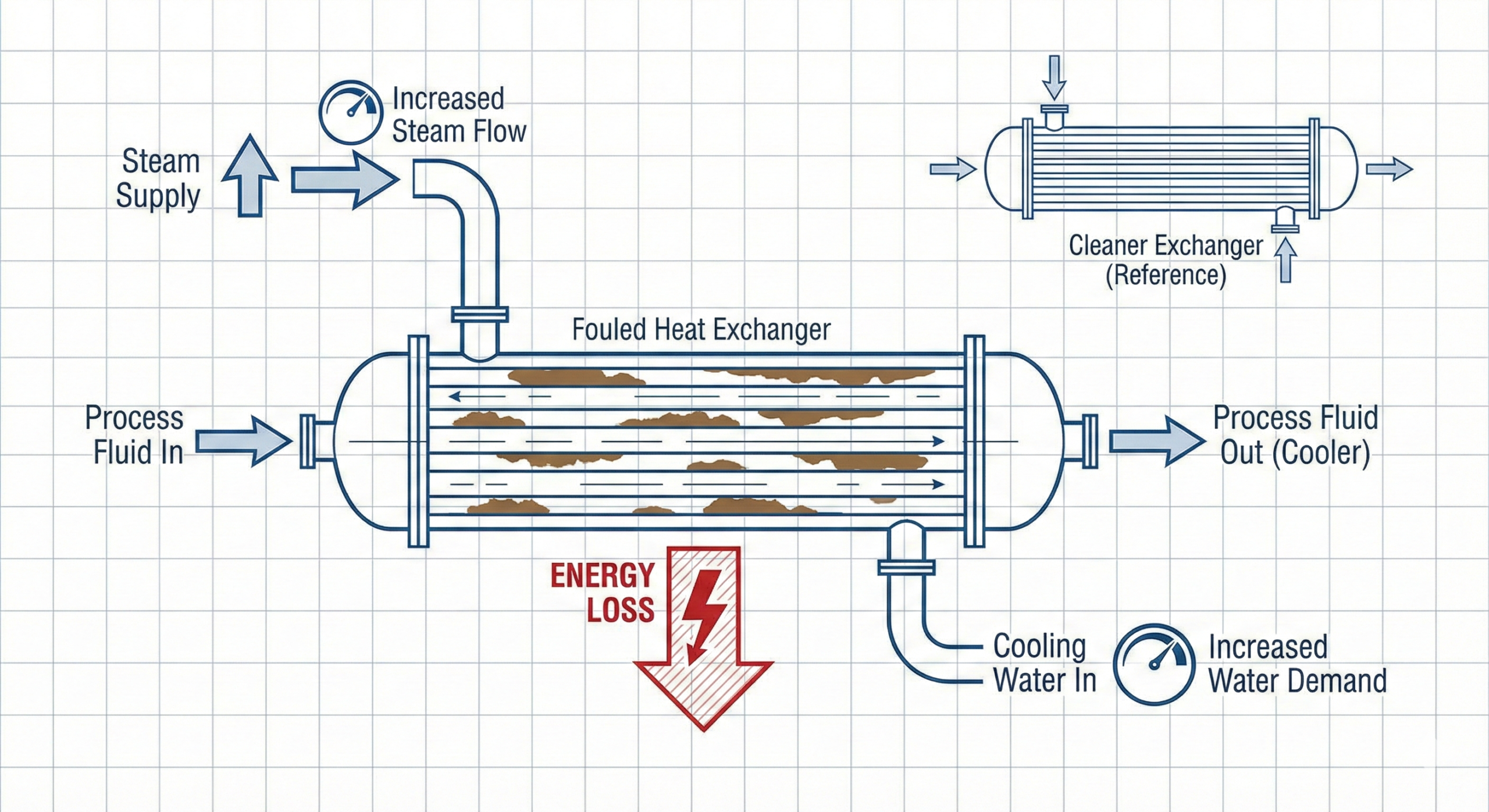
It comes from heat exchangers slowly losing effectiveness. Heat transfer does not stop — it simply becomes less effective when resistance builds.
And the loss is rarely dramatic.
It builds quietly:
- more steam is used,
- cooling water demand increases,
- temperatures become harder to maintain,
- operators compensate without realizing the cost.
This article explains how heat transfer and energy efficiency are directly connected, what plants actually lose when thermal performance drops, and why the impact is often much larger than it appears.
Table of Contents
Every Unit of Lost Heat Transfer Must Be Replaced by Energy
In a process plant, heat transfer performs essential work:
- preheating feeds
- recovering heat from products
- condensing vapors
- cooling streams for the next step
When exchangers work well, energy moves naturally within the system.
When they underperform, that missing heat must be replaced.
Usually with:
- more steam,
- more fuel,
- more electricity,
- more cooling.
So energy inefficiency is often not a utility problem.
It is a heat transfer performance problem.
The First Sign of Energy Loss Is Usually Small
Heat transfer degradation does not start with failure.
It starts with small changes:
- steam valves opening slightly more,
- cooling water flow increasing gradually,
- heaters running longer,
- condensers needing more utility support.
These changes feel normal.
But they represent one simple reality:
The exchanger is no longer transferring as much heat as before.
And the plant is paying to make up the difference.
Fouling: The Most Common Energy Thief
Fouling adds resistance.
Even a thin deposit:
- reduces U,
- reduces heat flow,
- forces higher temperature difference.
To maintain the same duty, the plant compensates by using more energy.
For example:
- more steam is required to reach the same outlet temperature,
- cooling systems work harder to remove the same heat.
Over months and years, this extra energy use becomes significant.
And it often goes unnoticed.
Why Plants Rarely See the Loss Directly
Energy loss due to poor heat transfer is difficult to detect because:
- production continues,
- temperatures still reach setpoints,
- no alarms are triggered.
The plant “still works.”
But behind the scenes:
- energy intensity per ton increases,
- fuel cost rises,
- utilities run closer to limits.
Since production remains stable, the loss is hidden in operating cost.
Heat Recovery Loss Is the Biggest Invisible Waste
One of the most important roles of heat exchangers is heat recovery.
Hot streams heat cold streams, reducing the need for external energy.
When heat transfer performance drops:
- less heat is recovered,
- more steam is needed downstream,
- more cooling is required elsewhere.
This creates a chain reaction across the plant.
So one underperforming exchanger can affect energy consumption far beyond its own location.
Temperature Approach Tightening Means Energy Is Being Wasted
As exchangers degrade:
- outlet temperatures shift,
- approach temperatures become tighter,
- more utility is needed to maintain process targets.
This is a clear sign of energy inefficiency.
But because the process still reaches required conditions, the inefficiency becomes normal.
Plants often accept it without questioning the underlying cause.
Why Energy Loss Accelerates Over Time
Heat transfer loss is not linear.
As fouling increases:
- resistance rises,
- U drops,
- driving force must increase,
- energy demand rises faster.
So the longer the exchanger runs without attention, the more expensive each additional month becomes.
Early-stage fouling has small impact.
Late-stage fouling becomes costly.
Seasonal Conditions Make the Loss More Visible
Energy inefficiency often becomes obvious in summer or winter.
For example:
- higher cooling water temperatures reduce heat rejection,
- colder feeds require more heating.
When exchangers are already degraded:
- the extra seasonal load pushes systems to their limits,
- energy demand spikes sharply.
So seasonal variation reveals problems that existed all along.
Why Energy Efficiency Projects Often Miss the Root Cause
Many plants invest in:
- boiler efficiency upgrades,
- insulation improvements,
- advanced control systems.
These help.
But if heat exchangers are underperforming:
- the process will still need more steam,
- utilities will still work harder,
- energy cost will remain high.
Improving heat transfer performance often gives faster and larger energy savings than utility-side upgrades.
Control Systems Hide Energy Waste
Control systems are designed to maintain process conditions.
If an exchanger transfers less heat:
- steam flow increases automatically,
- cooling water valves open more,
- process stability is preserved.
This is good for operation.
But it hides inefficiency.
Energy loss continues silently because the plant keeps meeting targets.
Why Plants Normalize Energy Loss
Over time, operators get used to higher utility consumption.
New normal conditions become accepted:
- higher steam demand,
- larger cooling loads,
- tighter temperature control.
Because the change is gradual, no single moment feels like a problem.
But the cost accumulates continuously.
Throughput Pressure Makes Efficiency Worse
When plants push for higher production — often discovering that heat transfer becomes the limiting factor in capacity:
- heat duties increase,
- fouling accelerates,
- utility demand rises.
If exchangers already operate near limits:
- energy consumption grows rapidly,
- efficiency drops further.
So heat transfer problems and energy inefficiency often grow together.
Owner Perspective: The Real Loss Is Not Just Fuel
From an ownership standpoint, poor heat transfer leads to:
- higher fuel bills,
- increased electricity consumption,
- more water usage,
- more frequent cleaning outages,
- shorter equipment life.
But the biggest loss is often indirect:
- reduced competitiveness,
- higher cost per unit production,
- unstable operation at peak demand.
Heat transfer performance quietly shapes the energy profile of the entire plant.
A Practical Way to See the Impact
In many plants, the connection between heat transfer and energy efficiency becomes visible through patterns like:
- energy use rising even when production stays constant,
- utility demand dropping after cleaning,
- better efficiency right after shutdown maintenance,
- higher fuel usage in older units compared to new ones.
These patterns point to one underlying truth:
Heat transfer efficiency and energy efficiency are the same story.
Final Perspective
Energy efficiency is often discussed as a utility issue.
In reality, it is deeply tied to how well heat moves inside the plant.
When heat exchangers perform well:
- energy is recovered,
- utilities are used efficiently,
- operating cost stays under control.
When heat transfer degrades:
- energy demand rises,
- costs increase quietly,
- efficiency slowly disappears.
Plants rarely lose efficiency overnight.
They lose it gradually, through small thermal resistances building up over time.
Understanding heat transfer vs energy efficiency helps plants see where the real losses occur — and where the biggest savings are hiding.
Explore the complete series in the Heat Transfer Engineering Hub.

A practicing chemical engineer with 17+ years of experience in process design, project execution, commissioning, and plant operations. Focused on practical engineering judgment beyond textbook explanations.