
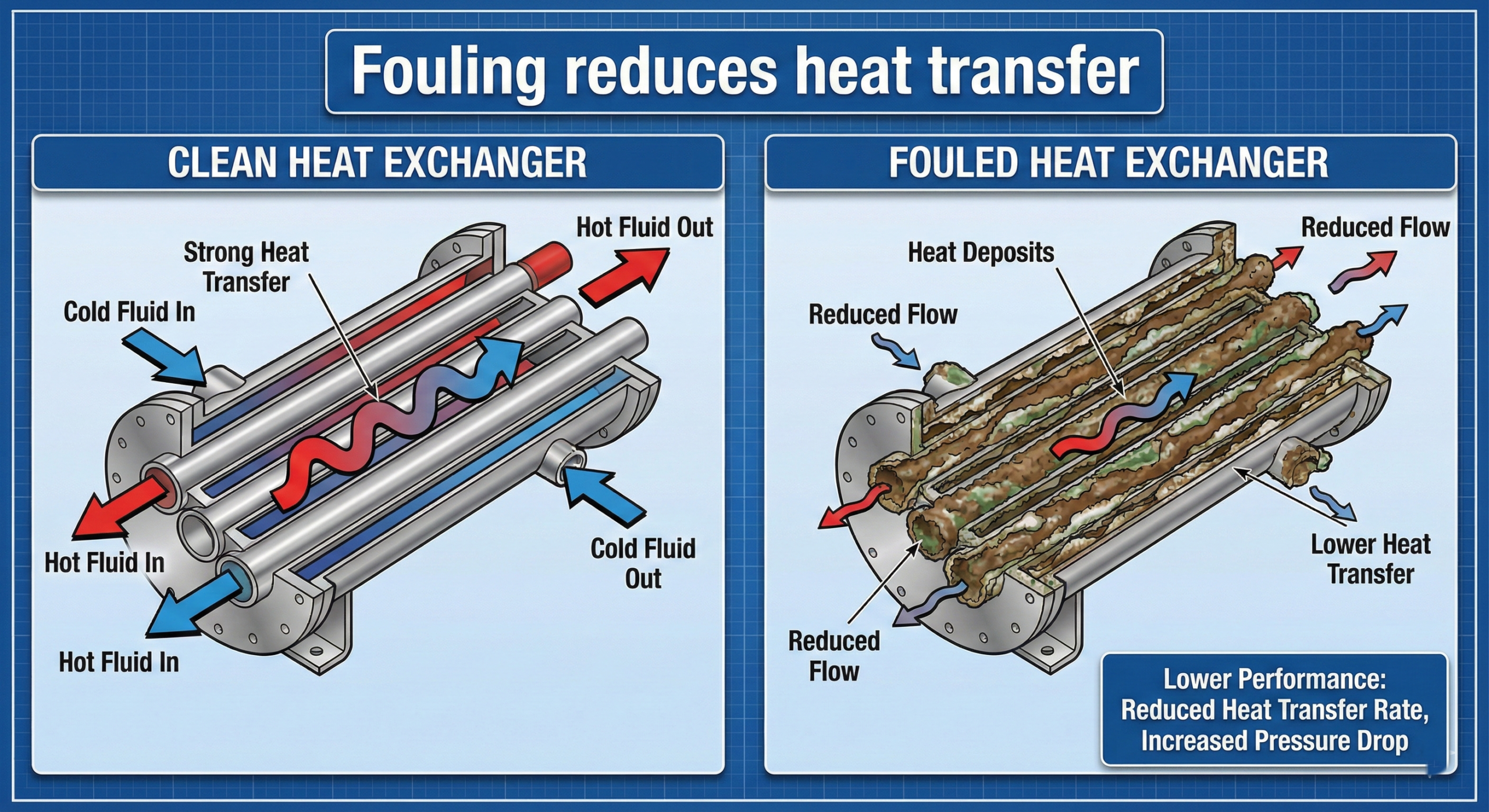
Fouling is rarely dramatic.
It does not announce itself with alarms or sudden breakdowns.
It does not appear as a clear failure mode on day one.
Instead, fouling quietly consumes performance, step by step, while the plant appears to be operating normally.
By the time fouling becomes visible, most of the damage has already been done.
This article explains how fouling silently destroys heat transfer performance, why it is so often overlooked, and why plants usually respond far too late.
Table of Contents
Fouling Begins Invisibly
One of the most dangerous aspects of fouling is that it begins below the threshold of perception.
Early fouling:
- adds very small thermal resistance,
- does not immediately reduce duty,
- is absorbed by control systems.
Operators increase:
- steam slightly,
- cooling water marginally,
- valve openings unconsciously.
Performance appears unchanged.
But margin is already shrinking.
Fouling Attacks Margin First, Not Capacity
A common misunderstanding is that fouling immediately reduces heat duty.
In reality, fouling follows this sequence:
- Driving force margin is consumed
- Energy input increases
- Control tightens
- Capacity eventually collapses
As long as driving force margin exists, duty is maintained.
This is why fouling remains hidden for so long.
Why Energy Consumption Rises Before Output Falls
As fouling resistance increases:
- higher temperature difference is required,
- utilities work harder,
- energy consumption rises.
Plants often interpret this as:
- seasonal variation,
- feed change,
- normal fluctuation.
The exchanger still meets duty — but at higher cost.
This energy penalty is the first real symptom of fouling, and it is often ignored.
Fouling Is Rarely Uniform
Design calculations assume fouling spreads evenly.
In reality:
- hot zones foul faster,
- low-velocity regions accumulate deposits,
- maldistribution accelerates local buildup.
This creates:
- localized hot spots,
- uneven resistance,
- early pinch points.
Overall performance may appear acceptable while local failure mechanisms are already active.
Fouling Increases Sensitivity Before It Causes Failure
As fouling grows:
- the exchanger becomes more sensitive to disturbances,
- small flow changes cause large temperature swings,
- control loops become aggressive.
Operators respond by tightening control.
This masks the underlying cause and increases stress on the system.
Instability appears before outright failure.
Why Fouling Suddenly “Gets Worse”
Plants often report that fouling:
- was manageable for years,
- then suddenly became severe.
This is not coincidence.
As fouling consumes margin:
- each additional unit of resistance has a larger impact,
- performance degrades non-linearly,
- collapse appears sudden.
The degradation was gradual — the perception was not.
Fouling Accelerates Itself
Once fouling begins:
- surface roughness increases,
- flow disturbance increases,
- low-shear zones expand.
These conditions:
- trap more deposits,
- increase residence time,
- accelerate further fouling.
This feedback loop explains why fouling rates often increase with time.
Early intervention breaks the loop.
Late intervention struggles against it.
Why Fouling Is Mistaken for Control or Utility Problems
Because fouling manifests indirectly, it is often misdiagnosed as:
- poor control tuning,
- insufficient utility supply,
- upstream variability.
Plants respond by:
- retuning controllers,
- increasing utility flow,
- pushing equipment harder.
These actions compensate temporarily — while fouling continues unchecked.
The root cause remains untouched.
Fouling Reduces Operability Before Throughput
Long before fouling limits throughput, it limits operability.
Symptoms include:
- narrow control margins,
- difficulty reaching setpoints,
- frequent manual intervention,
- operators “babysitting” temperatures.
The exchanger still transfers heat — but no longer comfortably.
Operability loss is an early warning.
It is often ignored.
Why Fouling Is Rarely Captured in KPIs
Most plants track:
- throughput,
- availability,
- energy consumption.
Few track:
- temperature approach trends,
- utility usage per unit duty,
- inferred U decline.
As a result:
- fouling progresses unnoticed,
- corrective action is delayed,
- cleaning becomes reactive.
What is not measured cannot be managed.
Fouling Persists Even After Cleaning
Another silent consequence of fouling is incomplete recovery.
After cleaning:
- performance improves,
- but rarely returns fully to original condition.
Reasons include:
- residual deposits,
- surface damage,
- roughness increase,
- altered flow distribution.
Each fouling–cleaning cycle leaves the exchanger slightly worse.
Performance erosion is cumulative.
Owner Perspective: Fouling Is a Hidden Cost
From an ownership standpoint, fouling:
- increases energy consumption quietly,
- reduces effective capacity gradually,
- triggers emergency cleaning eventually,
- shortens equipment life.
Because costs are distributed and delayed, fouling is often underestimated.
By the time it becomes obvious, corrective options are expensive.
Final Perspective
Fouling does not destroy heat exchangers suddenly.
It destroys them quietly — by consuming margin, increasing stress, and eroding operability long before capacity is lost.
Plants that wait for obvious failure are always late.
Plants that understand how fouling silently destroys performance act earlier, clean deliberately, and operate with far fewer surprises.
This understanding is not about fear of fouling.
It is about respecting its subtlety.
And respecting it is the key to reliable, economical heat transfer in real process plants.
A practicing chemical engineer with 17+ years of experience in process design, project execution, commissioning, and plant operations. Focused on practical engineering judgment beyond textbook explanations.