
This article is part of the Heat Transfer in Process Plants
series, which builds the physical foundations behind real thermal behavior
in process equipment.
It follows the earlier discussion of why heat flows naturally in:
Why Heat Flows Spontaneously
.
This article explains why heat transfer cannot be completely stopped, only
resisted or slowed, and how this reality shapes insulation, equipment
design, and plant operation.
An Inescapable Reality in Process Plants
In process plants, isolation is often interpreted as control.
Valves are closed.
Lines are blinded.
Utilities are shut off.
Equipment is declared “isolated.”
Yet heat transfer continues.
This is not a failure of procedures or design.
It is a fundamental reality of how energy behaves.
Understanding why heat transfer cannot be stopped is essential for realistic expectations during operation, startup, shutdown, and long-term plant management.
Table of Contents
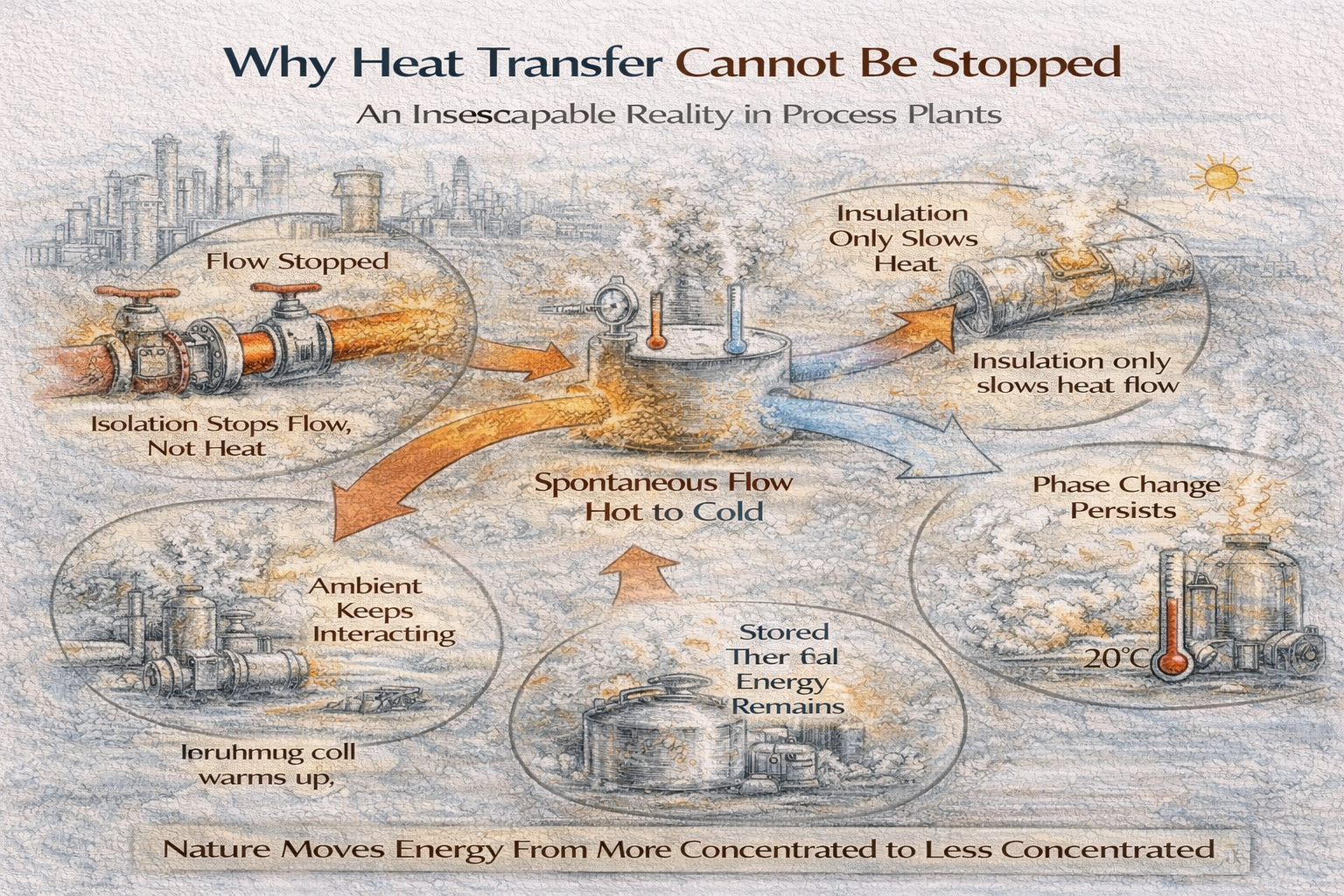
Isolation Stops Flow, Not Heat
The first misconception to clear is this:
Stopping fluid flow does not stop heat transfer.
Valves, blinds, and pumps control mass movement.
Heat transfer occurs through energy movement, which follows different paths.
Heat continues to move through:
- metal walls,
- pipe connections,
- structural supports,
- foundations,
- surrounding air.
As long as a temperature difference exists and a path remains, heat will flow.
Temperature Difference Is Enough
Heat transfer requires no permission.
If:
- one region is hotter,
- another is colder,
energy will move between them.
This applies whether the plant is:
- operating,
- idling,
- partially shut down,
- fully isolated from process flow.
Isolation removes one path.
Many others remain.
Conduction Makes Complete Isolation Impossible
Conduction is the primary reason heat transfer cannot be stopped.
Metal connects:
- vessels to nozzles,
- pipes to equipment,
- equipment to structures.
Even when fluids are stationary, heat moves through these solid paths.
This explains why:
- hot equipment cools during shutdown,
- cold systems warm even when isolated,
- temperature equalizes across connected units.
Removing conduction would require removing physical connection — which is neither practical nor desirable in plants.
Insulation Slows Heat Transfer, It Does Not Eliminate It
Insulation is often misunderstood as a barrier.
It is not.
Insulation:
- increases resistance,
- reduces heat transfer rate,
- delays temperature change.
It does not stop heat flow.
Given enough time, insulated systems will still:
- cool down,
- heat up,
- approach ambient conditions.
This is why:
- insulation thickness affects energy loss,
- damaged insulation increases operating cost,
- even well-insulated systems require energy input to maintain temperature.
Ambient Interaction Is Always Present
Plants exist in an environment.
Ambient air, sunlight, wind, and weather continuously interact with equipment.
Heat transfer occurs through:
- convection with air,
- radiation to surroundings,
- conduction through supports.
This explains why:
- seasonal changes affect performance,
- outdoor equipment behaves differently from indoor equipment,
- night and day conditions influence temperatures.
No practical plant can be thermally isolated from its environment.
Stored Thermal Energy Continues to Redistribute
Large equipment stores significant thermal energy.
During shutdown:
- hot equipment releases stored energy,
- cold equipment absorbs energy from surroundings.
This redistribution continues until equilibrium is reached.
This explains:
- long cooldown periods,
- warm surfaces long after shutdown,
- delayed temperature stabilization during startups.
Stopping heat transfer would require removing stored energy instantly, which is physically impossible.
Phase Change Ensures Heat Transfer Persists
In many systems, phase change sustains heat transfer.
Examples:
- condensation in shutdown lines,
- boiling in partially isolated vessels,
- vapor formation during depressurization.
Phase change locks temperature and enables energy transfer even when bulk conditions appear stable.
This is why:
- isolated systems still show temperature movement,
- pressure changes trigger unexpected heating or cooling,
- residual fluids influence thermal behavior.
Why Heat Transfer Continues During Shutdowns
Shutdowns often reveal thermal behavior most clearly.
Common observations:
- lines heating up unexpectedly,
- condensation forming in cold systems,
- slow cooldown despite isolation,
- thermal stresses developing.
These are not anomalies.
They occur because:
- temperature gradients remain,
- conduction paths remain,
- ambient interaction continues.
Shutdown procedures that ignore thermal reality often create safety and reliability risks.
Why Heat Transfer Cannot Be Stopped Even With Time
Given enough time, all connected systems move toward thermal equilibrium.
This is unavoidable.
The only way to stop heat transfer completely would be to:
- remove temperature differences,
- remove all physical connections,
- remove environmental interaction.
In real plants, none of these conditions can be fully achieved.
Therefore, heat transfer never truly stops — it only slows.
Why Control Systems Cannot Override This Reality
Control systems:
- regulate process variables,
- respond to deviations,
- manage flow and pressure.
They cannot:
- stop conduction,
- prevent radiation,
- isolate ambient effects.
This explains why:
- temperature drifts occur during long holds,
- controllers reach limits during shutdown,
- manual intervention becomes frequent.
Thermal reality sets boundaries that control logic cannot cross.
Operational Risks of Ignoring This Principle
When plants assume heat transfer can be stopped, risks increase:
- thermal shock during startup,
- condensation-related corrosion,
- unexpected vapor generation,
- insulation damage,
- personnel safety hazards.
Recognizing unavoidable heat transfer allows:
- better shutdown planning,
- controlled warm-up and cooldown,
- realistic isolation procedures.
Owner Perspective: Why This Matters Economically
From an ownership standpoint, unavoidable heat transfer leads to:
- continuous energy loss,
- heating and cooling costs even during downtime,
- maintenance driven by thermal stress,
- reduced equipment life.
Plants that manage heat transfer realistically:
- reduce unnecessary energy use,
- avoid thermal damage,
- improve reliability.
The goal is not to stop heat transfer, but to manage its consequences.
Final Perspective
Heat transfer is not an operational choice.
It is a physical certainty.
Plants can:
- slow it,
- guide it,
- manage it.
They cannot stop it.
Accepting this reality improves:
- design judgment,
- operational planning,
- safety awareness,
- long-term performance.
This understanding does not complicate engineering.
It simplifies it — by aligning expectations with reality.
And that alignment is what separates predictable plants from problematic ones.
Once we accept that heat transfer continues even under isolation, shutdown,
or standby conditions, a deeper confusion often appears in plant thinking.
Many engineers and operators assume that a system at steady operation is the
same as being in equilibrium — but these are not the same thing.
The upcoming article, Equilibrium vs Steady State – Common Plant
Misunderstanding, explains the difference in practical terms, why
heat can still flow in steady operation, and how confusing these concepts
leads to incorrect expectations during startup, shutdown, and troubleshooting.

A practicing chemical engineer with 17+ years of experience in process design, project execution, commissioning, and plant operations. Focused on practical engineering judgment beyond textbook explanations.