
In process engineering, most calculations aim to reduce physical behavior into manageable equations. Conduction and convection, while complex, can often be approximated with reasonable accuracy using standard correlations.
Radiation is different.
Even when its importance is recognized, radiation remains notoriously difficult to calculate with confidence. Small assumptions can lead to large errors, and real plant behavior often deviates from predictions.
This article explains why radiation is hard to calculate in process plants, where the uncertainty comes from, and why experienced engineers treat radiation calculations with caution.
Table of Contents
Radiation Depends Strongly on Temperature
One of the main reasons radiation is hard to calculate is its extreme sensitivity to temperature.
Radiant heat transfer increases very rapidly as surface temperature rises. A small error in temperature estimation can cause a disproportionately large error in calculated heat flux.
In practice:
- measured temperatures may not represent true surface temperature,
- transient conditions distort readings,
- hot spots are difficult to detect.
As a result, even accurate-looking inputs can produce misleading results.
Surface Emissivity Is Rarely Known Precisely
Radiation depends heavily on emissivity, a surface property that describes how effectively a surface emits radiant energy.
In real plants:
- emissivity changes with oxidation,
- fouling alters surface behavior,
- coatings degrade over time,
- surface roughness varies.
Design calculations often assume constant emissivity values.
Operating reality rarely matches these assumptions.
Two identical-looking surfaces can radiate very differently depending on age and condition.
Geometry Complicates Radiation Behavior
Radiation is highly dependent on geometry.
Heat exchange occurs only between surfaces that “see” each other. This introduces view factors, which describe how much radiant energy reaches a target surface.
In complex equipment:
- surfaces are curved,
- obstructions exist,
- relative positions change with expansion,
- line-of-sight is partially blocked.
Accurately accounting for these effects requires detailed geometric modeling, which is rarely feasible during early design.
Multiple Radiating Surfaces Interact
In real systems, radiation rarely occurs between just two surfaces.
Instead:
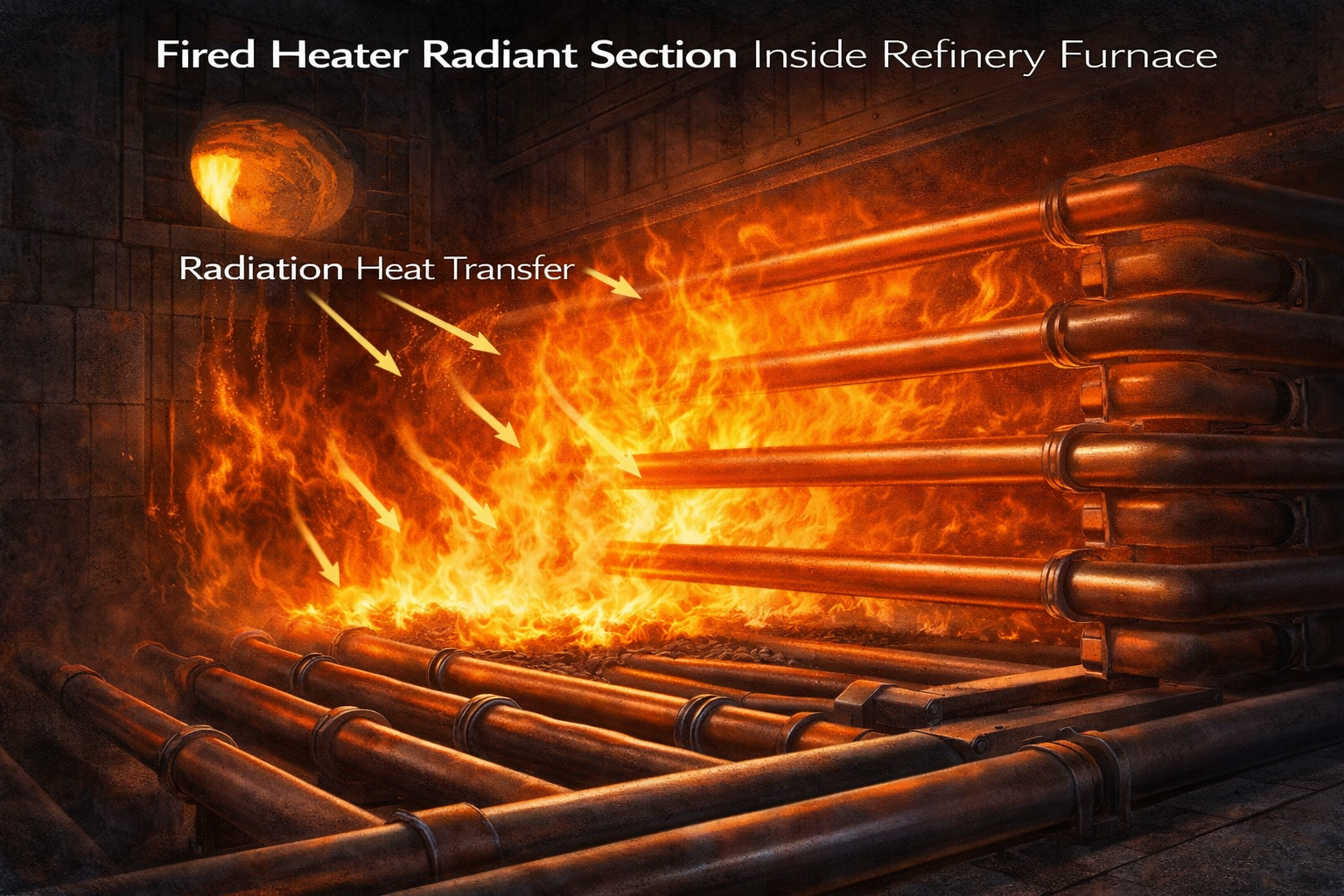
- flames radiate to walls,
- walls radiate to tubes,
- tubes radiate to each other,
- hot gases radiate throughout the enclosure.
Each surface both emits and absorbs radiation simultaneously.
This network of interactions makes radiation calculations nonlinear and interdependent.
Simplifying this network often hides important effects.
Radiation Occurs Through Gas Media
Radiation in furnaces and high-temperature equipment is not limited to surfaces.
Hot gases themselves emit and absorb radiation.
Gas radiation depends on:
- composition,
- pressure,
- temperature,
- path length.
These properties vary throughout the equipment and change with operating conditions.
Accurately modeling gas radiation requires advanced methods and detailed data, which are often unavailable.
Transient Conditions Break Steady Assumptions
Most radiation calculations assume steady-state conditions.
In real plants:
- startups,
- shutdowns,
- firing changes,
- process upsets,
all introduce rapid temperature changes.
Radiation responds instantly to these changes, while conduction and convection lag.
This mismatch makes transient radiation behavior extremely difficult to predict accurately using steady-state models.
Surface Temperature Is Hard to Measure
Radiation calculations depend on true surface temperature, not bulk fluid temperature.
Measuring surface temperature accurately is challenging because:
- sensors disturb the surface,
- insulation hides surfaces,
- radiant heating affects readings,
- hot spots are localized.
Errors in surface temperature propagate directly into radiation calculations.
Fouling and Degradation Change Radiation Over Time
Radiation characteristics evolve.
Over time:
- surfaces oxidize,
- deposits build up,
- refractory ages,
- coatings deteriorate.
These changes alter emissivity and surface temperature distribution.
As a result, a radiation calculation that was valid at commissioning may be inaccurate months or years later.
Simplified Models Hide Important Effects
To make radiation calculations manageable, engineers use simplified models.
These models:
- average temperatures,
- assume uniform emissivity,
- ignore minor surfaces,
- neglect partial shielding.
While useful for design, these simplifications limit accuracy.
When plants operate near thermal limits, these “minor” effects become important.
Why Experience Often Trumps Calculation
Because of these uncertainties, experienced engineers rely on:
- conservative design margins,
- empirical limits,
- operational feedback,
- inspection data.
Radiation calculations guide design, but experience validates it.
This is why:
- firing rates are limited conservatively,
- tube metal temperatures are monitored closely,
- design codes embed safety margins.
Role of Modern Simulation Tools
Advanced computational tools can model radiation more accurately.
However:
- they require detailed input data,
- results depend heavily on assumptions,
- validation remains difficult.
Simulation improves understanding, but it does not eliminate uncertainty.
Owner Perspective: Why Radiation Uncertainty Matters
From an ownership viewpoint, radiation uncertainty affects:
- safety margins,
- equipment life,
- maintenance planning,
- risk management.
Overconfidence in radiation calculations can lead to:
- premature failure,
- unplanned shutdowns,
- safety incidents.
Balanced judgment reduces these risks.
Final Perspective
Radiation is powerful, immediate, and unforgiving.
Its behavior depends on temperature, surface condition, geometry, and transient effects — all of which are difficult to know precisely.
This does not make radiation unmanageable.
It makes it deserving of respect.
Engineers who recognize the limits of radiation calculation:
- design conservatively,
- monitor carefully,
- respond early.
Those who treat radiation like conduction or convection often learn its importance the hard way.
Understanding why radiation is hard to calculate is as important as understanding radiation itself.
And that understanding completes the foundation of practical heat transfer in process plants.
Radiation is difficult to calculate because it depends heavily on geometry,
surface behavior, and assumptions that rarely hold perfectly in real
equipment.
The next step in this radiation series is to address a question every fired
heater engineer eventually faces: when both radiation and convection are
present, which one truly dominates heat transfer in practice?
The upcoming article, Radiation vs Convection in Fired Heaters – Who
Really Dominates, will explain how the balance shifts inside heater
boxes, why convection is not always secondary, and where engineers often
misjudge the controlling mechanism.
Until that article is published, you can continue with the next main article
in this heat transfer series:
How Heat Transfer Is Quantified in Process Plants
This article introduces the practical engineering quantities — duty,
driving force, U values, and real performance metrics — that connect heat
transfer theory to design and operating decisions.

A practicing chemical engineer with 17+ years of experience in process design, project execution, commissioning, and plant operations. Focused on practical engineering judgment beyond textbook explanations.