
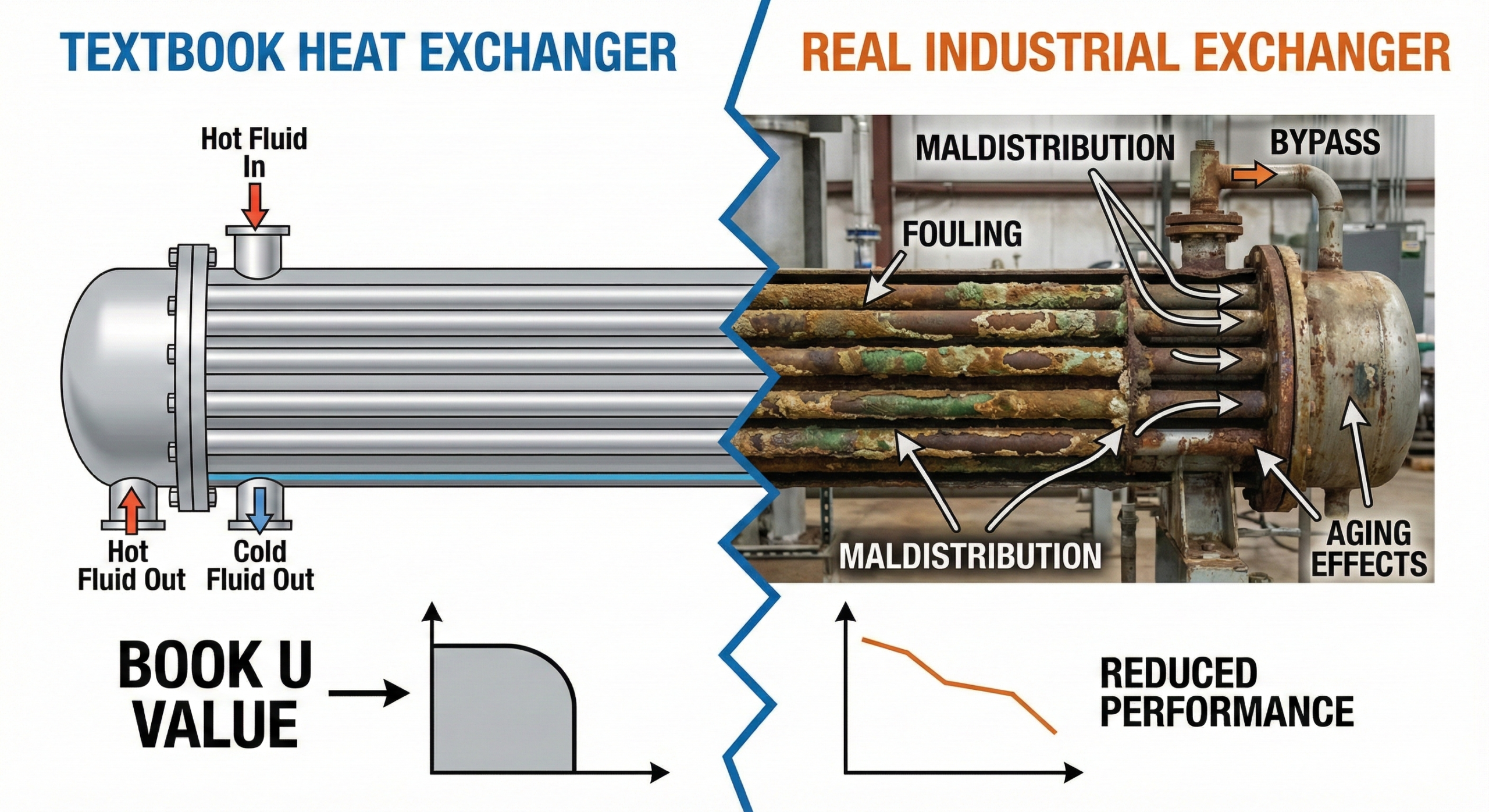
Textbooks, handbooks, and design manuals are full of neat tables listing typical U values for different services. These tables are widely used during preliminary design and quick checks.
Yet in operating plants, one common observation repeats again and again:
“The exchanger was designed with a reasonable book U value — but it never performed as expected.”
This is not because books are wrong.
It is because book U values describe idealized situations that rarely exist in real plants.
This article explains why U values taken from books often fail when applied directly to plant equipment, and why relying on them without judgment leads to fragile designs and repeated surprises.
Table of Contents
Book U Values Are Averages of Idealized Conditions
Published U values are typically based on:
- clean surfaces,
- steady operation,
- uniform flow distribution,
- well-defined fluid properties,
- laboratory or pilot-scale data.
They represent averages, not guarantees.
Real plants rarely operate under these ideal conditions for long — if ever.
As soon as conditions deviate, the actual U begins to diverge from the book value.
Books Assume Clean Heat Transfer Surfaces
Most book U values implicitly assume clean heat transfer surfaces.
In real plants:
- fouling begins almost immediately after startup,
- deposits grow unevenly,
- cleaning is periodic, not continuous.
Because fouling resistance adds directly to total resistance:
- even thin fouling layers reduce U significantly,
- book values become optimistic within months,
- long-term performance falls well below design assumptions.
Designs that depend on sustained clean U values are inherently fragile.
Flow Distribution in Books vs Flow Distribution in Plants
Book values assume uniform flow across all heat transfer surfaces.
Real exchangers experience:
- maldistribution,
- bypassing,
- dead zones,
- uneven velocity profiles.
As a result:
- some areas contribute little to heat transfer,
- some areas foul faster,
- average U looks acceptable while capacity is limited.
Book U values do not account for this loss of effective area.
Books Hide Sensitivity to Operating Range
Book values are usually quoted at:
- a specific temperature range,
- a specific viscosity,
- a representative flow regime.
In plants:
- throughput varies,
- temperature changes with season and load,
- viscosity may change dramatically.
U is highly sensitive to these changes.
A U value that looks reasonable at design load may collapse at turndown — something book tables rarely warn about.
Books Do Not Capture Fouling Behavior
Fouling is service-specific, time-dependent, and often unpredictable.
Books may include:
- generic fouling factors,
- conservative allowances.
But they cannot capture:
- local fouling hotspots,
- fouling acceleration with temperature,
- chemistry-driven deposition,
- interaction between fouling and flow regime.
As a result:
- real fouling resistance often exceeds assumed values,
- effective U drops faster than expected,
- designs lose margin early in life.
Book Values Mask Geometry Effects
U values in books are usually associated with:
- ideal exchanger geometries,
- well-designed baffles,
- optimal spacing.
In practice:
- geometry is compromised by mechanical constraints,
- pass arrangements reduce effectiveness,
- correction factor losses appear.
Book values rarely reflect these geometric penalties.
The same service in two different exchangers can have very different U values — even with identical fluids.
Books Cannot Represent Aging Equipment
Book values describe new equipment behavior.
Plants deal with:
- corrosion,
- erosion,
- surface roughening,
- deformation over time.
These effects alter:
- surface condition,
- flow distribution,
- fouling tendency.
As equipment ages, U drifts away from book expectations.
Designs that assume book U values over the full life of equipment underestimate degradation.
Book Values Encourage Overconfidence in Design
Perhaps the most dangerous effect of book U values is psychological.
They:
- feel authoritative,
- look precise,
- encourage single-number thinking.
This often leads to:
- minimal area margins,
- optimistic exchanger sizing,
- underestimation of long-term degradation.
When reality intrudes, plants respond reactively rather than proactively.
Why “Matching the Book U” Does Not Mean Good Design
Many design reviews focus on whether the calculated U matches the book value.
This is the wrong question.
A better question is:
“How sensitive is this design to U degradation?”
An exchanger that performs acceptably even when U falls well below book value is robust.
An exchanger that fails as soon as U drifts slightly is not.
Books do not evaluate robustness — plants do.
Why Book Values Still Exist (and Still Matter)
Book U values are not useless.
They are:
- screening tools,
- order-of-magnitude references,
- starting points for thinking.
Used this way, they are valuable.
Problems arise when they are treated as:
- design guarantees,
- performance targets,
- operating expectations.
Books guide engineering judgment.
They cannot replace it.
What Experienced Engineers Do Differently
Experienced engineers use book U values to:
- estimate feasibility,
- compare concepts,
- identify gross mismatches.
Then they:
- apply conservative margins,
- favor extra area over optimistic U,
- design for dirty operation,
- accept that U will degrade.
They design for how plants behave, not how books describe them.
Owner Perspective: Why Book-Based Designs Cost More Over Time
From an ownership standpoint, reliance on book U values leads to:
- exchangers that underperform early,
- frequent cleaning,
- aggressive operation to chase duty,
- premature revamps.
Designs that expect U degradation:
- maintain capacity longer,
- operate with lower stress,
- cost less over the life of the plant.
The difference is not initial capital.
It is long-term reliability.
Final Perspective
Book U values are not wrong.
They describe clean, idealized behavior under controlled conditions. Plants operate with fouling, variability, aging, and compromise.
Engineers who understand this difference:
- design with margin,
- avoid fragile equipment,
- spend less time fighting reality.
Those who expect plants to behave like books often learn otherwise — repeatedly.
Understanding why U values from books fail in plants is not cynicism.
It is practical engineering realism.
And it is essential for anyone designing or operating real heat transfer equipment.
Explore the complete series in the Heat Transfer Engineering Hub.

A practicing chemical engineer with 17+ years of experience in process design, project execution, commissioning, and plant operations. Focused on practical engineering judgment beyond textbook explanations.