One of the most frustrating situations in a process plant is this:
The heat exchanger was designed correctly.
The calculations were reviewed.
The equipment met duty at startup.
And yet — it failed in operation.
This case study examines a real and very common scenario where a heat exchanger was technically “right” by design standards, but still became a persistent plant problem.
The objective is not to assign blame, but to extract practical lessons that apply across industries.
Table of Contents
The Design at a Glance
The exchanger in question was:
- a shell-and-tube exchanger,
- designed for liquid–liquid heat transfer,
- sized using standard industry practices,
- reviewed by an experienced design team.
Key design features:
- clean and fouled U values per standards,
- conservative fouling factors,
- acceptable pressure drops,
- correction factor within allowable limits,
- utility sized for design conditions.
On paper, the design was solid.
Startup Performance: Everything Looked Perfect
At commissioning:
- outlet temperatures met targets,
- control was stable,
- utilities operated within limits,
- no alarms or constraints appeared.
For several weeks, the exchanger performed exactly as expected.
This early success reinforced confidence that the design was correct.
The First Signs of Trouble
After a few months:
- utility consumption increased slightly,
- control valves operated at higher openings,
- temperature response became slower.
None of these were alarming.
The exchanger still met duty.
These early signs were interpreted as:
- normal variation,
- seasonal effects,
- minor feed changes.
No action was taken.
Gradual Degradation Becomes Noticeable
Over the next operating cycle:
- approach temperatures tightened,
- energy usage rose steadily,
- operators required frequent manual intervention.
Eventually:
- duty could not be maintained at peak load,
- throughput had to be reduced during summer,
- cleaning frequency increased.
The exchanger was now considered “undersized.”
Post-Failure Review: What the Design Did Not Capture
A detailed review revealed several issues that were not design errors, but design blind spots.
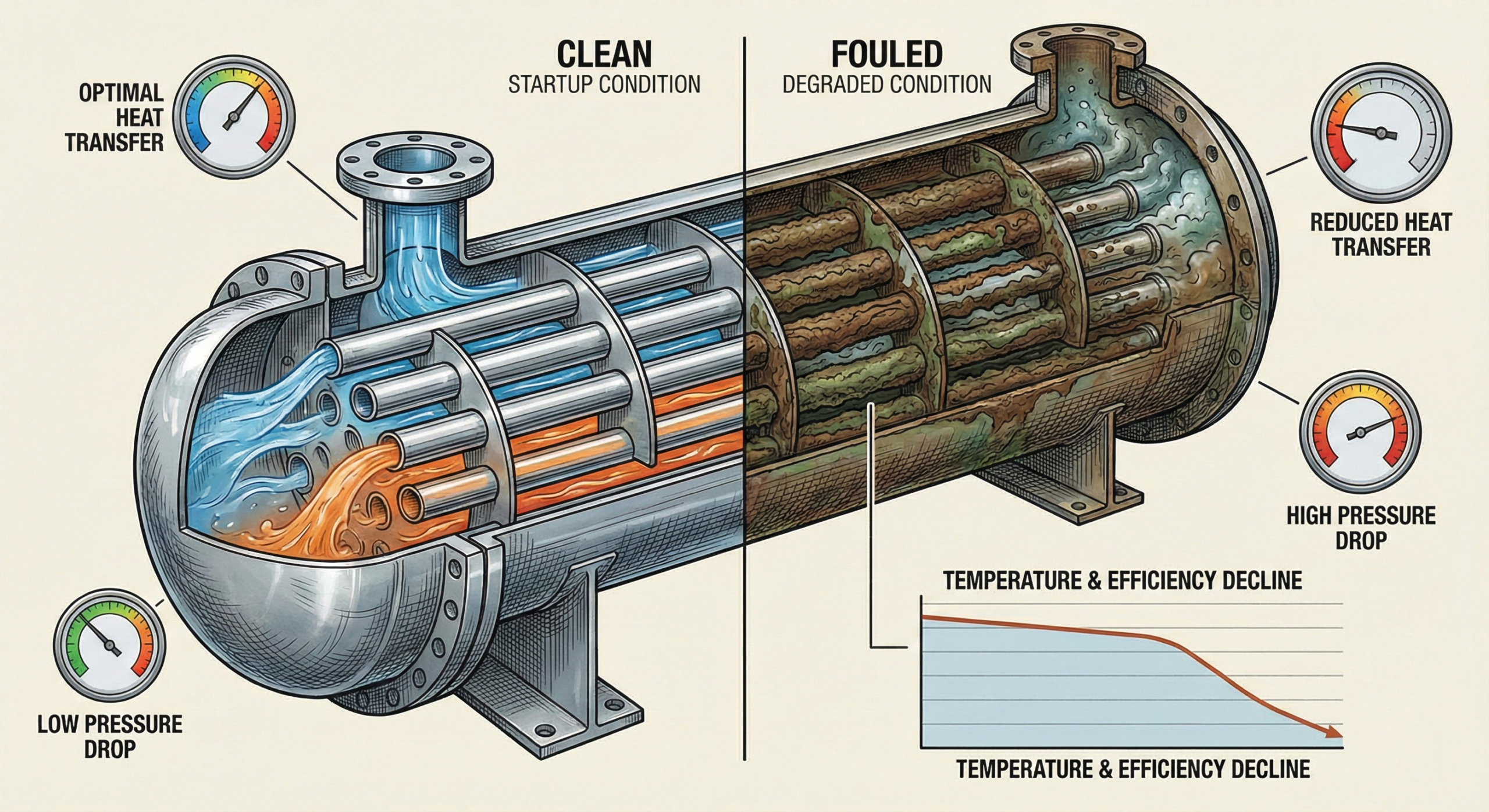
1. Fouling Was Non-Uniform
Design assumed uniform fouling resistance.
In reality:
- fouling concentrated near the hot end,
- low-velocity zones accumulated deposits faster,
- effective heat transfer area shrank unevenly.
Average fouling factors masked localized failure.
2. Startup Conditions Accelerated Early Fouling
The exchanger experienced:
- frequent startups,
- rapid heating during commissioning,
- low-flow warm-up periods.
These conditions:
- promoted deposit nucleation,
- baked fouling onto surfaces,
- altered surface roughness early.
Design assumed steady-state fouling rates.
3. Utility Temperature Was Optimistic
Cooling utility design temperature was based on:
- historical averages,
- nominal summer conditions.
Actual operation experienced:
- higher peak temperatures,
- reduced driving force during critical periods.
This eroded margin exactly when it was most needed.
4. Correction Factor Sensitivity Was Underestimated
Although the correction factor met guidelines:
- it was close to the lower acceptable limit,
- fouling reduced its effectiveness faster than expected.
As fouling grew:
- effective LMTD collapsed rapidly,
- duty loss accelerated nonlinearly.
5. Control Masked the Problem Too Well
For a long time:
- control systems compensated successfully,
- operators increased utilities gradually.
This delayed recognition.
By the time limits were reached:
- fouling margin was exhausted,
- recovery options were limited.
Why Cleaning Did Not Solve the Problem Permanently
Cleaning restored performance temporarily.
But:
- recovery was incomplete,
- performance degraded faster after each cycle.
Surface damage from repeated cleaning:
- increased roughness,
- accelerated re-fouling,
- shortened intervals.
The exchanger entered a cycle of:
clean → recover partially → foul faster → clean again
The Fix: Not Just More Area
The eventual solution was not simply a larger exchanger.
It involved:
- redistributing flow to reduce dead zones,
- adjusting startup procedures,
- adding modest additional area,
- revising cleaning strategy,
- accepting slightly higher capital cost for long-term stability.
Only after addressing system behavior did performance stabilize.
Key Lessons from This Failure
Lesson 1: “Correct” Design Is Not the Same as “Robust” Design
Meeting standards does not guarantee tolerance to reality.
Lesson 2: Early Operating History Shapes Long-Term Performance
Startup behavior matters more than most calculations assume.
Lesson 3: Fouling Is Local and Nonlinear
Average values hide critical local failures.
Lesson 4: Control Systems Delay, Not Prevent, Failure
Successful control masks degradation until margins disappear.
Lesson 5: Fixes Must Address Behavior, Not Just Capacity
Adding area without correcting root causes only delays failure.
Why This Case Is Not Unique
This case is repeated across:
- refineries,
- chemical plants,
- pharmaceutical facilities,
- utilities.
The details change.
The pattern does not.
Heat exchangers often fail not because they were poorly designed — but because they were designed for a world that does not persist.
Owner Perspective: The Cost of “Designed Right”
From an ownership standpoint, this failure resulted in:
- lost throughput during peak seasons,
- repeated cleaning outages,
- higher energy costs,
- eventual revamp expenditure.
All from equipment that was “designed right.”
The real issue was not design competence — it was design philosophy.
Final Perspective
This exchanger did not fail because someone made a mistake.
It failed because:
- assumptions aged faster than expected,
- margins were thinner than reality demanded,
- degradation pathways were underestimated.
The most dangerous heat exchangers are not the badly designed ones.
They are the ones that look perfect on paper — and quietly struggle in real operation.
Understanding this distinction is essential for anyone who wants to design, review, or operate heat transfer equipment that works beyond startup and beyond assumptions.
Explore the complete series in the Heat Transfer Engineering Hub.

A practicing chemical engineer with 17+ years of experience in process design, project execution, commissioning, and plant operations. Focused on practical engineering judgment beyond textbook explanations.