
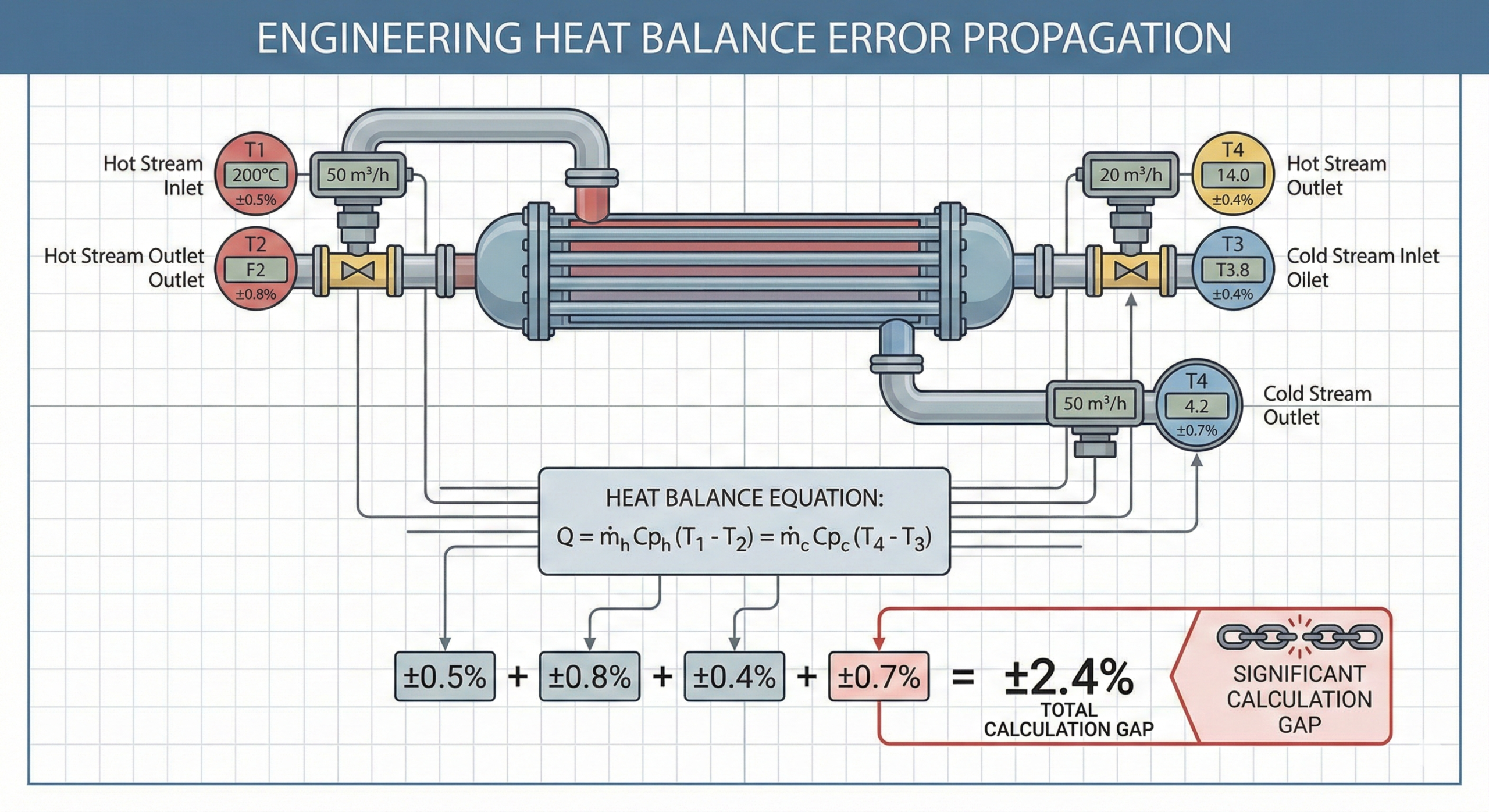
In process plants, heat balance calculations depend completely on what instruments report.
We trust numbers from:
- temperature sensors
- flow meters
- pressure transmitters
- level indicators
These numbers are used to calculate:
- heat duty
- energy efficiency
- exchanger performance
- system losses
On paper, the logic is simple:
If the instruments are accurate, the heat balance should be accurate.
But in real plants, even when instruments are within acceptable accuracy limits, heat balance calculations can still show large mismatches.
This confuses many engineers.
The reason is simple but often overlooked:
Heat balance accuracy is much more sensitive than instrument accuracy. This sensitivity becomes even more important when heat duty and temperature differences are already small.
This article explains why small instrument errors can create large differences in energy calculations, and why heat balance rarely closes perfectly even in well-maintained plants.
Table of Contents
Heat Balance Depends on Multiple Measurements at Once
A typical heat duty calculation requires:
- flow rate
- inlet temperature
- outlet temperature
- fluid properties
Each of these comes from a different instrument.
If each reading has a small uncertainty, those uncertainties combine.
And when combined, they can produce a noticeable difference in the final heat balance.
Temperature Errors Have a Bigger Impact Than Expected
Temperature difference is a key part of heat duty.
Even a small error in temperature can cause a large change in calculated duty.
For example:
- if inlet and outlet temperatures are close
- a small sensor error changes the temperature difference significantly
This changes the calculated heat transfer value more than expected.
So even when temperature sensors are working properly, heat balance may not match exactly. This is especially true when real temperature profiles inside the equipment are highly uneven.
Flow Measurement Uncertainty Multiplies the Effect
Flow meters also have tolerance limits.
Even a small percentage error in flow measurement can affect duty calculation.
Because:
- heat duty depends directly on flow rate
- any error in flow multiplies the effect of temperature error
So when both flow and temperature have small uncertainties, the final difference becomes larger.
Instruments Are Accurate Within a Range, Not Exact
Every instrument has a rated accuracy.
For example:
- a temperature sensor may be accurate within a small range
- a flow meter may be within a few percent
This does not mean the reading is exact.
It means the real value lies somewhere within a band.
When several instruments are used together:
- each may be slightly high or slightly low
- the combined result may show a larger difference
This is normal.
Heat Balance Magnifies Small Differences
Heat duty calculations involve multiplication:
- flow × temperature change × heat capacity
So a small measurement difference gets multiplied.
For example:
- slight temperature error
- combined with slight flow error
- multiplied by fluid property
This can create a noticeable gap between expected and calculated duty.
Even though each instrument is functioning correctly. The resulting mismatch often appears as disagreement between calculated and measured heat duty.
Sensor Placement Affects Accuracy
Instruments measure at specific locations.
But conditions may vary across the pipe.
For example:
- temperature may not be uniform
- mixing may not be complete
- stratification may exist
So the sensor reading may not represent the true average value.
This creates another source of difference in heat balance calculations.
Time Synchronization Matters
Heat balance calculations assume all readings represent the same moment.
In real operation:
- flows fluctuate
- temperatures change gradually
- instruments update at different intervals
If readings are not taken at exactly the same time:
- data may represent slightly different conditions
This leads to mismatch in calculated energy transfer. Transient operating conditions make this mismatch even harder to interpret correctly.
Phase Change Makes Accuracy Even More Sensitive
In systems involving:
- condensation
- boiling
- evaporation
temperature may remain almost constant.
So small measurement errors can create large uncertainty in energy estimation.
Because most of the energy is in latent heat, not temperature change.
This makes heat balance more sensitive to instrument accuracy.
Calibration Drift Over Time
Even good instruments change slowly over time.
They may:
- drift slightly
- lose calibration accuracy
- respond differently to temperature or pressure
These small changes are often within acceptable limits.
But when used in energy calculations, they can produce noticeable differences.
Why Perfect Heat Balance Is Rare
In theory, heat lost by one stream should equal heat gained by another.
In practice, differences appear due to:
- instrument tolerances
- heat losses to surroundings
- property estimation errors
- measurement timing
So perfect agreement is not expected.
A small gap is normal in real plants.
Operators See Stability, Engineers See Numbers
Operators focus on:
- stable temperatures
- consistent performance
- reliable control
Engineers often focus on:
- calculated duty
- balance closure
- efficiency numbers
If performance is stable but numbers do not match exactly, the issue may be measurement sensitivity, not process failure.
Understanding this helps avoid unnecessary adjustments.
Owner Perspective: Practical Accuracy Is What Matters
From a plant management view, the goal is not perfect calculation.
The goal is:
- stable operation
- predictable performance
- reasonable efficiency
Heat balance is a useful tool for:
- spotting large deviations
- tracking trends
- identifying performance decline
But small mismatches are expected.
How Experienced Engineers Use Heat Balance
With experience, engineers learn to:
- accept small differences
- focus on trends instead of exact numbers
- check whether gaps are growing or stable
If the difference remains consistent:
- it may be measurement-related
If it grows over time:
- it may indicate fouling, losses, or performance change.
A Simple Way to Understand the Effect
Imagine measuring water flow using several cups and containers.
Each container has a small size difference.
Individually, the error is small.
But after several steps, the total difference becomes noticeable.
Heat balance works the same way.
Each measurement has a small uncertainty.
Together, they create a visible difference.
Final Perspective
Heat balance calculations are essential tools in process plants.
But they are only as accurate as the measurements behind them.
And every measurement has limits.
Small instrument uncertainties:
- combine
- multiply
- and appear as gaps in calculated duty
This does not mean the process is failing.
It means real-world measurement is not perfectly precise.
Understanding the relationship between instrument accuracy and heat balance accuracy helps avoid unnecessary confusion and allows engineers to use thermal calculations with better judgment.
Explore the complete series in the Heat Transfer Engineering Hub.

A practicing chemical engineer with 17+ years of experience in process design, project execution, commissioning, and plant operations. Focused on practical engineering judgment beyond textbook explanations.