
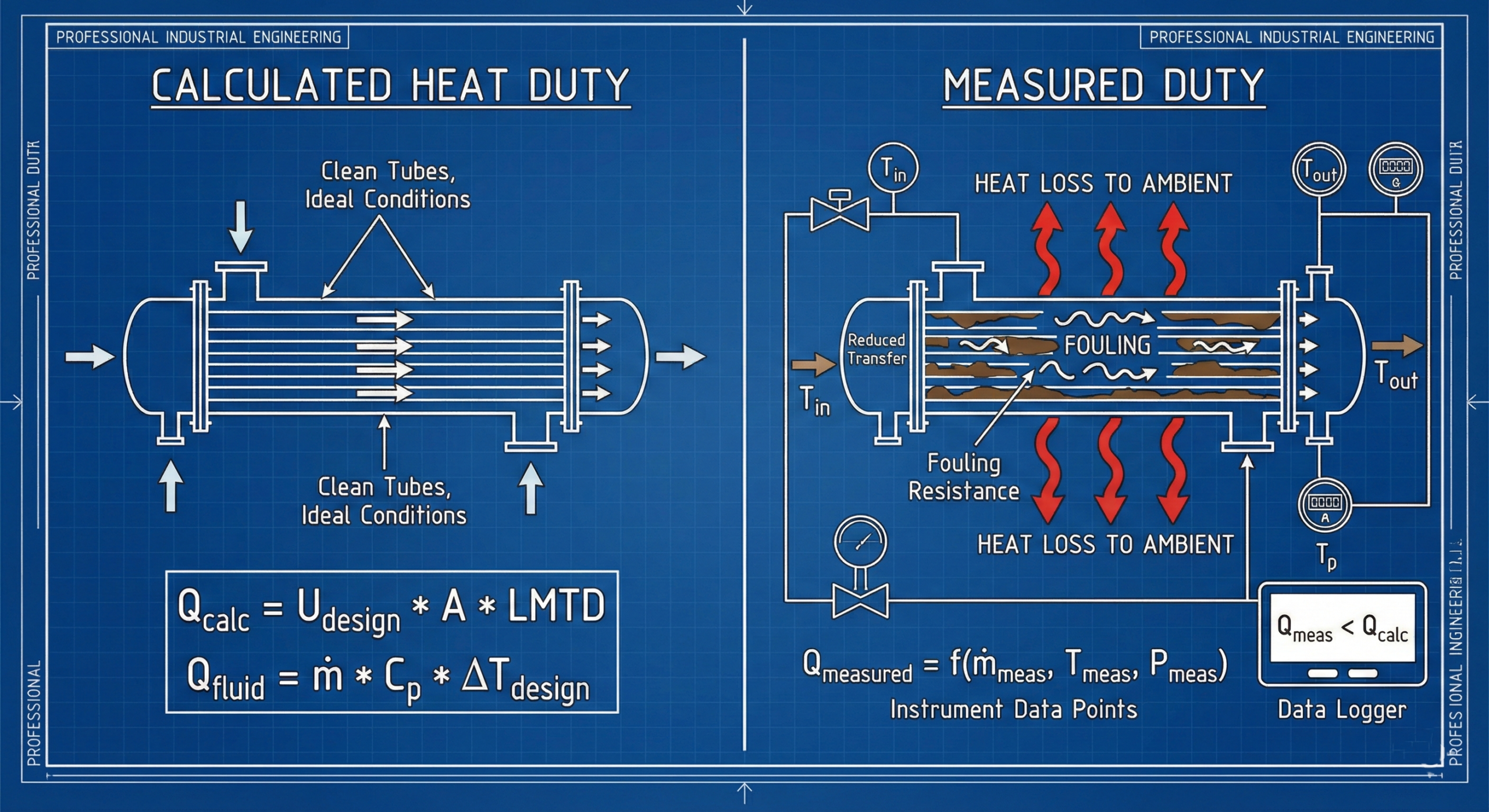
In process plants, heat duty is calculated regularly.
Engineers calculate it during:
- design
- commissioning
- troubleshooting
- performance review
The calculation itself looks simple:
- measure flow
- measure inlet and outlet temperatures
- use heat capacity
- compute heat transferred
On paper, this gives a clear number.
But in real plants, something puzzling happens.
The calculated heat duty often does not match the measured or expected performance.
Sometimes the difference is small.
Sometimes it is large enough to create confusion and debate.
This is not unusual.
It happens in almost every operating plant.
This article explains why calculated heat duty and real performance rarely align perfectly, and why the difference is a normal part of working with real processes.
Table of Contents
Heat Duty Calculation Looks Straightforward
In its simplest form, heat duty is based on:
- flow rate
- temperature change
- fluid properties
If a stream enters at one temperature and leaves at another, the energy gained or lost can be estimated.
This makes it seem like a precise number.
But that calculation assumes:
- measurements are accurate
- properties are constant
- heat transfer is uniform
- no external losses occur
In real plants, none of these are perfectly true.
Measurement Errors Add Up Quickly
Heat duty depends heavily on temperature and flow measurements.
Even small errors can cause noticeable differences.
For example:
- temperature sensors may be slightly off
- flow meters may have calibration drift
- readings may fluctuate
A difference of just a few degrees or small flow variation can change the calculated duty significantly.
So the mismatch often starts with measurement uncertainty.
Temperature Readings May Not Represent the Whole Stream
Temperature is usually measured at a single point.
But inside pipes and exchangers:
- temperature may not be uniform
- mixing may not be complete
- stratification may exist
So the sensor may not capture the true average temperature of the fluid.
This leads to differences between calculated and actual heat transfer. Real temperature profiles inside equipment are usually far more complex than single-point measurements suggest.
Fluid Properties Are Not Always Exact
Heat duty calculations assume known properties like:
- heat capacity
- density
- viscosity
But in real services:
- composition may vary
- temperature changes affect properties
- impurities may be present
So the assumed values may not match actual conditions.
This creates small errors that show up in duty calculation.
Heat Loss to Surroundings Is Often Ignored
In theory, all heat lost by one stream should be gained by another.
In reality:
- some heat escapes to the environment
- insulation is not perfect
- long pipelines lose energy
This means:
- calculated duty based on process streams may not balance exactly.
The missing energy is not lost in calculation — it is lost physically.
Fouling Changes Performance Over Time
Heat exchangers do not stay clean.
As fouling builds:
- resistance increases
- heat transfer reduces
- outlet temperatures shift
If calculations assume clean performance, measured duty may appear lower.
But the exchanger is simply operating under real, fouled conditions. Under these conditions, original heat duty assumptions may no longer represent actual capability.
Flow Distribution Is Rarely Perfect
In many exchangers:
- some paths carry more flow
- some areas receive less
This creates uneven heat transfer.
Even if total flow is correct, actual heat exchange inside the equipment may differ from ideal assumptions.
So calculated duty based on total flow may not reflect local variations.
Steady State Is Assumed, but Plants Fluctuate
Heat duty calculations work best under steady conditions.
But in real plants:
- loads change
- feed composition varies
- utilities fluctuate
- control systems adjust continuously
So the system may not be perfectly stable at the moment of measurement.
This makes real values differ from calculated ones. Average temperature difference methods also become less reliable during these fluctuations.
Instrument Location Can Affect Results
Where measurements are taken matters.
If temperature sensors are placed:
- too close to mixing points
- too far from exchangers
- in areas with poor flow
readings may not represent actual process conditions.
So two calculations using different measurement points may give different results.
Phase Change Makes Calculation More Complex
In services involving condensation or boiling:
- latent heat is involved
- temperature may stay nearly constant
- small measurement errors create large duty differences
If vapor fraction or phase distribution is not known exactly, calculated duty may not match actual performance.
Startup and Transient Conditions Add Confusion
During startup or changing load:
- metal surfaces absorb heat
- system temperatures shift gradually
- energy goes into warming equipment
This energy may not be captured in process stream calculations.
So measured duty may appear lower or higher than expected during transitions.
Pressure Effects Can Change Actual Heat Transfer
Changes in pressure can influence:
- boiling temperature
- condensation behavior
- fluid properties noticed at measurement points
If pressure conditions differ slightly from assumptions, duty calculation can shift.
Why Two Different Calculations May Not Match
In some cases, heat duty is calculated on both sides of an exchanger:
- hot side energy loss
- cold side energy gain
Ideally, they should match.
In reality, they often differ slightly.
This difference can come from:
- measurement errors
- property assumptions
- heat loss
- instrument accuracy
A small mismatch is normal. Instrument accuracy limitations are often a major contributor to this difference.
Operator Observations Often Reflect Reality Better
Operators may notice:
- outlet temperature changes
- heating becoming weaker
- cooling taking longer
These observations reflect actual performance.
Calculated numbers may lag behind because they depend on multiple assumptions.
So both measured behavior and calculated duty must be considered together.
Owner Perspective: Focus on Trends, Not Perfect Numbers
From a plant performance point of view, the exact duty number is less important than the trend.
What matters more is:
- whether duty is improving or declining
- whether energy use is increasing
- whether performance is stable
Trying to force perfect agreement between calculated and measured values may not always be useful.
Understanding why differences exist helps focus on real improvement.
A Practical Way to Think About It
Heat duty calculation is like estimating how much water fills a tank based on:
- flow rate
- time
- measurement accuracy
If any input is slightly off, the estimate shifts.
In heat transfer, the situation is more complex because:
- multiple measurements are involved
- conditions change continuously
So some difference is always expected.
Final Perspective
Heat duty calculations are essential tools.
They help in:
- design
- performance evaluation
- troubleshooting
But real plants are not perfect systems.
Measurements have limits.
Conditions change.
Surfaces age.
Heat is lost along the way.
So calculated and measured values will rarely match exactly.
And that is normal.
Understanding why this difference exists helps shift focus from chasing perfect numbers to understanding real process behavior — where heat transfer is happening continuously, but never exactly as simply as equations suggest.
When heat-balance calculations fail to match perfectly, the problem is often not the equation itself, but the assumptions hidden inside the calculation.
Small mistakes involving measurements, timing, properties, and operating conditions can quietly create large thermal confusion in real plants.
Energy Balance Errors Engineers Commonly Make – Why Simple Calculations Often Lead to Confusing Conclusions
This article explains the most common energy-balance mistakes in process plants and why even simple thermal calculations can become misleading in real operating conditions.
Explore the complete series in the Heat Transfer Engineering Hub.

A practicing chemical engineer with 17+ years of experience in process design, project execution, commissioning, and plant operations. Focused on practical engineering judgment beyond textbook explanations.