
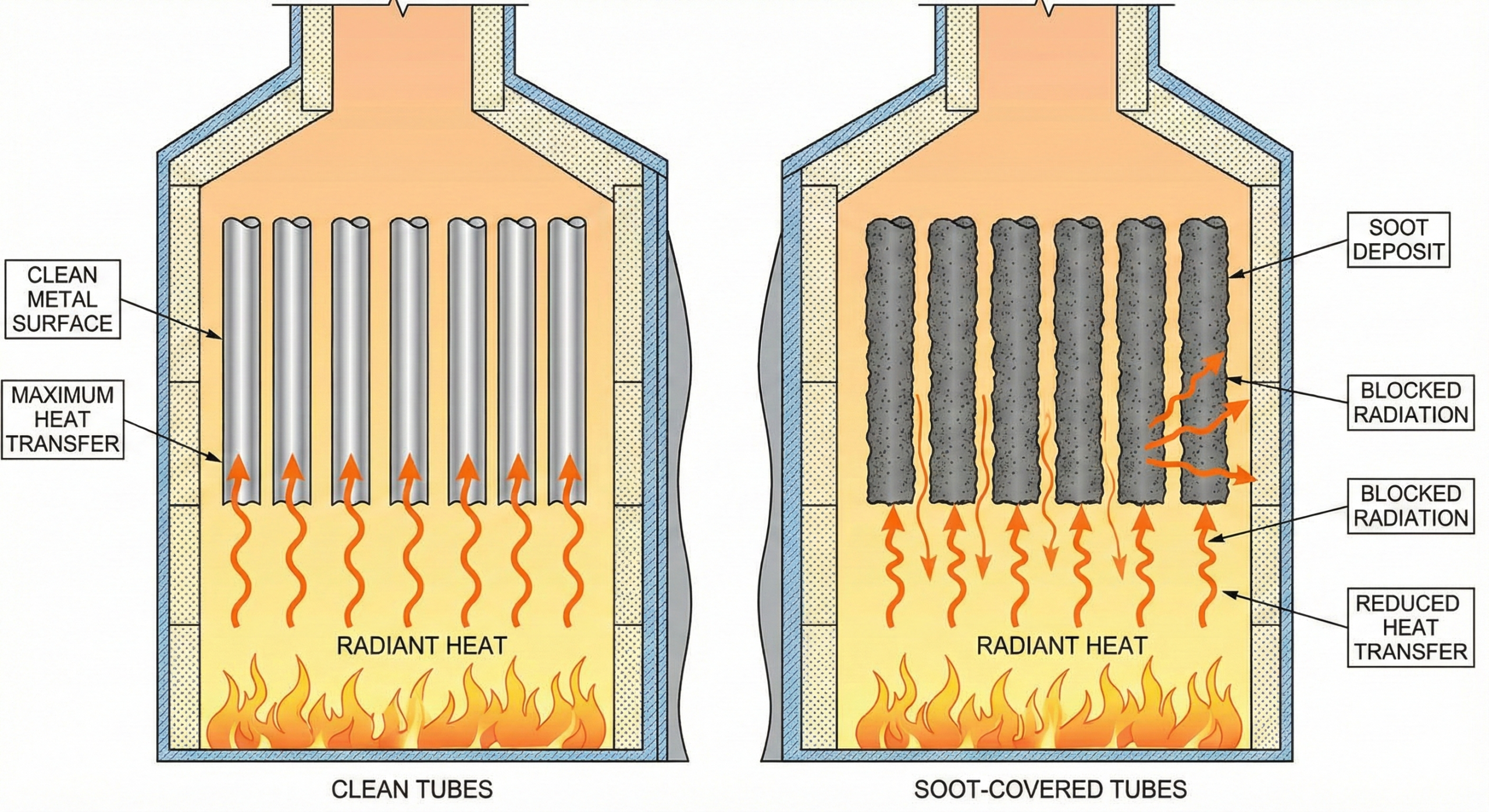
In fired heaters and other high-temperature equipment, the natural assumption is simple:
Higher temperature means better heat transfer.
And at first glance, this feels logical.
Hotter flames should transfer more heat.
Hotter gases should heat process fluids faster.
Higher firing should increase duty.
But in real plant operation, another factor often matters even more than temperature:
Surface cleanliness.
A furnace can be running hot, flames can be strong, and yet heat transfer can still be poor if surfaces are dirty.
This article explains why clean surfaces often influence performance more than temperature itself, how deposits quietly block radiant heat, and why maintaining clean heat transfer paths is essential for efficiency.
Heat Must Reach the Surface First
In the radiant section of a fired heater:
- flames generate intense thermal radiation
- that radiation must reach process tubes
- tubes absorb the heat and transfer it to the fluid inside
If radiation cannot reach the tube surface effectively, increasing flame temperature alone cannot fully solve the problem.
Because the path is blocked.
Deposits Act Like an Insulating Blanket
When deposits form on tube surfaces, they create an extra layer.
This layer:
- reduces heat absorption
- blocks radiation
- slows conduction into the metal
Common causes include:
- soot formation
- ash deposition
- scale buildup
- corrosion products
Even a thin layer can significantly affect performance. In fired heaters, these layers interfere with the same radiant heat transfer mechanisms that dominate furnace operation.
Because heat must now pass through this layer before reaching the tube wall.
Higher Temperature Cannot Always Overcome Surface Resistance
If surfaces are dirty:
- more heat is reflected
- less heat is absorbed
- more energy escapes with flue gases
So operators may try:
- increasing fuel firing
- raising flame temperature
This increases heat input, but:
- part of the extra energy is wasted
- surface resistance still limits transfer
So fuel use rises without proportional performance gain. This is one reason high-temperature systems can unexpectedly shift into radiation-controlled inefficiency.
Clean Surfaces Absorb Radiation Better
When tube surfaces are clean:
- radiation strikes metal directly
- absorption is efficient
- heat flows into the tube more easily
This improves:
- heating rate
- temperature control
- fuel efficiency
So even at the same firing rate, a clean surface transfers more heat than a dirty one. Surface emissivity strongly influences this absorption behavior, especially as furnace surfaces age.
Soot Deposits Are a Common Problem
In fired heaters, incomplete combustion can produce soot.
Soot settles on:
- tube surfaces
- refractory walls
- convection section tubes
This creates a layer that:
- blocks radiation
- acts as insulation
- reduces effective heat transfer
Over time, performance drops even though firing remains the same.
Convection Section Also Suffers from Dirty Surfaces
In the convection section:
- flue gases transfer heat by contact
- clean metal surfaces allow efficient heat flow
When dust or ash accumulates:
- surface resistance increases
- gas-side heat transfer weakens
- pressure drop may increase
So both radiation and convection sections are affected by surface cleanliness.
Why Tube Temperature May Rise When Surfaces Are Dirty
One dangerous effect of dirty surfaces is uneven heating.
If deposits prevent heat from entering the fluid easily:
- tube metal may get hotter
- heat accumulates in the wall
- local overheating can occur
This creates risk:
- reduced tube life
- material stress
- potential damage over time
So dirty surfaces do not just reduce efficiency — they can affect safety.
Cleaning Often Restores Performance Immediately
Plants often observe a simple pattern:
- after cleaning, performance improves quickly
- fuel consumption drops
- outlet temperatures stabilize
This happens because:
- heat can again reach metal surfaces directly
- resistance layers are removed
This improvement may be more noticeable than what temperature changes alone can achieve.
Refractory Surface Condition Also Matters
It is not only tubes that matter.
Refractory walls inside the radiant box:
- become hot
- radiate heat toward tubes
If refractory surfaces become:
- glazed
- damaged
- covered with deposits
radiation intensity may reduce.
So heat reaching the tubes decreases.
This shows how surface condition across the entire furnace affects performance. These interacting surface effects are one reason radiation behavior is much harder to calculate accurately than convection or conduction.
Why Plants Sometimes Increase Firing Without Results
When duty starts falling, the natural reaction is:
- increase firing rate
But if surfaces are dirty:
- extra heat may not be absorbed efficiently
- flue gas temperature may rise
- fuel consumption increases
But process heating may not improve much.
This creates the feeling that the heater is “working harder” but not “working better.”
Clean Surfaces Improve Radiation and Conduction Together
Clean metal surfaces help in multiple ways:
- better radiation absorption
- better conduction into the wall
- better heat transfer into the fluid
So one action — cleaning — improves the entire heat transfer path.
That is why its impact is often greater than adjusting temperature alone.
Seasonal Effects Can Make Surface Problems More Visible
In colder weather:
- heaters may need to work harder
- extra load makes surface resistance more noticeable
In summer:
- higher ambient temperatures reduce cooling efficiency
- deposits in convection sections become more limiting
So seasonal variations can reveal surface-related heat transfer issues more clearly.
Owner Perspective: Fuel Efficiency Depends on Surface Condition
From a cost point of view, dirty surfaces mean:
- higher fuel consumption
- lower heat recovery
- higher flue gas losses
- reduced efficiency
Regular maintenance that keeps surfaces clean can:
- reduce energy cost
- improve reliability
- extend equipment life
So surface condition is not just an operational concern — it directly affects economics.
A Simple Way to Visualize the Difference
Imagine trying to warm your hands near a fire.
If you hold them in front of the flame:
- you feel strong heat.
Now imagine placing a thick cloth between your hands and the fire:
- heat still exists
- but much less reaches you
The flame temperature did not change.
But the barrier reduced heat transfer.
Deposits on furnace tubes act in a similar way.
Final Perspective
In high-temperature equipment, heat transfer is not controlled by temperature alone.
It depends on how easily heat can reach and enter the surfaces.
Clean surfaces allow:
- strong radiation absorption
- efficient heat flow
- better fuel utilization
Dirty surfaces create resistance:
- blocking heat
- reducing efficiency
- increasing energy demand
So in many real furnace situations, improving surface condition can have a bigger impact than simply increasing temperature.
The balance between radiation, convection, emissivity, and surface cleanliness ultimately determines how effectively fired equipment performs over long operating periods.
Understanding why clean surfaces matter more than temperature helps explain why maintenance and inspection are as important as firing control in achieving reliable and efficient heat transfer.
Explore the complete series in the Heat Transfer Engineering Hub.

A practicing chemical engineer with 17+ years of experience in process design, project execution, commissioning, and plant operations. Focused on practical engineering judgment beyond textbook explanations.