
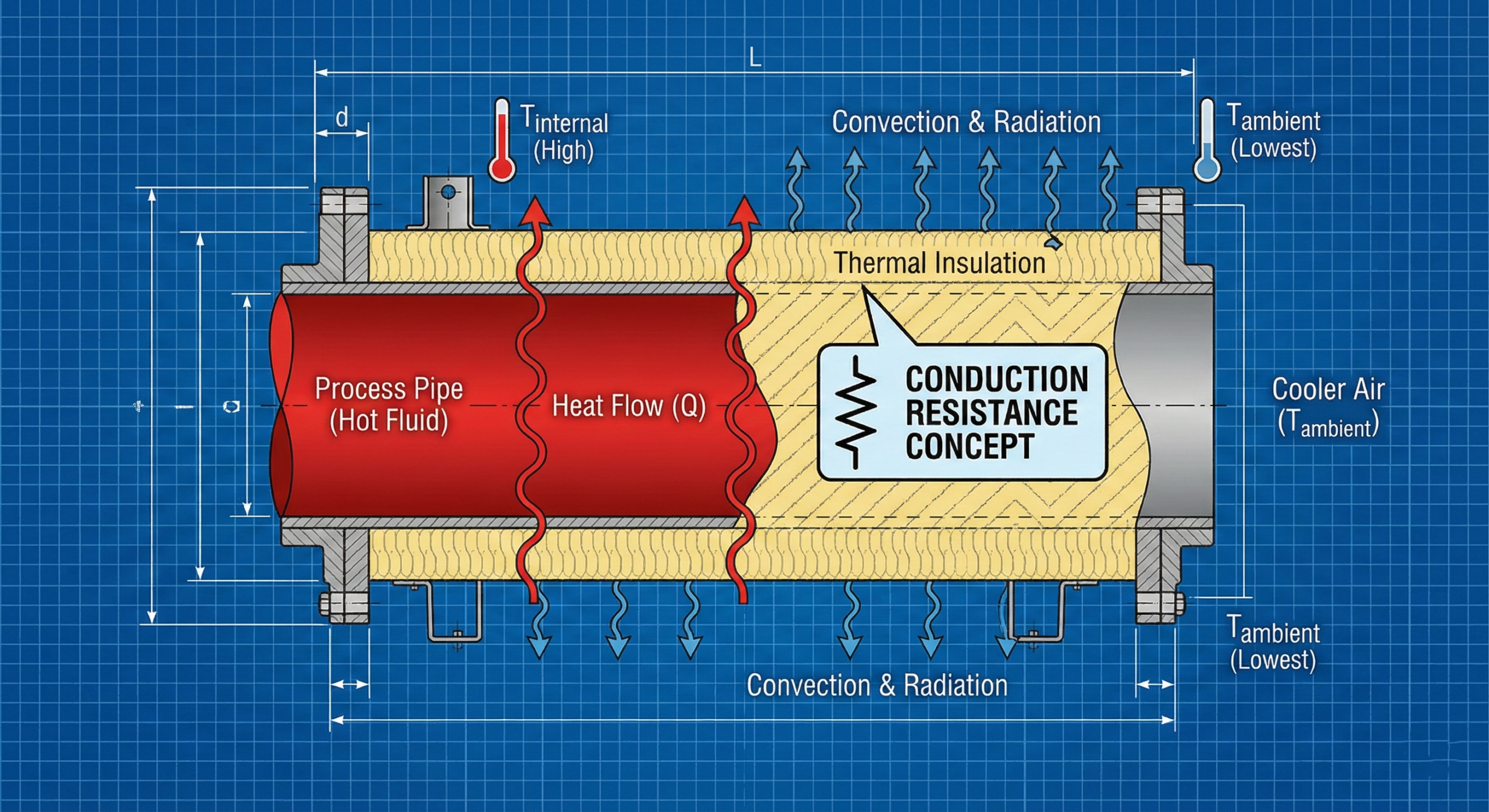
In process plants, insulation is often seen as a final solution.
Once a pipe, vessel, or exchanger is insulated, the natural assumption is:
- heat loss is controlled
- temperatures are protected
- energy waste is minimized
Sometimes the expectation goes even further:
“Now heat loss is stopped.”
But in reality, insulation never stops heat transfer completely.
It only slows it down.
This is not a design failure.
It is a basic law of thermodynamics.
This article explains why insulation can reduce heat loss but never eliminate it, how heat still finds a way out, and why understanding this helps plants make better decisions about energy, safety, and operation.
Table of Contents
Heat Always Moves from Hot to Cold
Heat transfer happens for one simple reason:
A temperature difference exists — which is why heat flows spontaneously from hot to cold.
If a pipe carries hot fluid and the surrounding air is cooler:
- heat will move outward
- energy will leave the pipe
- temperature will try to equalize
Insulation does not remove this temperature difference.
It only creates resistance.
So heat keeps moving — just more slowly.
What Insulation Actually Does
Insulation works by increasing resistance to heat flow.
Instead of heat moving easily from hot surface to air:
- it must pass through the insulating layer
- conduction becomes slower
- surface temperature drops
- heat loss rate decreases
But the key point is:
Insulation reduces heat loss.
It does not stop heat loss.
As long as the outside is cooler than the inside, heat will continue to escape.
Why Zero Heat Loss Is Physically Impossible
To stop heat loss completely, two things would need to happen:
- no temperature difference exists, or
- infinite resistance exists.
Neither is practical.
If temperatures become equal:
- the process will stop working
- heating would become useless
If resistance were infinite:
- heat could not pass at all
- such materials do not exist in real applications
So in the real world, insulation can only limit heat flow, never eliminate it.
Even the Best Insulation Conducts Some Heat
Every insulation material has a thermal conductivity value.
Even high-quality insulation:
- fiberglass
- mineral wool
- ceramic fiber
still allows some heat to pass through.
The difference is only in how much.
Thicker insulation means:
- more resistance
- lower heat loss rate
But still not zero loss.
Heat Also Escapes from Ends, Supports, and Joints
In real plants, heat loss does not occur only through straight pipe surfaces.
It also escapes through:
- pipe supports
- flanges
- valves
- instrument connections
- insulation gaps
These are called thermal bridges.
Even if most of the pipe is insulated well, heat can leak through these paths.
So total heat loss is always higher than ideal calculations suggest.
Weather and Air Movement Increase Heat Loss
External conditions strongly affect how much heat escapes.
For example:
- wind increases heat removal
- rain cools outer surfaces
- cold ambient temperature increases driving force
Even with good insulation, these factors can increase heat loss.
That is why plants see:
- higher heating demand in winter
- faster cooling of exposed equipment
The insulation is still working.
But the environment is pulling heat away more aggressively.
Why Insulated Pipes Still Feel Warm
If you touch an insulated hot line and it feels warm on the outside, that is proof that heat is still escaping.
The heat path is:
- hot fluid → pipe wall → insulation → outer surface → air
If heat were not flowing:
- the outer surface would be at air temperature
- no warmth would be felt
So a warm insulation surface is not a problem.
It is evidence that insulation is reducing — but not stopping — heat transfer.
Insulation Performance Changes Over Time
Insulation does not stay perfect forever.
Over years, it can:
- absorb moisture
- compress
- crack
- shift from its original position
When this happens:
- resistance reduces
- heat loss increases
- energy consumption rises
This is why older units often lose more heat than newer ones.
Why Insulation Thickness Has Practical Limits
A common question is:
“Why not keep adding insulation until heat loss is negligible?”
Because:
- insulation adds cost
- space becomes limited
- structural load increases
- maintenance access becomes difficult
So insulation is designed to reduce heat loss to an acceptable level — not to eliminate it.
There is always a balance between cost and performance.
The Role of Insulation in Energy Efficiency
Even though insulation cannot stop heat loss, it plays a major role in saving energy.
It helps by:
- slowing heat escape from hot pipes
- reducing cooling load on cold lines
- stabilizing temperatures
- protecting process conditions
Without insulation, heat loss would be much faster.
So insulation does not eliminate loss — but it significantly reduces waste.
Why Heat Loss Is Higher in Long Pipe Runs
In large plants, long pipe networks carry hot fluids across distances.
Even with insulation:
- heat loss accumulates along the length
- temperature drops gradually
- additional heating may be needed downstream
This is why long transfer lines often show:
- lower outlet temperatures
- higher heating demand at destination
The insulation worked — but distance allowed small losses to add up.
Cold Lines Also Gain Heat
Insulation is not only about preventing heat loss.
It also prevents heat gain.
For example:
- chilled water lines
- refrigerated storage pipes
- cryogenic services
Without insulation:
- heat from surroundings enters the line
- cooling load increases
- temperature control becomes difficult
So insulation slows heat movement in both directions.
But again, it never stops it completely.
Owner Perspective: Why Insulation Still Matters
From a cost point of view, insulation affects:
- fuel consumption
- steam demand
- refrigeration load
- operating stability
Even small heat losses across many lines add up to large energy costs over time.
So while insulation cannot stop heat transfer, it:
- reduces waste
- improves efficiency
- protects process performance
The savings over years are significant.
Why This Understanding Is Important
When people expect insulation to stop heat loss completely, they may feel:
- disappointed when pipes still feel warm
- surprised by temperature drop across long lines
- confused by energy use in insulated systems
But once the basic principle is understood, it becomes clear:
Heat transfer never stops as long as temperatures are different.
Insulation only slows the process.
Final Perspective
Insulation is one of the most important tools in a process plant.
It protects equipment.
It saves energy.
It improves safety.
But it does not create a perfect barrier.
As long as there is a temperature difference:
- heat will move
- energy will escape or enter
- the process will interact with its surroundings
Understanding why insulation never stops heat loss completely helps set realistic expectations.
It allows better design, better operation, and better energy planning — based not on hope, but on how heat truly behaves in the real world.
Explore the complete series in the Heat Transfer Engineering Hub.

A practicing chemical engineer with 17+ years of experience in process design, project execution, commissioning, and plant operations. Focused on practical engineering judgment beyond textbook explanations.