
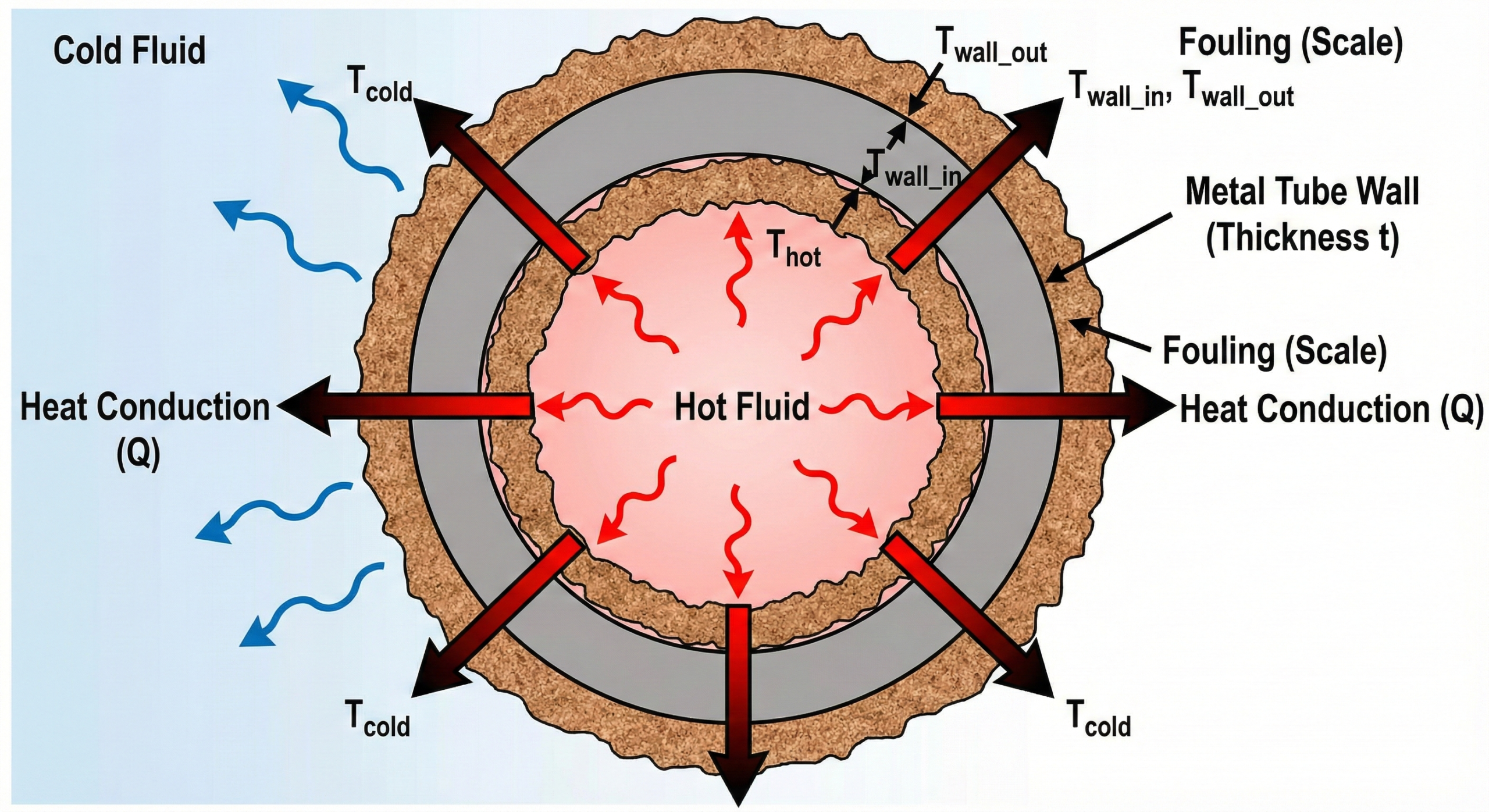
When discussing heat exchanger performance, most attention goes to:
- heat transfer coefficient (U)
- fouling
- fluid velocity
- temperature difference
But there is one physical element that sits directly in the heat path and quietly affects performance:
The wall thickness of tubes or plates.
It is always present.
Heat must always pass through it.
And yet, it is rarely discussed unless a mechanical issue appears.
This article explains how wall thickness affects heat exchanger performance, when it matters, when it doesn’t, and why mechanical decisions often influence thermal behavior more than expected.
Table of Contents
Heat Must Pass Through the Wall — Always
In a typical heat exchanger, heat flows like this:
- from hot fluid
- through the hot-side fluid film
- through fouling layer
- through the metal wall
- through fouling on the cold side
- into the cold fluid
The metal wall sits in the middle of this chain.
It is the physical barrier separating the two fluids.
No matter how good the fluids are at transferring heat, heat cannot skip the wall.
It must conduct through it.
Wall Thickness Creates Thermal Resistance
Any solid material resists heat flow, a behavior explained by thermal resistance of solids in process equipment.
This resistance depends on:
- thickness of the wall
- thermal conductivity of the metal
Thicker wall → more resistance
Thinner wall → less resistance
This is basic conduction behavior.
So in theory:
Thinner tubes improve heat transfer.
Thicker tubes reduce heat transfer.
But in real plants, the story is more balanced.
Why Wall Resistance Is Often Smaller Than Fluid Resistance
In most exchangers:
- fluid film resistance dominates
- fouling resistance grows over time
Compared to these, metal resistance is often smaller.
For example:
- carbon steel conducts heat reasonably well
- tube thickness is usually not extremely high
- fluid-side resistance is much larger in many services
So in many cases, changing wall thickness slightly does not dramatically change U.
That is why wall thickness is not always the first factor engineers worry about.
But Wall Thickness Still Matters
Even if wall resistance is not dominant, it still contributes to total resistance.
And when margins are tight, every resistance matters.
Wall thickness becomes more important when:
- dealing with low heat transfer fluids (oils, viscous liquids)
- working near pinch temperatures
- operating with already low U values
- using low conductivity materials
In such cases, the wall can become a noticeable part of the thermal limitation.
Why Tubes Are Not Made As Thin As Possible
If thinner walls improve heat transfer, a natural question arises:
Why not make tubes as thin as possible?
Because thermal performance is only one part of design.
Wall thickness must also handle:
- pressure containment
- mechanical strength
- corrosion allowance
- vibration resistance
- long service life
A very thin tube may transfer heat well but fail mechanically.
This balance between thermal performance and durability becomes even more important when exchanger materials have different conductivity behavior in real service:
- thermal efficiency
- mechanical reliability
Safety and durability usually take priority.
Corrosion Allowance Increases Thickness Over Time
When exchangers are designed, extra thickness is often included as a corrosion allowance.
This means:
- tubes start slightly thicker than needed
- over time, corrosion may reduce thickness
- strength is preserved for years
This additional thickness slightly increases thermal resistance from the beginning.
But it protects equipment life.
So thermal performance is slightly sacrificed for long-term reliability.
Wall Thickness Changes as Equipment Ages
Over years, tube walls may:
- thin due to corrosion
- become rough internally
- accumulate scale and deposits
From a thermal point of view:
- reduced thickness lowers conduction resistance
- but fouling and surface damage increase other resistances
So the net effect is usually:
- performance declines, not improves
Even though the metal layer may be thinner, the surrounding resistances grow.
Material Choice Matters More Than Thickness in Some Cases
Wall thickness is only part of the conduction story.
Material thermal conductivity is equally important.
For example:
- copper transfers heat very well
- stainless steel transfers heat less effectively
- special alloys may transfer even less
So even with the same thickness:
- different materials can change heat transfer performance.
In services where corrosion resistance is critical, stronger alloys are used.
This improves life but slightly reduces thermal performance.
Again, design balances safety and efficiency.
Plate Heat Exchangers and Thin Walls
Plate heat exchangers use very thin metal plates.
Because:
- plates are thin
- metal conduction resistance is very low
So performance is often higher.
But plate exchangers are used where:
- pressure is lower
- corrosion is manageable
- mechanical stresses are controlled
Shell-and-tube exchangers use thicker tubes because:
- they handle higher pressures
- they tolerate harsher conditions
- they last longer in difficult services
So wall thickness reflects service conditions, not just thermal preference.
Thick Walls Affect Startup and Heating Rates
Wall thickness also affects how quickly equipment heats up or cools down.
Thicker metal:
- stores more heat
- warms up slowly
- cools down slowly
This creates thermal inertia. Such slow response is commonly observed in conditions where conduction becomes the controlling heat transfer mechanism.
During startup:
- it takes longer for the exchanger to reach stable performance
During shutdown:
- heat remains stored longer
These effects influence operation, especially in frequently cycled plants.
When Wall Thickness Becomes a Bigger Thermal Issue
In some cases, wall resistance becomes more important than usual.
Examples include:
- cryogenic services
- very high-performance exchangers
- services with small temperature differences
- equipment using low-conductivity alloys
In these situations:
- even small additional resistance matters
- wall design must be considered more carefully.
Why Wall Thickness Rarely Explains Sudden Performance Drop
In troubleshooting, wall thickness is almost never the cause of sudden duty loss.
Because:
- thickness changes slowly over years
- fouling changes quickly over months
So when exchangers suddenly underperform, the usual reasons are:
- fouling
- maldistribution
- utility variation
- flow changes
Wall resistance remains relatively stable.
Owner Perspective: Reliability vs Efficiency
From an ownership viewpoint, wall thickness decisions influence:
- equipment life
- maintenance frequency
- failure risk
- long-term safety
A slightly thicker wall may:
- reduce heat transfer slightly
- but prevent leaks
- extend service life
- reduce replacement cost
So the best design is not the thinnest possible.
It is the one that balances performance and durability.
A Simple Way to Visualize the Role of the Wall
Imagine heat passing through layers like people moving through doors.
- fluid film is one door
- fouling is another
- the metal wall is one more
If one door is very narrow, it controls movement.
In many exchangers:
- fluid and fouling doors are narrower than the metal door
But the metal door still matters.
It is always part of the path.
Final Perspective
Wall thickness plays a quiet but constant role in heat exchanger performance. Even perfect wall design cannot eliminate hidden resistance created at metal contact interfaces.
It does not usually dominate heat transfer.
It does not often cause sudden problems.
But it is always part of the resistance heat must cross.
Designers balance thickness for:
- strength
- safety
- corrosion allowance
- long life
And that balance slightly shapes thermal behavior for years.
Understanding the role of wall thickness helps explain why heat transfer is not just about fluids and temperatures — it is also about the physical structure through which heat must travel.
Wall thickness is only one part of conduction resistance inside heat exchangers.
Even when metals conduct heat extremely well, exchanger performance can still decline because real plant behavior depends on much more than material conductivity alone.
Why High-Conductivity Metals Still Fail in Service
This article explains why high-conductivity metals do not always guarantee superior exchanger performance once fouling, corrosion, fluid resistance, and operating conditions begin influencing the full heat-transfer path.
Explore the complete series in the Heat Transfer Engineering Hub.

A practicing chemical engineer with 17+ years of experience in process design, project execution, commissioning, and plant operations. Focused on practical engineering judgment beyond textbook explanations.