
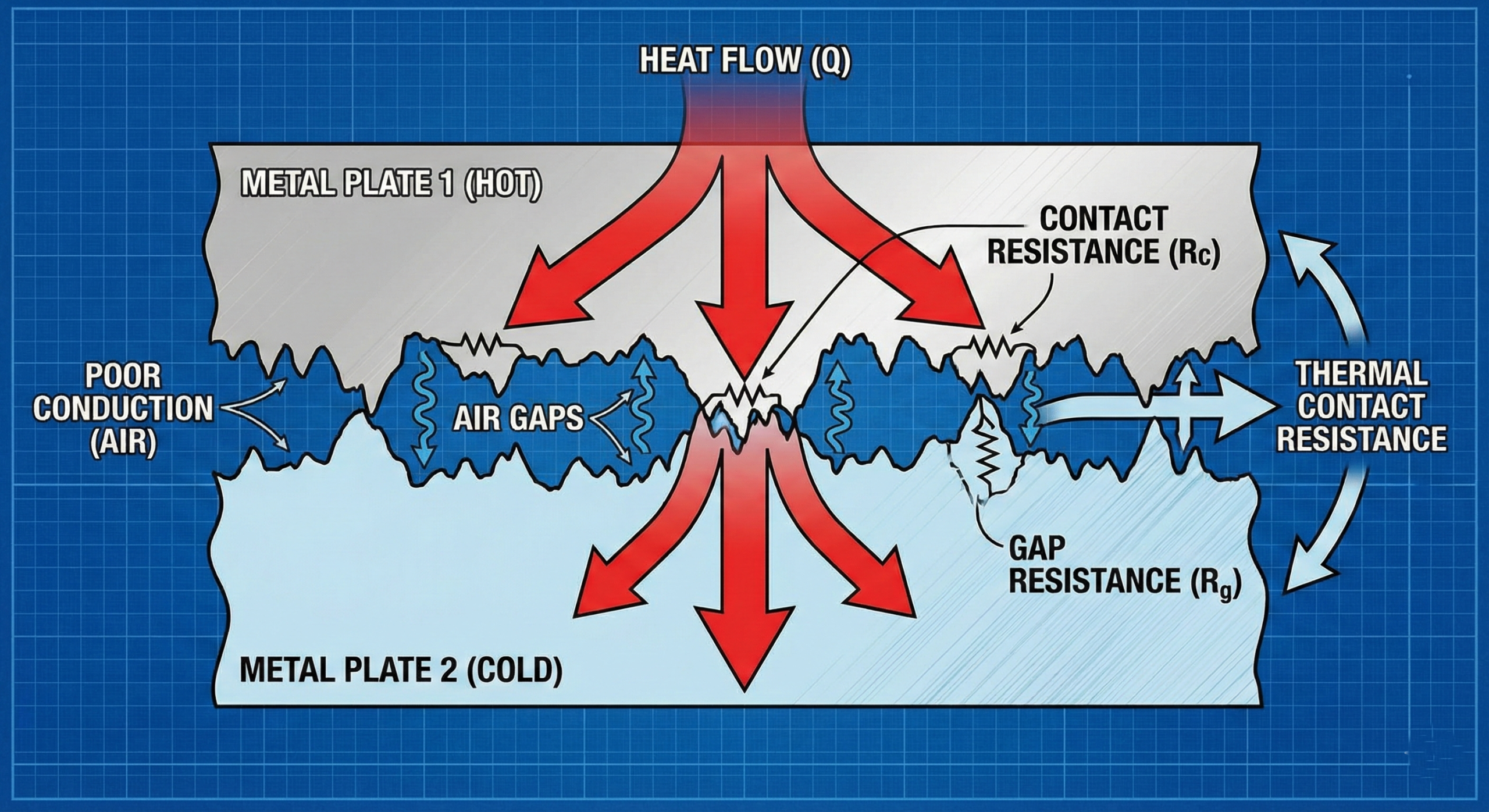
When engineers think about conduction, they usually imagine heat passing through a solid metal wall:
- tube walls
- plates
- reactor shells
- vessel jackets
The assumption is simple and logical:
If two metal surfaces touch, heat should pass easily.
But in real process equipment, this is not always true.
Between two solid surfaces, there is often an invisible barrier that resists heat flow.
This barrier is called contact resistance.
It is not obvious.
It is rarely measured.
It is often ignored in early design thinking.
Yet it can quietly reduce heat transfer performance in many types of equipment especially in systems already limited by conduction resistance through solid materials.
This article explains what contact resistance is, where it appears in real plants, and why it becomes an unexpected source of conduction loss.
Table of Contents
What Is Contact Resistance?
Contact resistance occurs when heat must pass from one solid surface to another.
Examples include:
- tube-to-tube sheet joints
- plate heat exchanger contacts
- cladded surfaces
- fin-to-tube connections in air coolers
- bolted metal interfaces
In theory, if two metal surfaces are touching, heat should pass freely.
In reality, surfaces are never perfectly smooth.
Even polished metal looks flat, but at a microscopic level it has:
- peaks
- valleys
- small air gaps
So actual contact occurs only at a few points.
Heat must jump across these tiny gaps, which creates resistance.
Why Air Gaps Reduce Heat Flow
Air is a very poor conductor of heat.
So when tiny pockets of air exist between two metal surfaces:
- they act like insulation
- they slow down heat transfer
Even if the metals themselves conduct heat well, the air layer in between becomes the bottleneck.
This is the essence of contact resistance.
A Simple Way to Visualize It
Imagine placing two metal plates together.
To the eye, they seem fully touching.
But in reality:
- only a small percentage of the area is actually in contact
- the rest is separated by microscopic spaces
Heat must travel through:
- metal → contact point → metal
and - metal → air gap → metal
The air gap path is much slower.
So overall heat transfer reduces.
Where Contact Resistance Appears in Process Equipment
Contact resistance is present in more places than most people realize.
Tube-to-tube sheet joints
In shell-and-tube exchangers:
- tubes are expanded or welded into the tube sheet
- heat passes from tube wall into tube sheet
If contact is not perfect:
- resistance increases
- heat flow reduces locally
Finned tubes in air coolers
Air coolers depend heavily on fins attached to tubes.
Heat path:
- hot fluid → tube → fin → air
If the fin does not make perfect contact:
- heat transfer to air reduces
- effective area decreases
This is one of the most important real examples of contact resistance.
Plate heat exchangers
In plate exchangers:
- plates are pressed together
- gaskets maintain sealing
Heat must pass across thin plates and contact regions.
Any imperfection in contact:
- reduces conduction efficiency
- creates uneven thermal performance.
Cladded or layered surfaces
Some equipment uses layered construction:
- corrosion-resistant cladding
- thermal lining
- bonded metal layers
Heat must pass through interfaces.
Each interface adds contact resistance.
Why Contact Resistance Is Hard to Notice
Contact resistance does not cause sudden failure.
Instead, it creates:
- slightly lower heat transfer rates
- small efficiency loss
- uneven temperature distribution
These effects are subtle.
They are often hidden by:
- fouling
- fluid resistance
- utility variation
So the impact is present, but not obvious.
Pressure Improves Contact and Reduces Resistance
When two surfaces are pressed together strongly:
- more contact points form
- air gaps reduce
- heat flows more easily
This is why:
- tightly expanded tubes perform better
- properly bonded fins transfer heat efficiently
- well-assembled equipment gives better conduction
Mechanical pressure improves thermal contact.
Aging Increases Contact Resistance
Over time, equipment undergoes:
- thermal expansion cycles
- vibration
- corrosion
- loosening of joints
These effects can:
- reduce tightness of contact
- create micro gaps
- increase resistance
So contact resistance can grow slowly as equipment ages.
Why Fins Lose Effectiveness Over Time
In air coolers, fins are critical for performance.
But with time:
- corrosion can develop at fin-tube interface
- mechanical loosening can occur
- thermal cycling can reduce bonding quality
When contact weakens:
- heat cannot move efficiently into fins
- effective heat transfer area reduces
This is a classic case where contact resistance quietly reduces performance even when the underlying metal itself has very high thermal conductivity.
Contact Resistance vs Wall Resistance
Wall resistance depends on:
- thickness
- thermal conductivity
Contact resistance depends on:
- surface condition
- pressure
- contact quality
Even if the wall is thin and highly conductive, poor contact can dominate.
So in layered structures, contact resistance may become more important than the metal itself.
Why It Is Rarely Calculated in Detail
In most designs, contact resistance is estimated or included as a safety margin.
Because:
- exact surface condition is hard to predict
- real contact area cannot be measured easily
- performance changes over time
So designers account for it indirectly.
But in troubleshooting, it is rarely the first suspected cause.
When Contact Resistance Matters Most
Contact resistance becomes more important when:
- temperature difference is small
- heat flux is high, especially during conditions where conduction dominates the overall heat-transfer path.
- surfaces rely on bonded interfaces
- fins play a major role
In such situations, even small losses at the interface can affect overall performance.
Owner Perspective: Small Losses Across Large Areas Add Up
From a plant perspective:
- one small interface loss may seem minor
- but across large surface areas, the impact adds up
Reduced fin efficiency, poor bonding, or aging joints can lead to:
- higher utility demand
- lower cooling effectiveness
- gradual performance decline
And the cause may remain hidden.
Why Good Assembly Matters for Heat Transfer
Thermal performance is not only about design.
It also depends on:
- how tightly parts are fitted
- how well surfaces are bonded
- how carefully equipment is installed
Good mechanical contact supports good heat transfer.
Poor assembly can create hidden resistance.
A Practical Example
Consider two identical air coolers:
- same area
- same material
- same design
If one has slightly looser fin contact:
- heat transfer may be noticeably lower
- cooling performance may drop
But the difference is not obvious from outside.
This is the effect of contact resistance.
Final Perspective
Contact resistance is one of the most hidden forms of conduction loss.
It exists wherever two solid surfaces meet.
It cannot be seen easily.
It is rarely measured directly.
But it affects how smoothly heat flows across equipment.
Even with:
- high-conductivity metals
- thin walls
- large surface area
poor contact can quietly reduce effectiveness.
Understanding contact resistance helps explain why real heat transfer performance depends not only on materials and thickness, but also on how well surfaces actually touch each other.
Explore the complete series in the Heat Transfer Engineering Hub.

A practicing chemical engineer with 17+ years of experience in process design, project execution, commissioning, and plant operations. Focused on practical engineering judgment beyond textbook explanations.