
Most industrial heat transfer duties are handled by:
- shell-and-tube exchangers
- plate heat exchangers
- air-cooled exchangers
- double pipe exchangers
These designs dominate because they solve the majority of industrial heating and cooling requirements.
However, some services push equipment beyond the practical limits of conventional exchangers.
The challenge may be:
- extreme fouling
- highly viscous fluids
- slurry handling
- severe space constraints
- cryogenic temperatures
- very high pressure operation
- difficult phase-change behavior
In these situations, standard exchanger designs may become inefficient, unreliable, or uneconomical.
This is where spiral and special heat exchangers enter the picture.
They represent a small percentage of installed exchangers, but they often solve problems that conventional equipment cannot.
This article explores where spiral and special heat exchangers make engineering sense and why specialized designs continue to play an important role in modern industry.
Why Special Heat Exchangers Exist
Not Every Process Fits Standard Equipment
Most exchanger selection begins with conventional options.
Engineers usually evaluate:
- shell-and-tube
- plate
- air-cooled
- double pipe
Only when these options reveal limitations do specialized designs enter the discussion.
Special exchangers exist because certain services create challenges such as:
- rapid fouling
- blockage risk
- extreme pressure
- compactness requirements
- difficult maintenance conditions
Rather than forcing a standard design into an unsuitable application, specialized exchangers are developed around the process challenge itself.
Spiral Heat Exchangers
The Basic Design
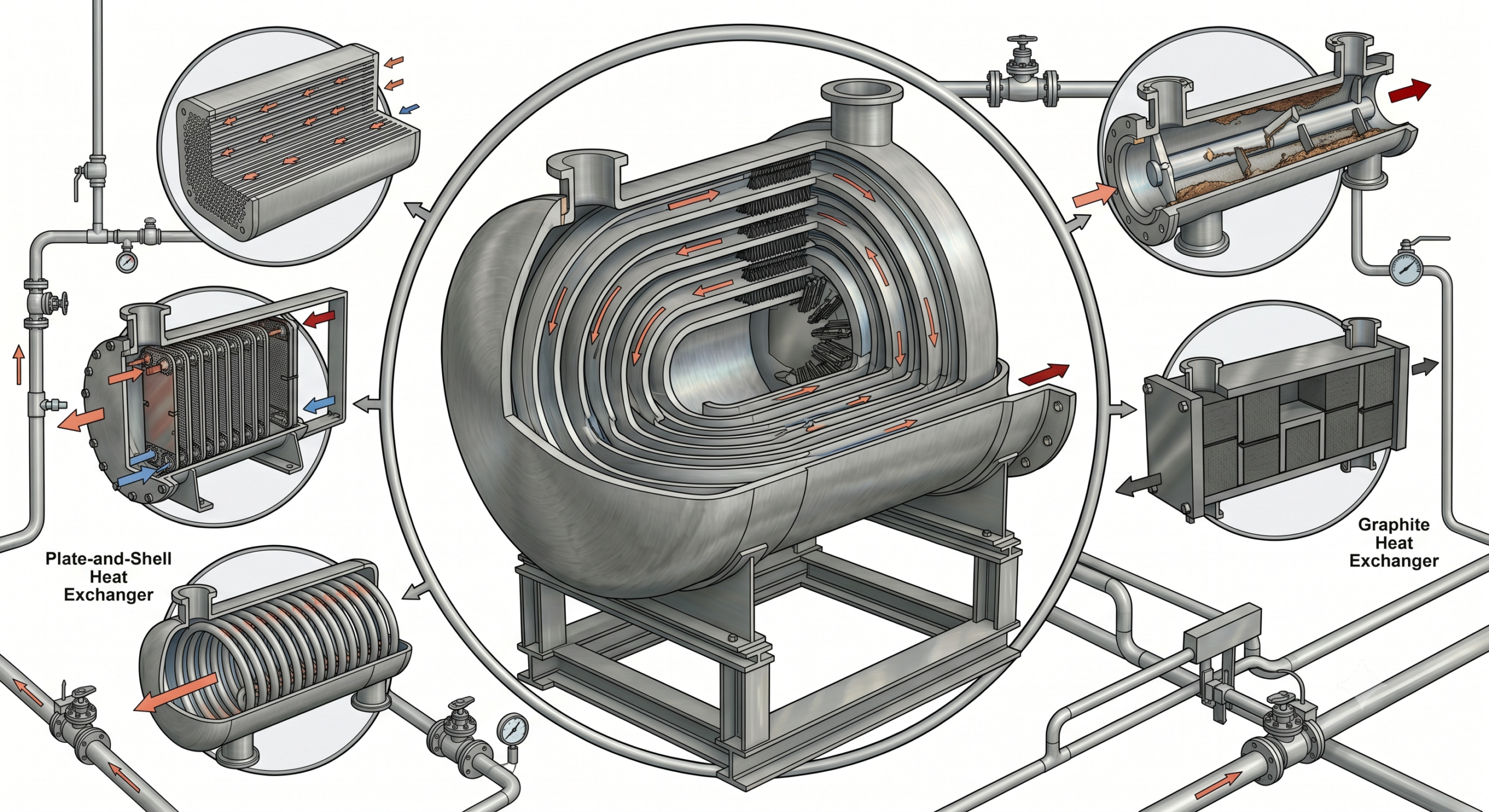
A spiral heat exchanger consists of two metal strips wound around a central core.
This creates two continuous flow channels.
The fluids flow through separate spiral passages while exchanging heat through the metal wall between them.
Unlike shell-and-tube exchangers, there are no multiple flow paths.
Each fluid follows a single continuous route.
This design feature drives many of its advantages.
Why Spiral Exchangers Handle Fouling Better
Single Channel Flow Reduces Dead Zones
Many fouling problems occur because of:
- stagnant regions
- low-velocity pockets
- uneven flow distribution
The spiral geometry minimizes these conditions.
As fluid moves through the curved channel:
- velocity remains relatively uniform
- flow remains well distributed
- deposits are less likely to accumulate unevenly
This creates a self-scouring effect in many services.
Industrial Use Cases for Spiral Heat Exchangers
Slurry Processing
Spiral exchangers are commonly used for:
- mineral slurries
- wastewater sludge
- pulp and paper streams
- solids-containing process fluids
These services often cause problems in narrow plate channels or tube bundles.
The wider spiral passage reduces plugging risk.
Wastewater Treatment Plants
Many wastewater streams contain:
- suspended solids
- biological material
- fibrous contaminants
Conventional exchangers can foul rapidly.
Spiral designs provide:
- easier cleaning
- lower blockage tendency
- more stable performance
This makes them attractive for wastewater heat recovery applications.
High-Fouling Chemical Services
Certain chemical processes generate:
- sticky deposits
- polymer residues
- crystallizing compounds
Spiral exchangers are often selected when conventional exchangers experience frequent cleaning requirements.
Reducing cleaning frequency can significantly improve plant availability.
Helical Coil Heat Exchangers
A Different Approach to Compact Heat Transfer
Helical coil exchangers use tubing wound into a coil configuration.
The curved geometry creates secondary flow patterns that improve fluid mixing.
This can enhance thermal performance compared to straight tubes.
Industrial Use Cases for Helical Coil Designs
High-Pressure Services
The coil geometry naturally handles pressure effectively.
Applications include:
- gas processing
- specialty chemical systems
- pressure-intensive utility services
The design provides both thermal performance and mechanical strength.
Compact Installations
Helical coils offer large surface area within a relatively small volume.
This makes them useful when installation space is limited.
Plate-and-Shell Heat Exchangers
Combining Two Technologies
Plate-and-shell exchangers combine:
- plate heat transfer surfaces
- shell-and-tube style pressure containment
The goal is to capture the thermal efficiency of plate exchangers while retaining higher pressure capability.
Industrial Use Cases for Plate-and-Shell Designs
Refrigeration and Cryogenic Systems
These exchangers are commonly used in:
- refrigeration plants
- LNG systems
- low-temperature processing
Their compactness and thermal efficiency are particularly valuable in these services.
High-Pressure Thermal Recovery
Where standard plate exchangers approach their pressure limits, plate-and-shell designs can often provide a practical alternative.
Printed Circuit Heat Exchangers
Extreme Compactness Through Microchannels
Printed circuit heat exchangers use chemically etched flow passages bonded together into a solid block.
The result is:
- very high surface area density
- exceptional pressure capability
- extremely compact construction
They represent one of the most advanced exchanger technologies currently available.
Industrial Use Cases for Printed Circuit Exchangers
LNG Plants
Liquefied natural gas facilities require:
- compact equipment
- precise temperature control
- high thermal efficiency
Printed circuit exchangers are widely used in these applications.
Hydrogen Processing
Hydrogen systems often involve:
- high pressure
- compact layouts
- demanding thermal requirements
Printed circuit exchangers can handle these conditions effectively.
Offshore Installations
Space and weight are critical offshore.
Compact exchangers offer significant advantages where platform footprint is limited.
Scraped Surface Heat Exchangers
Solving Extreme Fouling Problems
Some fluids deposit material so aggressively that conventional exchangers become impractical.
Examples include:
- food products
- polymers
- crystallizing solutions
- highly viscous materials
Scraped surface exchangers use rotating blades that continuously remove deposits from heat transfer surfaces.
Industrial Use Cases for Scraped Surface Designs
Food Industry
Products such as:
- sauces
- dairy products
- syrups
often require continuous surface cleaning.
Scraped surface exchangers are common in these services.
Polymer Manufacturing
Certain polymers rapidly foul exchanger surfaces.
Mechanical scraping allows heat transfer to continue while reducing buildup.
Graphite Heat Exchangers
When Corrosion Becomes the Main Challenge
Some chemical services are highly corrosive.
Examples include:
- strong acids
- aggressive chemical mixtures
Metallic exchangers may have limited life.
Graphite exchangers provide excellent corrosion resistance in specific services.
Industrial Use Cases for Graphite Designs
Acid Processing
Applications include:
- sulfuric acid systems
- hydrochloric acid services
- specialty chemical production
Graphite construction allows heat transfer where metals may struggle.
Why Special Exchangers Remain Niche Solutions
They Solve Specific Problems
Special exchanger designs are rarely selected first.
They are chosen when a process challenge exists that conventional equipment cannot handle efficiently.
Examples include:
- severe fouling
- extreme compactness requirements
- unusual materials
- difficult process fluids
Their value comes from solving specialized problems rather than general-purpose duties.
Trade-Offs of Specialized Designs
Advantages
Special exchangers often provide:
- superior performance in targeted applications
- reduced fouling
- improved compactness
- unique operating capabilities
Limitations
However, they may also involve:
- higher capital cost
- specialized maintenance
- limited vendor availability
- longer delivery times
The benefits must justify these additional complexities.
Operator Perspective
Operators often notice that special exchangers behave differently from standard equipment.
They may require:
- different cleaning procedures
- unique maintenance techniques
- specialized operating knowledge
Successful operation depends on understanding the design’s intended purpose.
Owner Perspective
From a business standpoint, special exchangers are often justified when they:
- reduce downtime
- extend operating campaigns
- improve energy recovery
- solve chronic maintenance problems
Their higher purchase cost may be offset by operational savings.
When Engineers Should Consider Special Designs
Strong Candidates
Special heat exchangers deserve consideration when:
- fouling repeatedly defeats conventional equipment
- space constraints are severe
- pressure conditions exceed normal limits
- process fluids create unusual challenges
- maintenance costs become excessive
These are often signals that standard equipment may not be the optimal solution.
Final Perspective
Spiral and special heat exchangers exist because industrial processes are not always standard.
While shell-and-tube, plate, and air-cooled exchangers handle most duties, some applications demand specialized solutions.
Whether the challenge is:
- fouling
- pressure
- compactness
- corrosion
- viscosity
special exchanger designs provide tools that conventional equipment cannot always match.
The best exchanger is not necessarily the most common one.
It is the one that solves the actual process problem with the greatest reliability and the lowest lifecycle cost.
And in certain services, that solution is a spiral or specialized heat exchanger rather than a traditional design.

A practicing chemical engineer with 17+ years of experience in process design, project execution, commissioning, and plant operations. Focused on practical engineering judgment beyond textbook explanations.