For decades, industrial heat exchanger selection was dominated by a simple question:
Can the exchanger perform the required duty?
Today, many projects face a different question:
Can the exchanger perform the duty within the available space?
Modern plants are increasingly constrained by:
- limited plot area
- offshore weight restrictions
- modular construction requirements
- expensive structural steel
- compact skid design
- brownfield expansion limitations
In these situations, conventional exchanger designs may provide the required thermal performance but fail practical installation requirements.
This is where compact heat exchangers become important.
They are designed to transfer large amounts of heat within a very small volume, making them valuable when size becomes a critical engineering constraint.
This article explains what compact heat exchangers are, why they exist, where they are used, and the trade-offs engineers must understand before selecting them.
What Makes a Heat Exchanger “Compact”?
Compactness Is About Surface Area Density
The defining characteristic of a compact heat exchanger is not its external size.
It is the amount of heat transfer surface packed into a given volume.
Compared with traditional exchangers, compact designs provide:
- much higher surface area density
- shorter flow paths
- reduced equipment footprint
- lower equipment weight
The goal is simple:
Transfer more heat while occupying less space.
Why Industry Started Moving Toward Compact Designs
Space Has Become Expensive
In many modern projects:
- plot space is limited
- steel structures are expensive
- transportation dimensions are restricted
Particularly in offshore and modular projects, every tonne of weight matters.
Every square meter of footprint matters.
Traditional exchangers can become difficult to justify when compact alternatives can deliver similar duties in a fraction of the space.
When Size Becomes the Primary Selection Driver
Brownfield Expansions
One of the most common situations occurs during plant expansions.
The process may require:
- additional heat recovery
- extra cooling capacity
- higher throughput
But the plant often lacks space for a new shell-and-tube exchanger.
Engineers may discover that:
- foundations cannot be expanded
- pipe routing is congested
- structures cannot support additional weight
In these situations, compact exchangers often become the only practical solution.
Offshore Installations
Offshore facilities face unique constraints.
Every equipment item affects:
- platform weight
- structural loading
- transportation cost
- installation complexity
A conventional exchanger that performs well thermally may simply be too large.
Compact designs help reduce:
- weight
- footprint
- support requirements
This is one reason compact exchangers are common in offshore processing systems.
Modular Plant Construction
Modern plants increasingly use modular construction.
Entire process units are assembled offsite and transported to their final location.
Modular design favors equipment that is:
- compact
- lightweight
- easy to integrate
Large exchanger footprints complicate transportation and module assembly.
Compact heat exchangers align naturally with modular construction philosophy.
Common Types of Compact Heat Exchangers
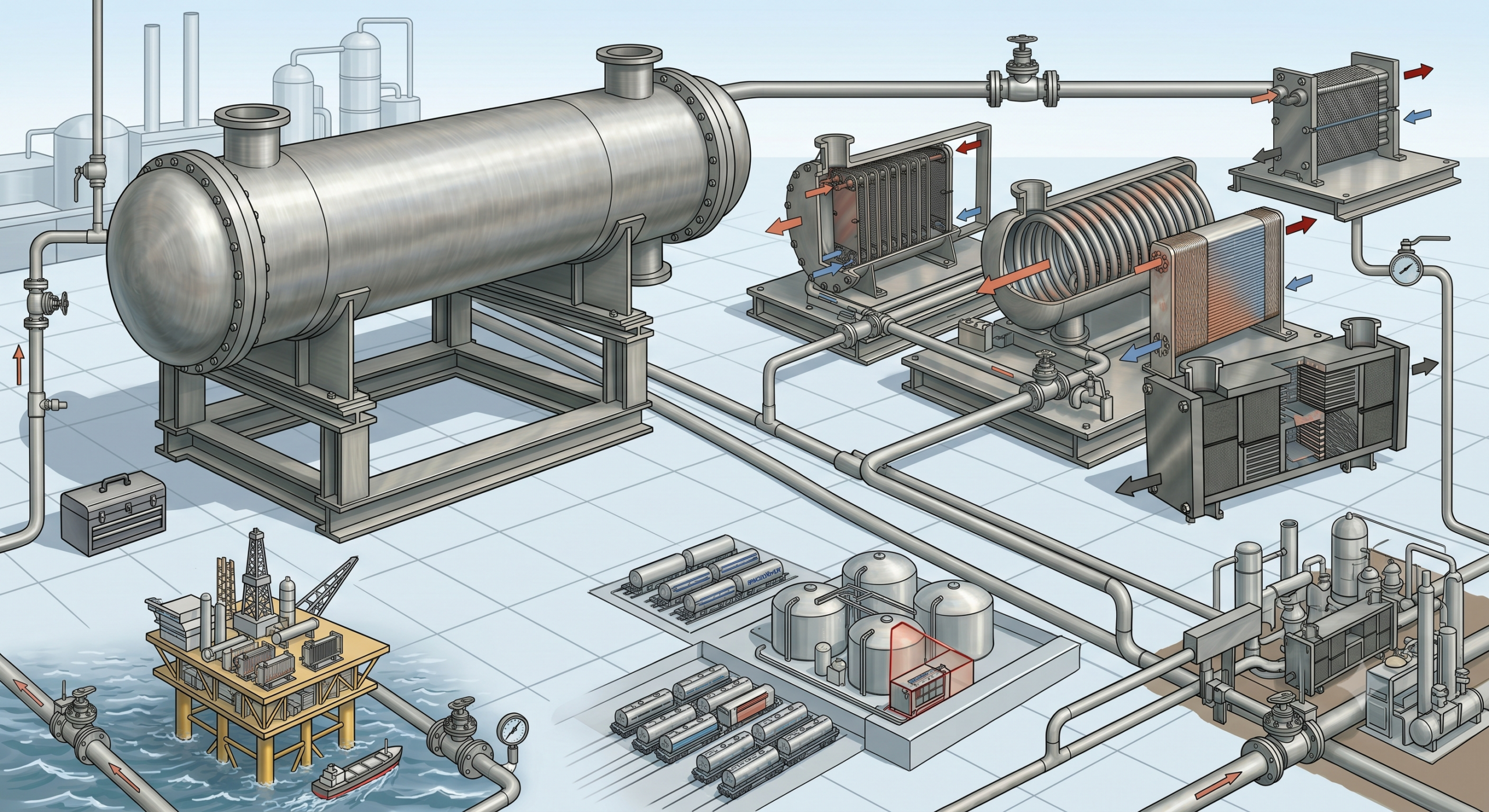
Plate Heat Exchangers
One of the most familiar compact designs is the plate heat exchanger.
Its compactness comes from:
- thin plates
- narrow flow channels
- large surface area within a small volume
Plate exchangers are often selected when:
- fluids are relatively clean
- high thermal efficiency is required
- space is limited
They are among the most widely used compact exchangers.
Plate-and-Shell Heat Exchangers
Plate-and-shell designs combine:
- compact plate technology
- shell-style pressure containment
This allows engineers to achieve:
- smaller footprint
- higher pressure capability
than many conventional plate exchangers.
They are increasingly used in refrigeration and cryogenic services.
Printed Circuit Heat Exchangers
Printed circuit heat exchangers represent one of the most compact industrial designs available.
They use:
- etched microchannels
- diffusion-bonded metal layers
to create extremely high surface area density.
Their compactness is particularly attractive in:
- LNG plants
- hydrogen systems
- offshore facilities
where space limitations are severe.
Brazed Plate Heat Exchangers
Brazed plate exchangers eliminate gaskets by permanently joining plates together.
This allows:
- smaller dimensions
- reduced leakage points
- improved compactness
They are commonly used in utility systems and packaged equipment.
Why Compact Exchangers Are Thermally Attractive
More Surface Area in Less Space
Traditional exchangers often require large bundles or long flow paths.
Compact designs achieve performance through:
- closely spaced surfaces
- enhanced turbulence
- improved surface utilization
As a result:
- thermal performance per unit volume increases
- equipment size decreases
This makes them attractive in energy recovery applications.
Better Fit for Modern Energy Integration
Heat Recovery Requires Close Temperature Approaches
Modern plants increasingly focus on:
- energy efficiency
- utility reduction
- waste heat recovery
Compact exchangers often achieve:
- tighter temperature approaches
- higher recovery efficiency
than larger conventional equipment.
This improves overall process integration.
The Hidden Trade-Off: Fouling Sensitivity
Compactness Often Means Narrow Passages
The biggest limitation of many compact exchangers is fouling.
To achieve compactness:
- channels become smaller
- flow passages become narrower
These features improve heat transfer but reduce tolerance for:
- solids
- scale
- sludge
- fibrous material
A compact exchanger may perform exceptionally well with clean fluids and very poorly with dirty fluids.
This trade-off must be understood clearly.
Maintenance Can Become More Challenging
Accessibility Is Often Reduced
Traditional shell-and-tube exchangers allow:
- mechanical cleaning
- tube replacement
- bundle inspection
Many compact designs do not.
Some compact exchangers:
- cannot be mechanically cleaned easily
- require chemical cleaning
- may need complete replacement if severely damaged
This changes maintenance strategy significantly.
High Pressure Capability Varies
Compact Does Not Always Mean Fragile
A common misconception is that compact exchangers are suitable only for low-pressure applications.
Some advanced designs handle:
- very high pressure
- demanding process conditions
However, capability depends heavily on exchanger type.
Selection must be based on actual service requirements rather than assumptions.
Lifecycle Cost Is More Important Than Purchase Cost
The Smallest Equipment Is Not Always the Cheapest Solution
Compact exchangers may offer:
- lower installation cost
- reduced structural cost
- smaller footprint
But they may also involve:
- higher fabrication cost
- specialized maintenance
- replacement challenges
Lifecycle evaluation is essential.
The correct choice depends on total ownership cost rather than initial purchase price.
Why Compact Exchangers Are Growing in Popularity
Industrial Priorities Are Changing
Historically, plants prioritized:
- robustness
- maintenance accessibility
- design familiarity
Today, many projects also prioritize:
- footprint reduction
- modular construction
- weight minimization
- energy efficiency
Compact exchangers align well with these priorities.
Their adoption continues to grow because industrial constraints are evolving.
When Compact Heat Exchangers Make Engineering Sense
Strong Selection Candidates
Compact exchangers are often attractive when:
- plot space is limited
- weight reduction is important
- fluids are relatively clean
- energy recovery is critical
- modular construction is planned
- offshore installation is involved
In these situations, their advantages become highly valuable.
When Conventional Designs Remain Better
Bigger Equipment Sometimes Wins
Traditional exchangers often remain preferable when:
- fouling is severe
- mechanical cleaning is required
- process fluids contain solids
- maintenance accessibility is critical
- very large capacities are involved
Compactness alone should never drive selection.
The process service must support the design.
Operator Perspective
Operators often appreciate compact exchangers because they:
- occupy little space
- provide excellent thermal performance
- respond quickly to process changes
However, they may also require:
- stricter fluid cleanliness
- closer monitoring of fouling
- specialized maintenance procedures
Operational discipline becomes more important.
Owner Perspective
From a business perspective, compact exchangers can provide:
- reduced plot requirements
- lower structural costs
- easier modularization
- improved energy recovery
But these benefits must be balanced against:
- maintenance philosophy
- replacement strategy
- lifecycle economics
The right answer depends on the entire project, not just the exchanger itself.
Why Compactness Is Becoming a Competitive Advantage
Industrial facilities are increasingly constrained by:
- space
- weight
- energy efficiency requirements
As these constraints become more important, compact exchanger technologies become more attractive.
Their role is likely to expand, particularly in:
- LNG facilities
- hydrogen projects
- offshore developments
- modular plants
- advanced energy recovery systems
The trend toward compactness is being driven by broader industry changes rather than exchanger technology alone.
Final Perspective
Compact heat exchangers exist because modern industrial projects increasingly face space and weight limitations.
By packing large heat transfer surfaces into small volumes, they offer solutions that conventional exchangers often cannot.
Their advantages include:
- reduced footprint
- lower weight
- improved thermal efficiency
- strong suitability for modern plant layouts
However, compactness comes with trade-offs involving:
- fouling tolerance
- maintenance accessibility
- lifecycle strategy
When size becomes a critical design constraint, compact heat exchangers can be the best engineering solution.
But like every exchanger type, their success depends not on how small they are—but on how well they match the realities of the service they are expected to handle.

A practicing chemical engineer with 17+ years of experience in process design, project execution, commissioning, and plant operations. Focused on practical engineering judgment beyond textbook explanations.