
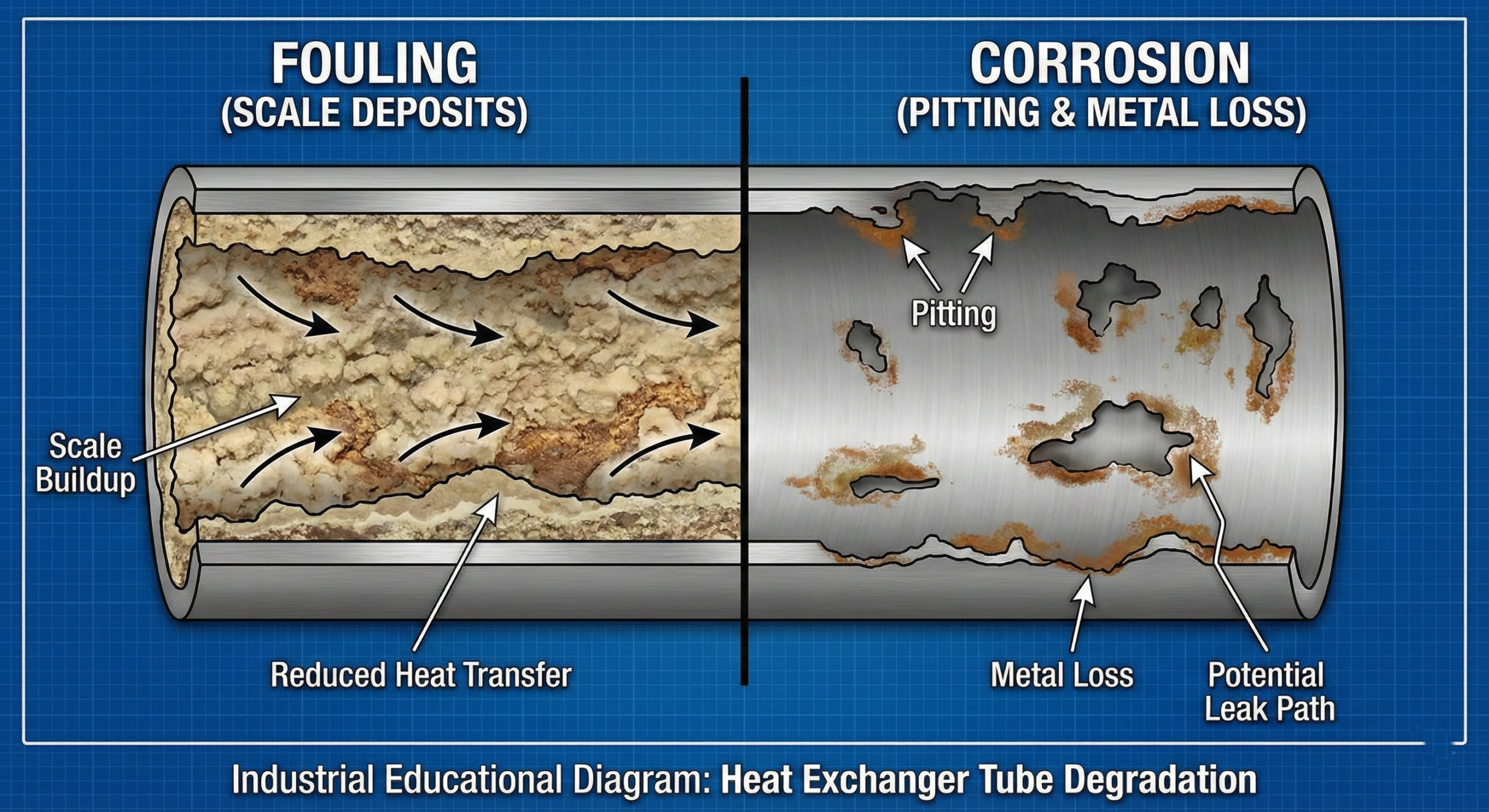
In operating plants, performance loss in heat exchangers is frequently described with a single word: “corrosion.”
In many cases, the real cause is fouling.
The confusion between fouling and corrosion is common because:
- both degrade performance,
- both worsen with time,
- both can exist simultaneously,
- both are hidden inside equipment.
Yet fouling and corrosion are fundamentally different phenomena. Treating one as the other leads to wrong corrective actions, unnecessary cost, and accelerated damage.
This article explains why fouling and corrosion are often confused, how they differ in behavior and impact, and why distinguishing between them is critical for effective plant decisions.
Table of Contents
Fouling and Corrosion Affect Performance in Different Ways
At a high level:
- Fouling adds thermal resistance.
- Corrosion removes metal and alters surface integrity.
Both reduce heat transfer performance — but through entirely different mechanisms.
Understanding which mechanism dominates determines whether the right response is:
- cleaning,
- chemical treatment,
- material upgrade,
- operating change,
- or mechanical repair.
Fouling Is an Additive Problem
Fouling works by adding something to the heat transfer surface.
Examples include:
- scale,
- sludge,
- polymer films,
- biological growth,
- corrosion products that redeposit.
The effects of fouling:
- increase thermal resistance,
- reduce effective heat transfer coefficient,
- consume temperature driving force,
- increase energy consumption.
Fouling does not remove metal.
It blocks heat flow.
Corrosion Is a Subtractive Problem
Corrosion works by removing metal.
Examples include:
- general wall thinning,
- pitting,
- crevice corrosion,
- erosion–corrosion.
The effects of corrosion:
- reduce wall thickness,
- weaken mechanical integrity,
- increase leakage risk,
- alter surface roughness.
Corrosion threatens equipment life and safety, not just performance.
Why Their Symptoms Look Similar
Despite different mechanisms, fouling and corrosion produce overlapping symptoms:
- declining heat duty,
- rising utility consumption,
- unstable temperature control,
- shortened operating cycles.
From the control room, both look like “the exchanger is getting worse.”
Without inspection or trend analysis, it is easy to assume corrosion — especially because corrosion is more familiar and feared.
Fouling Is Usually the First Culprit
In most services:
- fouling develops faster than corrosion,
- fouling causes performance loss earlier,
- corrosion progresses more slowly.
As a result:
- early performance degradation is usually fouling,
- corrosion becomes significant later in equipment life.
Mistaking early fouling for corrosion leads to overreaction.
Cleaning Improves Fouling — Not Corrosion
One of the clearest distinctions is response to cleaning.
- If cleaning restores performance quickly → fouling was dominant.
- If cleaning has little effect → corrosion or geometry damage may dominate.
When performance recovers after cleaning:
- corrosion did not suddenly reverse,
- the improvement came from removing resistance.
Ignoring this clue often leads to unnecessary material changes or revamps.
Corrosion Often Makes Fouling Worse
Although distinct, fouling and corrosion are not independent.
Corrosion:
- roughens surfaces,
- creates pits and crevices,
- produces corrosion products that redeposit.
These effects:
- accelerate fouling,
- make deposits harder to remove,
- shorten cleaning intervals.
This interaction deepens the confusion, as fouling appears to “get worse” even though corrosion is the underlying enabler.
Why Fouling Is Blamed on Corrosion Chemistry
Plants often associate fouling with:
- oxygen ingress,
- pH deviation,
- chemical imbalance.
These conditions also affect corrosion.
As a result:
- fouling is blamed on corrosion chemistry,
- corrective action focuses on metallurgy,
- cleaning and flow distribution issues are overlooked.
In many cases, chemistry adjustments reduce corrosion but leave fouling unchanged.
Fouling Is a Thermal Problem; Corrosion Is a Mechanical One
A useful way to distinguish them is by their primary impact:
- Fouling limits thermal performance first.
- Corrosion limits mechanical life first.
If the primary concern is:
- rising energy consumption → suspect fouling.
- thinning walls or leaks → suspect corrosion.
Confusing the two shifts attention to the wrong risk.
Inspection Timing Reinforces Confusion
Inspections are infrequent.
Fouling evolves continuously.
When inspections finally occur:
- deposits are seen,
- corrosion damage may also be visible,
- cause-and-effect is unclear.
By then:
- fouling caused months of energy loss,
- corrosion progressed quietly underneath.
The plant sees everything at once and assumes a single root cause.
Why Over-Cleaning Can Accelerate Corrosion
When fouling is mistaken for corrosion, plants often respond with:
- aggressive mechanical cleaning,
- frequent chemical cleaning.
This can:
- strip protective oxide layers,
- expose fresh metal,
- accelerate corrosion.
The exchanger becomes cleaner — and weaker.
Misdiagnosis turns a manageable fouling problem into a corrosion problem.
Corrective Actions Depend on Correct Diagnosis
If fouling dominates:
- improve flow distribution,
- adjust velocity,
- optimize cleaning interval,
- manage temperature profiles.
If corrosion dominates:
- address metallurgy,
- control chemistry,
- reduce erosion,
- redesign vulnerable zones.
Applying corrosion solutions to fouling problems wastes money.
Applying fouling solutions to corrosion problems risks failure.
Owner Perspective: Confusion Is Expensive
From an ownership standpoint, confusing fouling with corrosion leads to:
- unnecessary material upgrades,
- premature exchanger replacement,
- excessive cleaning cost,
- unresolved energy inefficiency.
Correctly distinguishing the two:
- focuses spending where it matters,
- improves reliability,
- extends asset life.
The cost of misdiagnosis is paid repeatedly.
Final Perspective
Fouling and corrosion are not the same problem.
They look similar from a distance, progress together over time, and interact in complex ways — which is why they are often confused.
But they require very different responses.
Plants that learn to distinguish fouling from corrosion:
- clean less aggressively,
- spend capital more wisely,
- protect equipment life,
- and solve the real problem instead of the visible one.
Understanding why fouling and corrosion are often confused is not academic detail.
It is practical plant intelligence — and it saves money, time, and equipment.
Explore the complete series in the Heat Transfer Engineering Hub.

A practicing chemical engineer with 17+ years of experience in process design, project execution, commissioning, and plant operations. Focused on practical engineering judgment beyond textbook explanations.