In most textbooks, heat exchangers are described in one clean sentence:
They transfer heat from one fluid to another.
That definition is correct.
But it does not describe what heat exchangers actually do inside operating process plants.
In real facilities, heat exchangers are not background equipment.
They are not secondary devices.
They are not passive utilities.
They actively shape:
- how units behave
- how stable operations remain
- how much throughput is possible
- how much energy is consumed
- how reliable equipment stays over years
This article explores the true role of heat exchangers in process plants — not from a theoretical heat transfer angle, but from how they influence plant performance every single day.
We are not discussing equations here.
We are discussing operational reality.
Table of Contents
Heat Exchangers Create Operating Windows
Every process unit operates within a temperature window.
Too cold:
- reactions slow down
- separation becomes poor
- viscosity increases
- pumps struggle
Too hot:
- degradation begins
- materials stress
- side reactions form
- safety risks rise
Heat exchangers create and maintain that window.
They allow processes to operate where chemistry and physics behave predictably.
Without them, temperature would drift — and process control would collapse.
They Decide Reaction Behavior
In reaction systems, temperature is not just a parameter. It is a driver.
Reaction rate depends on temperature.
Selectivity depends on temperature.
By-product formation depends on temperature.
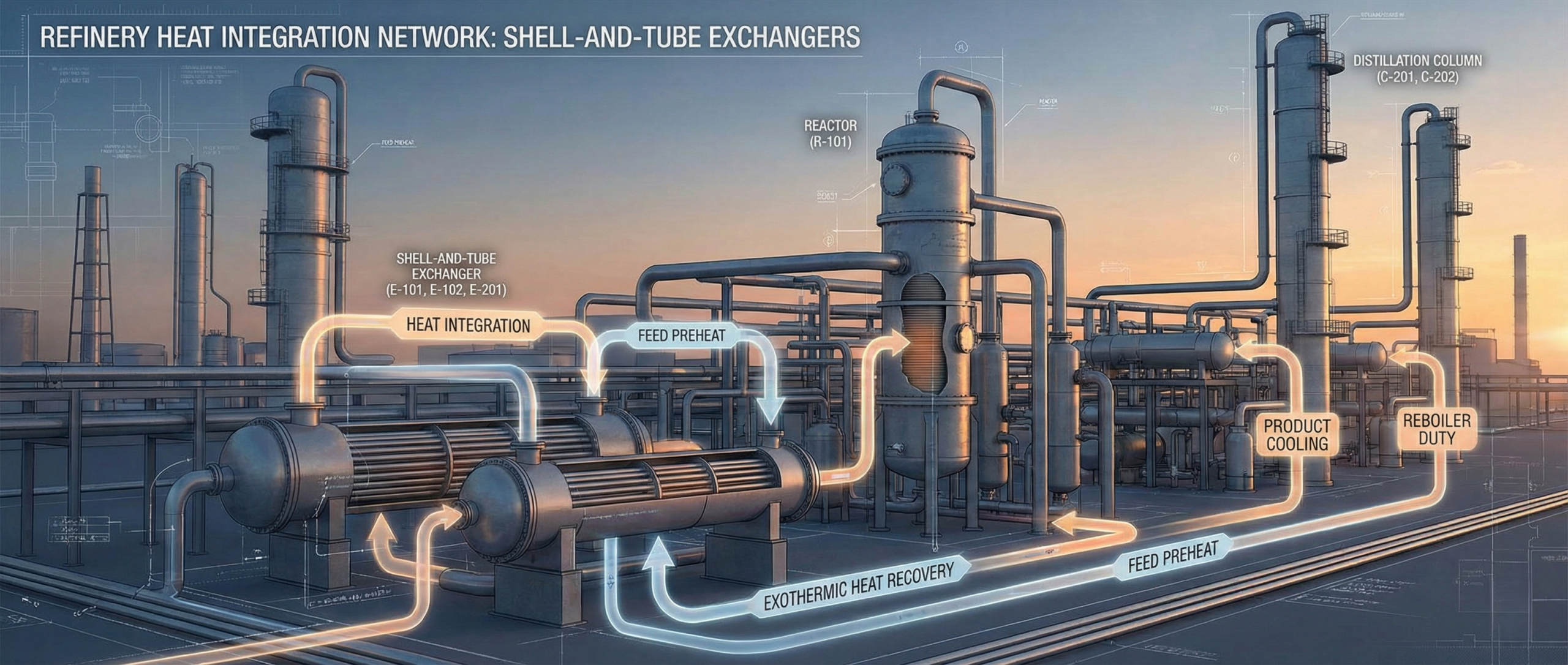
Heat exchangers connected to reactors:
- preheat feed streams
- remove excess heat
- stabilize exothermic reactions
- control endothermic reactions
If exchanger performance shifts:
- conversion shifts
- product distribution shifts
- downstream separation becomes unstable
So heat exchangers do not just “support” reactors.
They define how reactors behave.
They Make Separation Possible
In distillation systems, separation depends on controlled vaporization and condensation.
The reboiler:
- generates vapor
- drives mass transfer upward
The condenser:
- removes heat
- controls reflux
If reboiler duty drops:
- separation weakens
- bottom composition drifts
If condenser performance declines:
- column pressure rises
- overhead purity suffers
In many column troubleshooting cases, the issue is not inside the column.
It is inside the heat exchangers attached to it.
They Manage Fluid Properties
Temperature influences physical properties:
- viscosity
- density
- vapor pressure
- solubility
When fluids become too viscous:
- flow becomes unstable
- pressure drop rises
- energy consumption increases
Heat exchangers ensure fluids remain within pumpable and processable ranges.
In heavy hydrocarbon systems, this is not optional.
It is operational survival.
They Protect Equipment Downstream
Many pieces of equipment have temperature limits:
- pumps
- compressors
- mechanical seals
- filters
- membranes
Heat exchangers cool streams before they reach sensitive components.
Without that cooling:
- equipment life reduces
- failures increase
- maintenance cost rises
So exchangers act as thermal guards within the plant.
They Define Throughput Limits
During debottlenecking studies, one reality appears frequently:
The bottleneck is often a heat exchanger.
When production increases:
- more heat must be removed or supplied
- temperature targets must still be achieved
If exchangers cannot handle the additional duty:
- outlet temperatures shift
- process stability reduces
- throughput becomes limited
In many revamps, replacing or upgrading exchangers unlocks capacity.
Not modifying reactors.
Not resizing columns.
But improving heat exchange.
They Shape Energy Efficiency
Modern plants aim to reduce energy consumption.
Instead of discarding heat, they recover it:
- hot streams preheat cold streams
- waste heat reduces steam demand
- cooling loads are minimized
This energy integration depends entirely on process-to-process heat exchangers.
If these exchangers:
- foul
- degrade
- lose performance
energy efficiency drops.
Fuel consumption rises.
Operating cost increases.
So exchangers directly influence plant economics.
They Influence Control Stability
Temperature control loops depend on stable heat exchange.
If exchanger response becomes slow or inconsistent:
- temperature oscillations appear
- control valves fluctuate
- upstream units feel instability
Many unstable control loops trace back to exchanger behavior:
- fouling
- maldistribution
- vapor pockets
- utility variation
Stable heat exchange supports stable control.
They Determine Startup and Shutdown Behavior
Plants do not operate only at steady state.
Startup and shutdown periods stress equipment.
Heat exchangers:
- manage gradual heating
- prevent thermal shock
- distribute temperature evenly
- control cooldown rates
Improper temperature ramping can cause:
- expansion stress
- gasket leaks
- tube damage
So exchangers influence mechanical integrity during transitions.
They Affect Product Quality
In many processes, product properties depend on temperature history.
Examples include:
- crystallization
- polymer formation
- moisture removal
- final drying
If cooling is too fast:
- product structure changes
If heating is uneven:
- reaction completion shifts
Heat exchangers control the thermal profile that defines quality.
Small temperature variations can create large quality differences.
They Interconnect Plant Systems
Heat exchangers are not isolated devices.
They connect:
- process units
- utility networks
- upstream and downstream operations
A change in one exchanger can influence:
- steam demand
- cooling water temperature
- column pressure
- pump load
They are nodes in the plant energy network.
Their performance affects multiple systems simultaneously.
They Drive Maintenance Planning
Heat exchangers require:
- cleaning
- inspection
- tube bundle pulling
- gasket replacement
Their condition influences:
- turnaround duration
- maintenance manpower
- plant availability
In many units, exchanger cleaning frequency determines shutdown intervals.
So exchanger performance affects production planning.
They Influence Safety Margins
Temperature excursions can lead to:
- runaway reactions
- material degradation
- pressure spikes
Heat exchangers are part of temperature control strategies.
If cooling is insufficient:
- risk increases
If heating is unstable:
- process behavior changes
Reliable heat exchange supports safe operation.
They Are Silent Until They Fail
Unlike rotating equipment, heat exchangers:
- do not create noise
- do not visibly move
- do not draw attention
But when they fail or degrade:
- product drifts
- energy consumption rises
- pressure drop increases
- throughput falls
Their influence is constant, even if unnoticed.
Operator Perspective
Operators experience exchanger behavior through:
- slower heating
- rising utility consumption
- fluctuating temperatures
- increasing pressure drop
They may not see the inside of the exchanger.
But they feel its performance daily.
Engineer Perspective
For engineers, exchangers represent:
- thermal margin
- fouling behavior
- capacity constraint
- integration opportunity
- revamp potential
Understanding exchanger behavior often solves plant mysteries.
Owner Perspective
From a business standpoint, exchangers affect:
- fuel usage
- cooling cost
- product yield
- maintenance budget
- plant uptime
They are long-term assets influencing profitability.
Why “Beyond Simple Heat Transfer” Matters
If exchangers are seen only as heat transfer devices, they are undervalued.
In reality, they:
- enable reactions
- drive separations
- manage energy
- protect assets
- shape throughput
- define efficiency
They are process-defining equipment.
Not just thermal accessories.
Final Perspective
Heat exchangers do not simply move heat.
They control how the plant behaves.
They influence:
- reaction stability
- separation efficiency
- energy consumption
- throughput limits
- product quality
- maintenance strategy
In many plants, improving exchanger performance improves the entire unit.
Understanding what heat exchangers actually do — beyond simple heat transfer — changes how they are designed, operated, and valued.
They are not background equipment.
They are central to process performance.

A practicing chemical engineer with 17+ years of experience in process design, project execution, commissioning, and plant operations. Focused on practical engineering judgment beyond textbook explanations.