
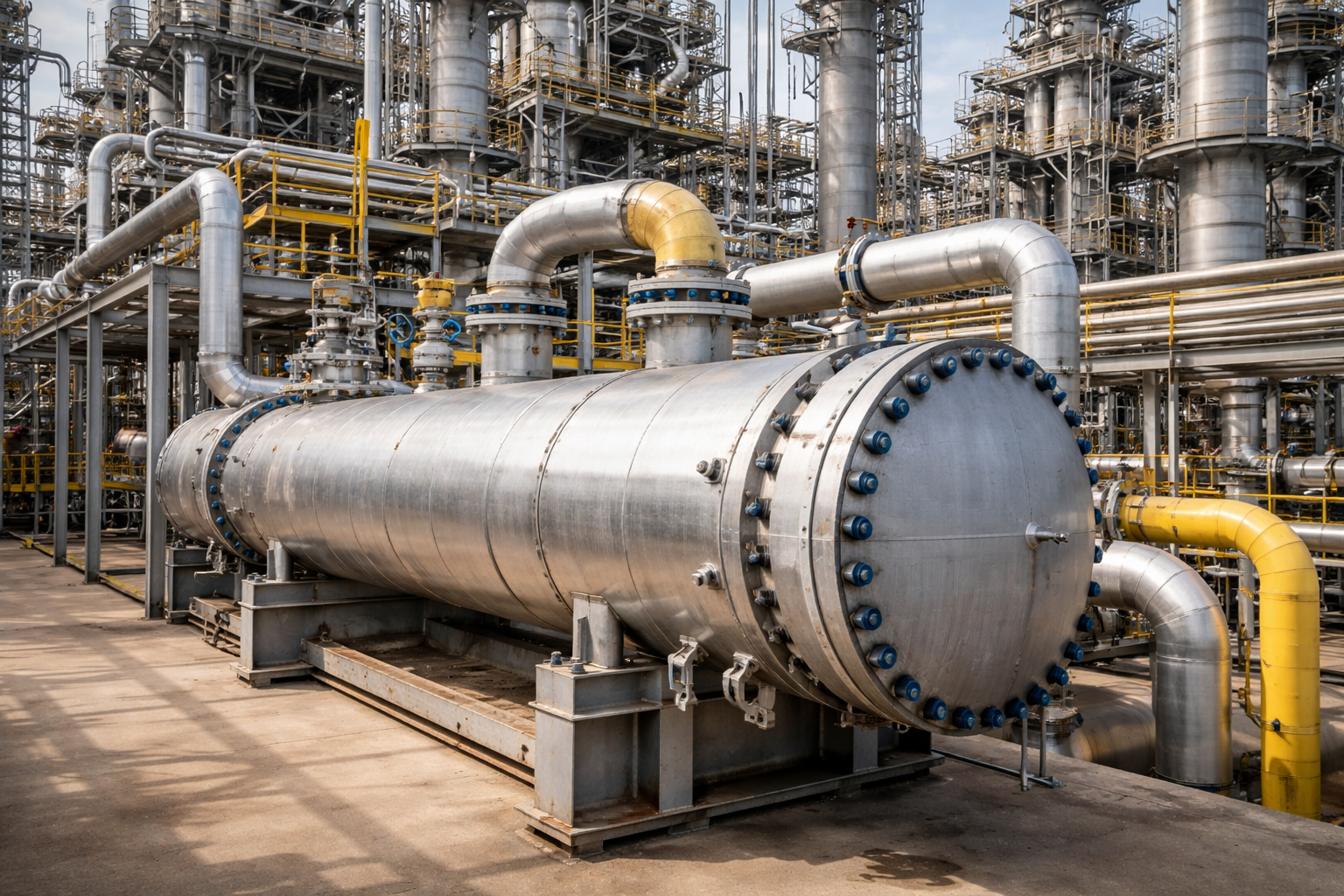
Heat transfer is one of those subjects that everyone in the process industry encounters early, but very few fully understand in practice.
Definitions are easy to learn. Equations are easy to apply.
Yet in real plants, heat transfer behaves very differently from how it appears on paper.
The purpose of this article is not to repeat textbook definitions, but to explain what heat transfer actually means inside operating process plants, how it influences day-to-day performance, and why so many persistent plant problems are thermal in nature.
This explanation is intended to be:
- clear enough for non-engineers,
- structured enough for beginners,
- meaningful for practicing engineers,
- and insightful for plant owners and decision-makers.
Table of Contents
The Simplest View of a Process Plant
At its core, every process plant performs only three functions:
- material is moved
- material is transformed
- energy is transferred
The first two are visible and obvious.
The third happens quietly, continuously, and often without direct attention.
Whenever energy moves because of a temperature difference, heat transfer is occurring.
This movement of heat determines:
- whether reactions stay under control,
- whether separation works as intended,
- whether equipment performs as designed,
- and whether utilities remain sufficient over time.
Ignoring heat transfer does not stop it.
It only removes the ability to predict and manage its consequences.
Why Heat Transfer Appears Everywhere in a Plant
Heat transfer does not occur only in heat exchangers or fired equipment.
It occurs wherever a temperature difference exists.
This includes:
- piping exposed to ambient conditions,
- vessels connected through metal nozzles,
- storage tanks affected by daily temperature swings,
- reactors with internal coils or jackets,
- even idle lines during shutdown.
In many cases, heat transfer was never intentionally designed at those locations — yet it still influences plant behavior.
This is why:
- products cool or heat unexpectedly,
- viscosity changes along pipelines,
- utilities demand slowly increases over time,
- seasonal variations affect plant stability.
Heat transfer is not selective.
It occurs wherever physics allows it.
Heat and Temperature Are Not the Same Thing
One of the most common sources of misunderstanding in plants is the assumption that heat and temperature mean the same thing.
They do not.
Temperature describes how hot or cold something is.
Heat describes energy in motion due to temperature difference.
This distinction is not academic — it affects real decisions.
A small object at high temperature may contain little total energy.
A large system at moderate temperature may contain enormous thermal energy.
Plant upsets, safety risks, and performance losses usually occur not because temperature is high or low, but because heat moves at a rate different from what was expected.
Understanding this difference between heat and temperature is essential before attempting any meaningful analysis or design.
How Heat Moves Inside Process Plants
In practice, heat transfer in plants occurs through three physical mechanisms.
Conduction — Through Solid Materials
Conduction is the movement of heat through solids such as:
- metal walls,
- pipe supports,
- vessel shells,
- exchanger tubes.
No fluid motion is required.
As long as a temperature difference exists, heat will flow through the material.
In real plants, this behavior is better understood through conduction in process equipment, where solid materials continuously transfer heat even when fluids are not moving.
This explains why:
- insulation quality matters,
- nozzle design influences heat loss,
- thermal bridges cause localized problems,
- equipment continues to exchange heat even when idle.
Conduction is often underestimated because it is silent and slow — yet persistent.
Convection — Carried by Moving Fluids
Convection is responsible for the majority of heat transfer in process equipment.
Whenever a fluid flows:
- inside a pipe,
- through exchanger tubes,
- within a vessel,
- across heating or cooling surfaces,
Heat is transferred along with the motion of the fluid. In real operations, this behavior is explored in greater depth under convective heat transfer in process plants, where fluid movement becomes the dominant thermal mechanism in most equipment.
This mode of heat transfer is sensitive to:
- flow velocity,
- fluid properties,
- surface condition,
- fouling and scaling.
Most long-term performance degradation in plants is linked to changes in convective heat transfer rather than design errors.
Radiation — Transfer Without Contact
Radiation becomes significant at higher temperatures.
It does not require a medium and occurs through electromagnetic waves.
In process plants, radiation plays an important role in:
- furnaces,
- fired heaters,
- high-temperature reactors,
- hot equipment surfaces affecting safety and insulation performance.
A broader technical discussion of radiation heat transfer in process plants explores how surface emissivity, geometry, and equipment configuration influence real operating behavior.
Although often overlooked, radiation can dominate heat transfer under certain conditions and must be respected accordingly.
Where Heat Transfer Influences Real Equipment
Heat transfer directly affects nearly every major piece of process equipment.
Heat Exchangers
Design calculations often assume clean surfaces and ideal flow distribution.
In operation, fouling, maldistribution, and property changes reduce actual performance.
Reactors
Reaction rates and selectivity depend strongly on temperature control.
Inadequate heat removal can cause instability, reduced yield, or safety concerns.
Distillation Columns
Separation efficiency depends on maintaining correct temperature gradients.
Small deviations in heat input or removal can affect product purity.
Storage Systems
Ambient heat gain or loss affects viscosity, vapor pressure, and emissions.
Piping Networks
Long pipelines exchange heat continuously with surroundings, affecting pump sizing, flow regime, and downstream performance.
Utility Systems
Steam, cooling water, and thermal fluids exist solely to manage heat transfer.
Their limitations often define plant capacity.
Why Thermal Issues Dominate Plant Performance Problems
Many chronic plant problems share common symptoms:
- gradual capacity loss,
- increasing utility consumption,
- unstable control loops,
- seasonal performance variation,
- frequent operator intervention.
In most cases, these are not mechanical or chemical problems.
They are thermal problems — a reflection of how heat transfer ultimately governs plant behavior across process systems.
Heat transfer surfaces foul.
Flow regimes change.
Properties drift with temperature.
Margins slowly disappear.
Plants rarely fail suddenly due to heat transfer.
They deteriorate gradually.
Recognizing that most plant performance issues are thermal is a major step toward sustainable plant performance.
Experience Changes How Heat Transfer Is Viewed
Less experienced engineers often try to control heat strictly through calculations.
More experienced engineers focus on:
- understanding heat paths,
- anticipating degradation,
- allowing realistic margins,
- respecting operational variability.
Heat transfer follows physical laws, not design intent.
Successful plants are those where thermal behavior is understood, respected, and continuously managed — not merely calculated once during design.
Why Heat Transfer Matters to Plant Owners
For owners and decision-makers, heat transfer directly affects:
- energy cost,
- plant throughput,
- maintenance frequency,
- safety margins,
- long-term reliability.
Poor thermal understanding results in:
- excessive fuel consumption,
- overworked utilities,
- recurring shutdowns,
- declining profitability.
Good thermal management improves:
- stability,
- predictability,
- equipment life,
- overall return on investment.
Heat transfer is not a background technical detail.
It is a core driver of plant economics.
Closing Perspective
Heat transfer rarely demands attention when it works well.
It becomes visible only when it is misunderstood.
Plants that perform reliably do so because heat transfer was respected — during design, during operation, and during troubleshooting.
Understanding heat transfer is not about mastering equations.
It is about understanding how energy actually moves inside real systems.
This is where that understanding begins.
Understanding heat transfer in process plants naturally leads to a deeper question:
Why does heat move at all — even without pumps, fans, or operator action?
Why Heat Transfer Always Occurs
This next article explains why heat transfer is inevitable whenever a temperature difference exists, and why plant systems continuously move toward thermal balance whether we intend it or not.
Explore the complete series in the Heat Transfer Engineering Hub.

A practicing chemical engineer with 17+ years of experience in process design, project execution, commissioning, and plant operations. Focused on practical engineering judgment beyond textbook explanations.