
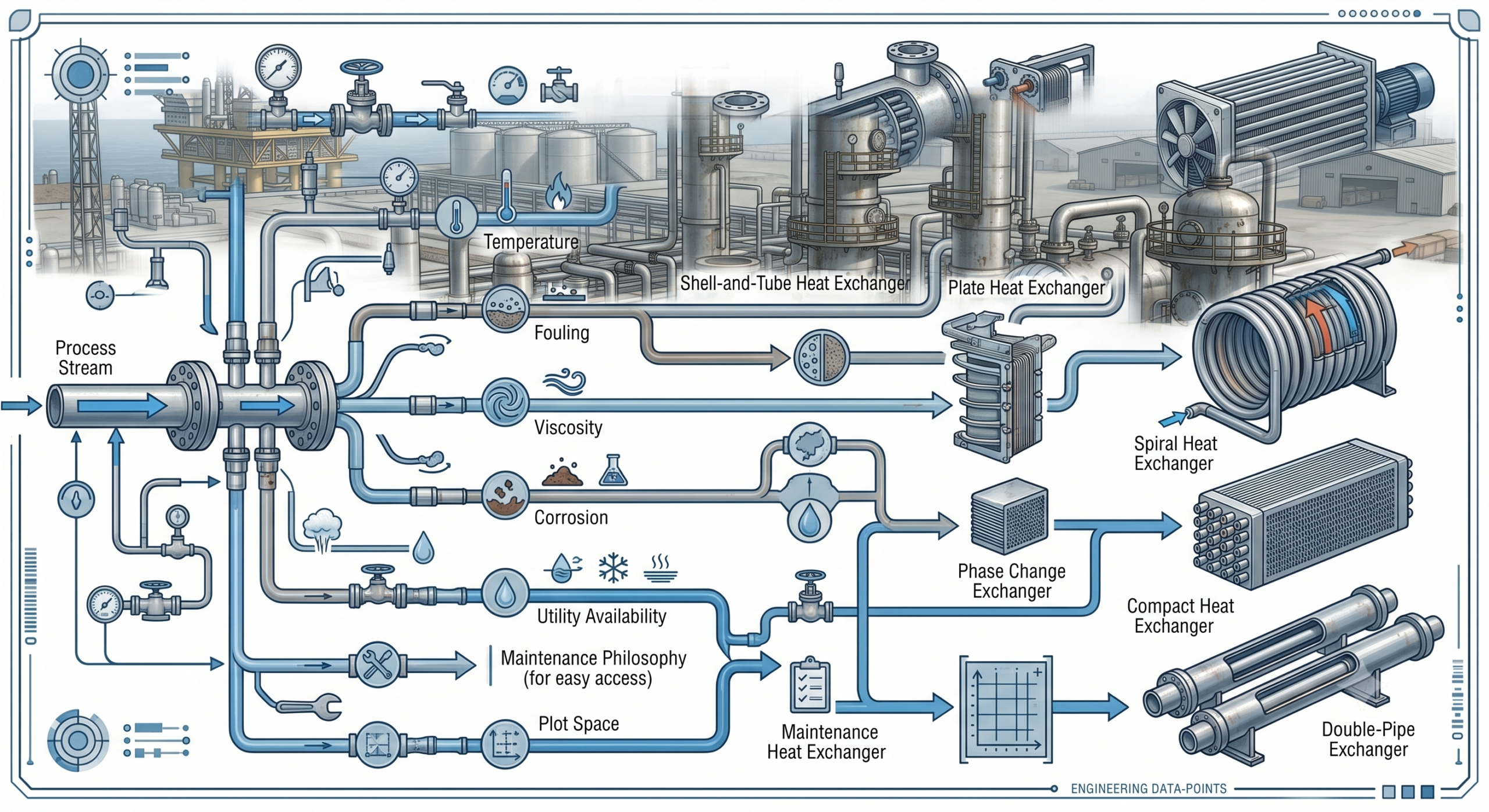
Many young engineers assume heat exchanger selection starts with heat duty.
The logic seems reasonable:
- Calculate required heat transfer.
- Size the exchanger.
- Select the equipment.
In reality, experienced engineers rarely start there.
Two exchangers may be capable of performing exactly the same heat duty, yet only one may survive actual plant operation.
Why?
Because exchanger selection is often driven more by process conditions than by thermal duty itself.
Factors such as:
- pressure
- temperature
- fouling tendency
- fluid properties
- phase change behavior
- maintenance philosophy
- utility availability
frequently determine which exchanger type is practical.
This article explains the process conditions that influence heat exchanger selection and why understanding them is essential for making the right engineering decision.
Heat Duty Does Not Automatically Decide Equipment Type
Multiple Exchanger Types Can Meet the Same Duty
Consider a cooling duty of 5 MW.
That duty might theoretically be handled by:
- a shell-and-tube exchanger
- a plate heat exchanger
- an air-cooled exchanger
- a compact exchanger
The heat duty alone does not tell us which one should be selected.
The final decision depends on the environment in which the exchanger must operate.
That is where process conditions become critical.
Pressure Is Often the First Screening Parameter
High Pressure Eliminates Many Options
Pressure significantly influences exchanger selection.
As operating pressure increases:
- mechanical loads increase
- sealing becomes more difficult
- material thickness increases
Certain exchanger types are naturally better suited to high-pressure operation.
Typical Selection Impact
For moderate-pressure liquid services:
- plate exchangers may be suitable
For severe pressure conditions:
- shell-and-tube exchangers often become preferred
For extremely high-pressure specialized services:
- compact high-pressure designs may be considered
The higher the pressure, the more mechanical integrity influences selection.
Temperature Strongly Influences Equipment Choice
Thermal Conditions Affect Both Materials and Design
High-temperature operation creates challenges such as:
- thermal expansion
- gasket degradation
- material stress
- cyclic fatigue
An exchanger that performs well at moderate temperature may become unsuitable at elevated temperatures.
Practical Selection Effects
As temperature increases:
- shell-and-tube designs often become more attractive
- gasket limitations become more important
- expansion accommodation becomes critical
Temperature frequently narrows the range of practical exchanger choices.
Fouling Tendency Is One of the Most Important Factors
Dirty Fluids Change Everything
Many process streams contain:
- suspended solids
- corrosion products
- catalyst particles
- scale-forming compounds
- heavy hydrocarbons
These materials create fouling.
And fouling can dominate exchanger selection.
Why Fouling Matters
An exchanger with excellent thermal efficiency may become a poor choice if it fouls rapidly.
The ability to:
- inspect
- clean
- maintain
often becomes more important than thermal performance.
This is one reason shell-and-tube exchangers remain common in heavy industry.
Fluid Viscosity Influences Flow Behavior
Not All Fluids Move Easily
Low-viscosity fluids generally flow without difficulty.
Highly viscous fluids behave differently.
Examples include:
- heavy oils
- polymers
- resins
- concentrated solutions
Viscous fluids can create:
- high pressure drop
- poor flow distribution
- reduced heat transfer performance
Certain exchanger designs handle these conditions better than others.
Fluid viscosity is therefore a key selection parameter.
Corrosiveness Drives Material and Design Choices
The Fluid May Be More Challenging Than the Duty
Some streams are highly corrosive.
Examples include:
- acidic solutions
- chloride-containing fluids
- aggressive chemical mixtures
In these cases, material selection becomes critical.
The exchanger type must accommodate:
- suitable metallurgy
- fabrication requirements
- inspection methods
Sometimes the corrosion challenge influences exchanger selection more than the heat transfer requirement itself.
Phase Change Often Narrows the Options
Condensation and Boiling Require Special Consideration
Many industrial duties involve:
- vapor condensation
- liquid vaporization
- reboiling
- evaporation
Phase change creates unique flow and distribution requirements.
Not every exchanger type handles these duties equally well.
Why It Matters
Equipment must manage:
- vapor distribution
- liquid drainage
- pressure control
- phase separation
For many phase-change services, shell-and-tube exchangers remain the preferred solution because of their flexibility and proven operating history.
Pressure Drop Constraints Influence Selection
Thermal Performance Is Not the Only Objective
A heat exchanger may provide excellent heat transfer while creating excessive pressure drop.
This can increase:
- pumping cost
- compressor load
- operating expense
Pressure drop limits often become selection constraints.
Engineers must balance:
- thermal performance
- hydraulic performance
An exchanger that satisfies both requirements is usually preferred.
Utility Availability Shapes the Decision
Cooling Medium Selection Matters
The available utility often determines exchanger type.
For example:
If cooling water is readily available:
- water-cooled exchangers become attractive
If water is scarce:
- air coolers may become necessary
Similarly, heating duties may depend on:
- steam availability
- hot oil systems
- process-to-process heat recovery
Utility infrastructure directly affects exchanger selection.
Plot Space Can Become a Major Constraint
The Best Thermal Design Must Still Fit the Plant
In brownfield facilities, space is often limited.
Engineers may face restrictions involving:
- equipment spacing
- pipe routing
- structural loading
- access requirements
Under these conditions:
- compact exchangers
- plate exchangers
- specialized designs
may become attractive even if other options perform equally well thermally.
The available footprint can influence equipment choice significantly.
Maintenance Philosophy Influences Selection
Different Plants Operate Differently
Some facilities prioritize:
- long operating campaigns
- infrequent shutdowns
Others perform regular maintenance and cleaning.
The plant’s maintenance strategy influences exchanger selection.
Questions often include:
- How will cleaning be performed?
- How frequently is fouling expected?
- Is mechanical cleaning required?
- How accessible must the equipment be?
Maintenance requirements often eliminate otherwise attractive options.
Reliability Expectations Matter
Critical Services Demand Conservative Choices
Some exchangers support:
- major reactors
- primary distillation systems
- critical utility services
Failure in these applications may have major production consequences.
In critical services, proven reliability often outweighs:
- compactness
- efficiency
- novelty
The importance of the service influences the level of conservatism in equipment selection.
Future Expansion Requirements Must Be Considered
Today’s Design May Not Be Tomorrow’s Design
Many facilities anticipate future capacity increases.
Engineers must consider:
- exchanger expansion potential
- additional area requirements
- operational flexibility
Some exchanger types are easier to expand than others.
Planning for future growth can influence the initial selection decision.
Why Selection Is Always a Trade-Off
No Exchanger Type Is Best at Everything
Every exchanger design has strengths and weaknesses.
A plate exchanger may offer:
- excellent efficiency
- compact size
A shell-and-tube exchanger may offer:
- superior maintainability
- better fouling tolerance
An air cooler may eliminate water consumption but require more space.
Selection involves balancing competing priorities rather than maximizing a single parameter.
Typical Selection Sequence Used by Experienced Engineers
The Practical Decision Path
Experienced engineers often evaluate:
- Process pressure
- Operating temperature
- Phase behavior
- Fouling tendency
- Fluid properties
- Pressure drop limits
- Utility availability
- Plot constraints
- Maintenance philosophy
- Lifecycle economics
Only after these factors are understood does the final exchanger type become obvious.
Operator Perspective
Operators ultimately live with the consequences of exchanger selection.
Poor selection can create:
- frequent cleaning
- unstable operation
- difficult maintenance
- reduced availability
Good selection often goes unnoticed because the equipment performs reliably for years.
That is usually the goal.
Owner Perspective
For plant owners, exchanger selection affects:
- capital investment
- operating cost
- maintenance expense
- plant uptime
- future flexibility
The lowest purchase price rarely represents the best long-term choice.
Lifecycle performance is what ultimately matters.
Why Understanding Process Conditions Matters More Than Memorizing Exchanger Types
Many engineers try to learn exchanger selection by memorizing:
- shell-and-tube applications
- plate exchanger applications
- air cooler applications
A better approach is understanding process conditions.
Once the service conditions are understood, the appropriate exchanger type often becomes obvious.
Selection becomes an engineering decision rather than a rule-following exercise.
Final Perspective
Heat exchanger selection is rarely determined by heat duty alone.
The real drivers are the process conditions surrounding the duty.
Factors such as:
- pressure
- temperature
- fouling
- viscosity
- corrosion
- phase change
- utility availability
- maintenance requirements
often determine which exchanger type will succeed in long-term operation.
The most effective engineers do not begin by asking:
“Which exchanger should I use?”
They begin by asking:
“What conditions must the exchanger survive?”
The answer to that question usually determines the correct exchanger type long before the thermal calculations are completed.

A practicing chemical engineer with 17+ years of experience in process design, project execution, commissioning, and plant operations. Focused on practical engineering judgment beyond textbook explanations.