
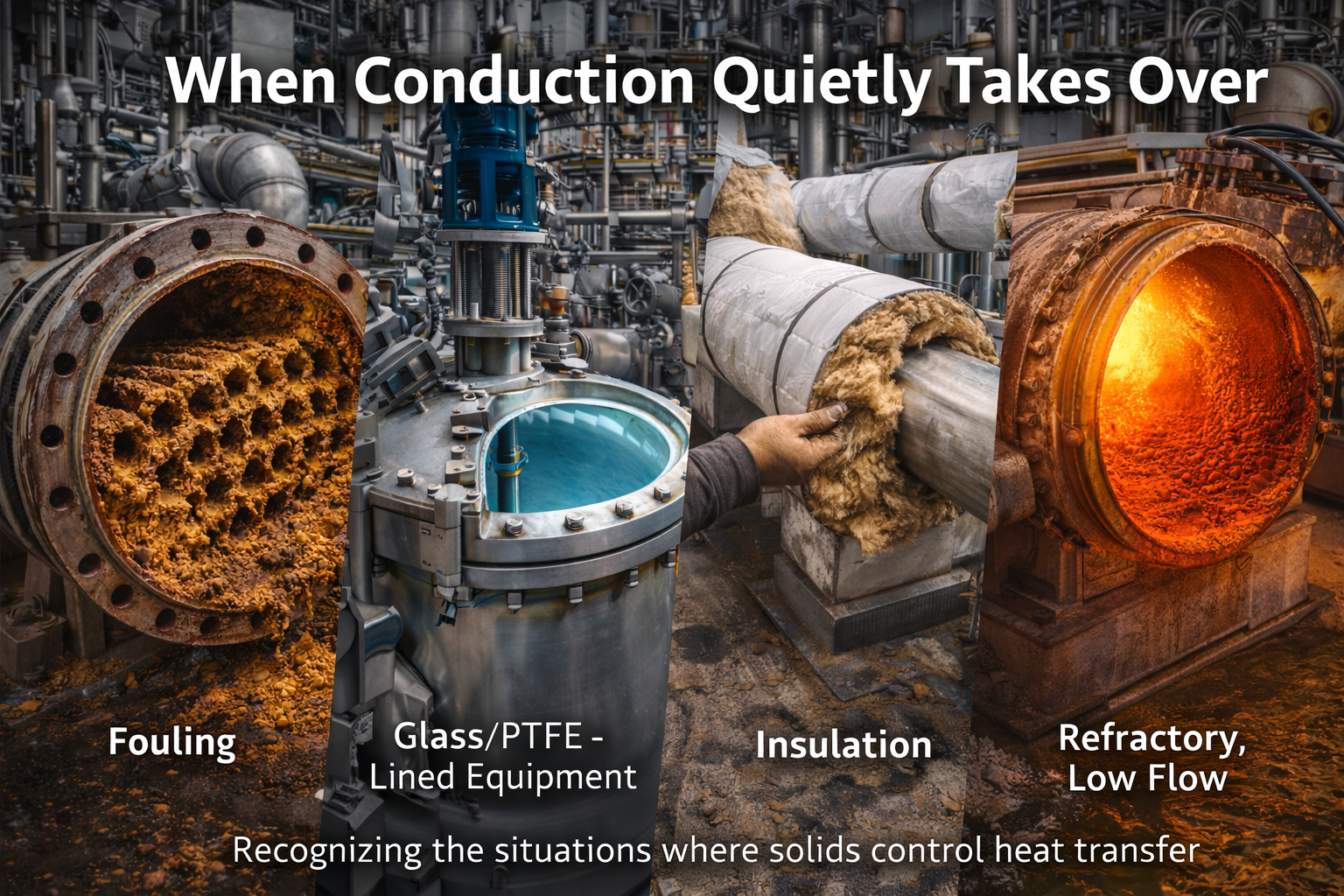
In most operating equipment, heat transfer involves more than one mechanism. Convection, radiation, and conduction act together, with one usually playing a dominant role.
Because flowing fluids are visible and adjustable, convection often receives the most attention. Conduction, by contrast, is frequently treated as secondary.
In many real plant situations, this assumption is incorrect.
There are operating conditions where conduction through solid materials becomes the controlling heat transfer mechanism, governing temperature response, stability, and performance.
This article explains when and why that happens.
Table of Contents
Dominance Depends on the Weakest Link
Heat transfer behaves like a chain.
The overall rate is governed by the largest thermal resistance in the heat transfer path.
When convection resistance is small, conduction resistance can dominate.
When convection weakens, conduction often becomes the limiting step.
Recognizing which resistance controls the process at a given condition is essential for correct diagnosis and effective action.
Low or Zero Flow Conditions
One of the most common situations where conduction becomes the dominant heat transfer mechanism is low flow or no flow.
Examples include:
- idle piping,
- standby vessels,
- blocked or isolated equipment,
- startup and shutdown phases.
When flow is low:
- convective heat transfer drops sharply,
- boundary layers thicken,
- temperature gradients flatten within fluids.
In these conditions, heat transfer continues primarily through solid walls by conduction.
This explains why:
- isolated systems still change temperature,
- heating or cooling appears slow,
- temperature equalization takes time.
Thick-Walled Equipment
Equipment with thick metal sections exhibits strong conduction effects.
Examples:
- high-pressure reactors,
- heavy-wall columns,
- large drums,
- exchanger tube sheets.
Thick walls:
- increase solid-wall thermal resistance,
- store large amounts of thermal energy,
- slow temperature response.
In such equipment, even when fluid-side convection is strong, wall conduction controls the rate of heat movement.
This is why:
- temperature ramps must be limited,
- startups and shutdowns are time-consuming,
- thermal stress risk increases.
Stagnant Zones and Dead Pockets
Many pieces of equipment contain regions where fluid motion is weak or absent:
- corners of vessels,
- dead legs in piping,
- poorly mixed zones,
- bypassed internals.
In these zones:
- convection is minimal,
- temperature gradients within fluid are small,
- heat transfer relies on conduction through metal or stagnant fluid.
These regions often develop:
- cold spots,
- hot spots,
- condensation zones,
- corrosion issues.
Conduction dominates behavior in these areas.
Highly Insulated Systems
Insulation reduces heat loss to the environment, but it does not remove internal conduction.
In well-insulated systems:
- external convection and radiation are minimized,
- internal temperature gradients persist,
- heat redistributes through solids.
Examples include:
- hot oil systems,
- high-temperature reactors,
- insulated storage tanks.
In these cases, conduction within the equipment determines:
- internal temperature uniformity,
- cooldown rate,
- response to disturbances.
During Startup and Shutdown
Startup and shutdown are periods when conduction often dominates overall behavior.
During startup:
- hot fluids contact cold metal,
- convection initially transfers heat at the surface,
- conduction spreads heat through wall thickness.
During shutdown:
- hot metal releases stored energy,
- convection may be weak or absent,
- conduction governs cooldown.
Operational limits on heating and cooling rates are based primarily on conduction constraints, not convection.
When Fouling Reduces Convection Effectiveness
Fouling adds resistance on the fluid side.
As fouling builds:
- convective heat transfer weakens,
- temperature gradients increase,
- solid-side resistance becomes relatively more important.
In severely fouled equipment, conduction through the metal wall thickness and fouling layer can dominate overall heat transfer behavior.
This explains why:
- increasing utility flow gives little benefit,
- cleaning restores performance suddenly,
- temperature approach worsens over time.
Small Equipment and Thin Flow Channels
In small-scale equipment or narrow channels:
- fluid volumes are small,
- surface-to-volume ratio is high,
- solids influence temperature strongly.
Examples include:
- small exchangers,
- instrument impulse lines,
- capillary systems.
In these cases, conduction through walls and supports can dominate temperature behavior, sometimes overriding process intent.
Cold Climate and Ambient-Dominated Conditions
In cold environments:
- external temperature differences are large,
- heat loss through walls and supports increases,
- conduction paths to ambient dominate.
Examples:
- outdoor piping in winter,
- exposed vessels,
- poorly insulated flanges.
Here, conduction to the environment governs temperature more than internal convection.
Why Increasing Flow Often Fails to Fix the Problem
A common operational response to poor heat transfer is increasing flow.
When conduction control heat transfer:
- higher flow does not reduce conduction resistance through the equipment wall
- temperature response remains slow,
- energy consumption increases without benefit.
This leads to frustration and misdiagnosis.
Recognizing conduction dominance avoids ineffective corrective actions.
Design Implications of Conduction-Dominated Conditions
Designers must account for conduction dominance when:
- selecting wall thickness and contact surfaces between metal parts,
- choosing materials,
- defining allowable temperature ramps,
- designing insulation and supports,
- planning startup procedures.
Ignoring conduction dominance often leads to:
- overly aggressive operating limits,
- premature equipment damage,
- conservative throughput restrictions later.
Maintenance Implications
Maintenance activities influence conduction behavior:
- insulation condition affects external heat loss,
- fouling alters internal resistance,
- repairs change metal continuity.
Understanding where conduction dominates helps prioritize:
- insulation repair,
- support redesign,
- dead-leg elimination,
- cleaning schedules.
Owner Perspective: Why Conduction Dominance Matters
From an ownership viewpoint, conduction-dominated conditions affect:
- startup time,
- energy consumption,
- reliability,
- equipment life.
Plants that understand these limits:
- plan realistic operating schedules,
- avoid unnecessary stress,
- reduce unplanned downtime.
Conduction dominance is not a defect.
It is a characteristic that must be managed.
Final Perspective
Conduction does not dominate all the time.
But when it does, it dictates how equipment responds, how fast temperatures change, and how much stress develops.
Ignoring conduction dominance leads to unrealistic expectations and repeated operational issues.
Recognizing it leads to better decisions, safer operation, and longer equipment life.
This understanding is not advanced theory.
It is practical plant awareness.
When conduction dominates heat transfer behavior, the limiting factor is usually the resistance of the solid material itself.
Understanding how thickness, material properties, and layered surfaces resist heat flow helps explain why equipment heats and cools at certain rates.
Thermal Resistance of Solids Explained
This article explains how thermal resistance develops inside solid materials and why it becomes the controlling factor in many plant situations.
A practicing chemical engineer with 17+ years of experience in process design, project execution, commissioning, and plant operations. Focused on practical engineering judgment beyond textbook explanations.