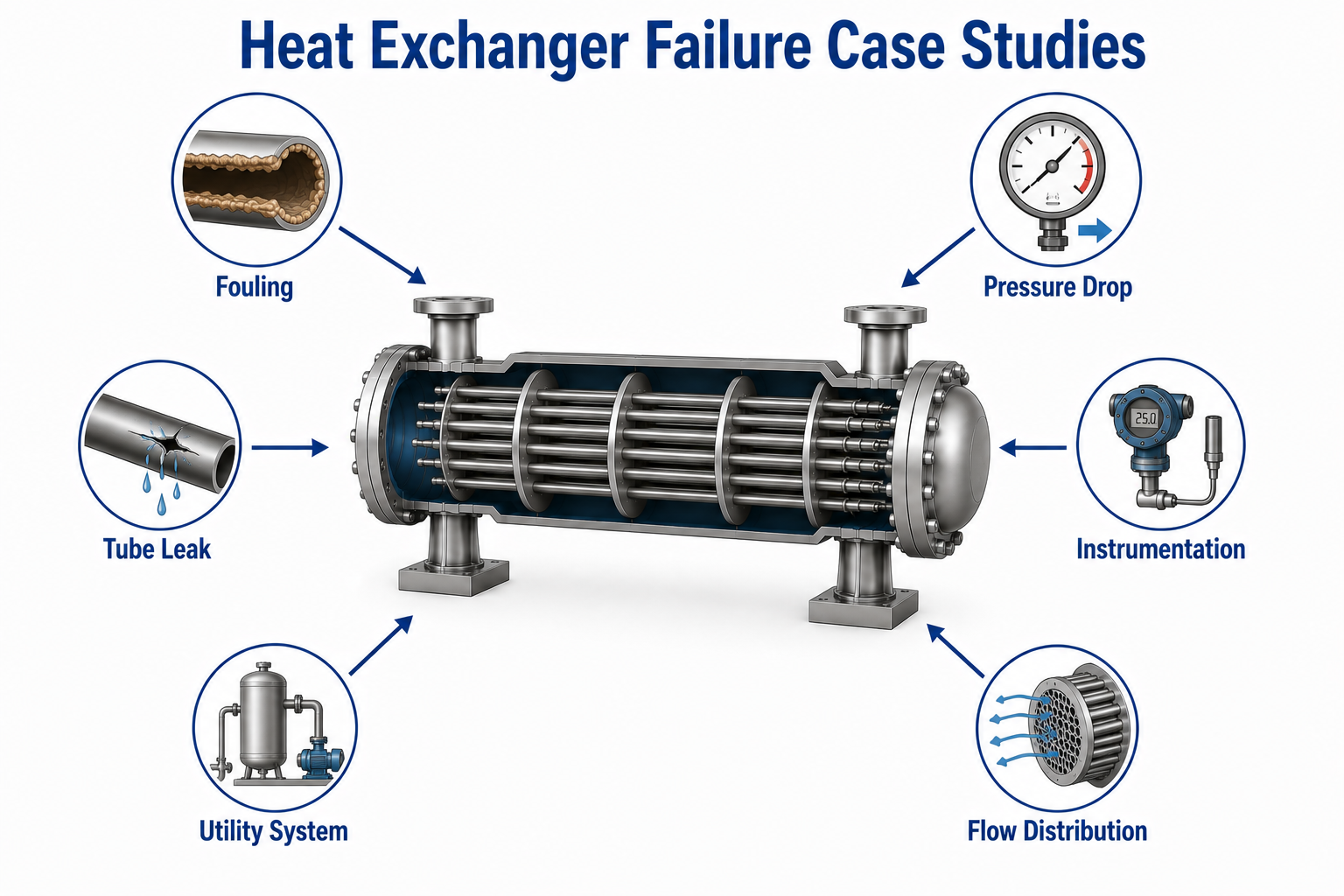
Most heat exchanger failures are not caused by a single catastrophic event. Instead, they develop gradually through a combination of design assumptions, changing operating conditions, inadequate maintenance, instrumentation errors, and operational decisions. The most valuable engineering lessons often come from investigating these failures rather than simply repairing the equipment. By understanding why exchangers underperform in real plants, engineers can improve future designs, optimize maintenance strategies, and avoid repeating the same mistakes across multiple projects.
Every experienced process engineer has heard statements like:
- “This exchanger never worked properly.”
- “It met design duty during commissioning.”
- “Performance keeps declining every year.”
- “We’ve cleaned it three times, but the problem remains.”
At first, these comments appear to describe different problems.
In reality, they often share a common characteristic.
The exchanger itself is rarely the only reason for poor performance.
Successful failure investigations usually reveal that several small issues combined over time until the exchanger could no longer perform as intended.
That is why experienced engineers study failures differently.
Instead of asking:
“Which component failed?”
They ask:
“What chain of events allowed this failure to develop?”
The following examples represent common situations encountered across refineries, chemical plants, API facilities, pharmaceutical plants, and utility systems. They illustrate engineering principles rather than failures from any specific plant.
Table of Contents
Case Study 1: The Exchanger That Never Reached Design Duty
Sometimes an exchanger underperforms from the very first day of operation.
Situation
A feed preheater consistently delivered a lower outlet temperature than specified.
Operators compensated by increasing steam flow.
Initial Assumption
The exchanger was believed to be undersized.
Investigation
A detailed review showed:
- actual process flow exceeded the original design basis,
- feed composition had changed before plant startup,
- utility temperature was slightly lower than assumed during design.
The exchanger itself matched the approved drawings and design calculations.
Lesson Learned
The equipment had been designed correctly.
The operating conditions had changed.
Design verification should always confirm that process assumptions remain valid before commissioning.
Case Study 2: Increasing Steam Consumption Every Year
Higher utility consumption often indicates gradual performance deterioration rather than utility system problems.
Situation
A reactor heating exchanger required progressively more steam to achieve the same batch temperature.
Initial Assumption
The boiler system was suspected.
Investigation
Performance monitoring revealed:
- increasing fouling,
- lower overall heat transfer coefficient,
- gradual reduction in exchanger effectiveness.
Pressure drop had also increased over several years.
Corrective Action
The exchanger was cleaned and the water treatment program was improved.
Lesson Learned
Monitoring heat duty and pressure drop together often identifies fouling much earlier than utility consumption alone.
Case Study 3: Frequent Tube Leakage
Repeated tube failures usually indicate an underlying engineering problem rather than poor tube quality.
Situation
An exchanger experienced recurring tube leaks despite repeated tube plugging.
Initial Assumption
The tube material was believed to be defective.
Investigation
Further inspection identified:
- excessive flow velocity,
- flow-induced vibration,
- localized erosion near the inlet region.
The replacement tubes failed in the same locations.
Corrective Action
The inlet flow distribution was modified and operating velocity was reduced.
Lesson Learned
Replacing damaged components without identifying the failure mechanism rarely solves the problem permanently.
Case Study 4: Pressure Drop Increased Much Faster Than Expected
Hydraulic problems may become critical before thermal performance noticeably declines.
Situation
Pump discharge pressure increased steadily over several months.
Initial Assumption
The process pump was considered the source of the problem.
Investigation
Differential pressure measurements showed:
- increasing exchanger pressure drop,
- tube-side deposit formation,
- partial flow restriction.
Outlet temperatures remained close to normal.
Corrective Action
Cleaning restored both pressure drop and pumping energy to normal values.
Lesson Learned
Pressure drop trends often provide earlier warning of fouling than outlet temperature measurements.
Case Study 5: Cleaning Did Not Restore Performance
Cleaning cannot solve problems unrelated to fouling.
Situation
After a scheduled shutdown, an exchanger was chemically cleaned.
Performance improved only slightly.
Initial Assumption
Cleaning had been ineffective.
Investigation
The actual problems included:
- bypass valve leakage,
- faulty temperature transmitter,
- partially closed isolation valve.
Very little fouling remained inside the exchanger.
Lesson Learned
Maintenance should always follow accurate diagnosis.
Cleaning cannot compensate for instrumentation or operational problems.
Case Study 6: Seasonal Performance Problems
Changing environmental conditions can significantly influence exchanger operation.
Situation
Cooling performance declined every summer but returned to normal during winter.
Initial Assumption
Seasonal fouling was suspected.
Investigation
The actual cause was:
- higher cooling water temperature,
- reduced cooling tower efficiency,
- lower available temperature driving force.
The exchanger itself remained in good condition.
Lesson Learned
Not every apparent exchanger problem originates inside the exchanger.
Utility systems must always be evaluated during troubleshooting.
Case Study 7: Repeated Fouling After Every Cleaning
Rapid recurrence of fouling often indicates that the root cause remains unchanged.
Situation
An exchanger required cleaning every few months.
Initial Assumption
The service was naturally prone to severe fouling.
Investigation
Engineers identified:
- operating velocity below design recommendations,
- ineffective upstream filtration,
- process contamination entering the exchanger.
Corrective Action
Flow conditions and filtration were improved.
Cleaning intervals increased substantially.
Lesson Learned
Successful fouling management addresses the cause of deposition rather than simply removing deposits.
Case Study 8: Instrumentation Created a False Failure
Incorrect measurements can lead engineers toward the wrong conclusions.
Situation
Operating data suggested that exchanger performance had fallen dramatically.
Initial Assumption
The exchanger required immediate replacement.
Investigation
Calibration checks discovered:
- inaccurate temperature transmitter,
- drifting flow measurement,
- pressure transmitter error.
The exchanger itself remained close to its expected performance.
Lesson Learned
Always verify instrumentation before diagnosing equipment failure.
Reliable measurements are the foundation of successful troubleshooting.
Common Patterns Seen Across Real Plants
Although every failure is unique, similar engineering themes appear repeatedly.
Most investigations eventually identify combinations of:
- changing process conditions,
- fouling,
- hydraulic imbalance,
- instrumentation errors,
- maintenance deficiencies,
- operating outside design limits,
- inadequate monitoring.
Rarely does a single factor explain the complete problem.
Successful troubleshooting therefore requires a systematic engineering approach.
What Successful Plants Do Differently
Organizations with high exchanger reliability focus on prevention rather than repeated repair.
Their practices typically include:
- continuous performance monitoring,
- trend analysis,
- regular instrumentation calibration,
- predictive maintenance,
- root cause analysis,
- operating procedure reviews,
- capturing lessons learned after every major maintenance activity.
These organizations treat every failure investigation as an opportunity to improve future plant performance.
Common Misunderstandings About Heat Exchanger Failures
Real plant experience often challenges assumptions made during design and operation.
“Every Failure Has One Root Cause”
Most exchanger failures develop through several interacting factors rather than one isolated defect.
“Replacing the Exchanger Solves the Problem”
If the underlying operating conditions remain unchanged, the replacement exchanger may experience the same problems.
“Cleaning Always Restores Original Performance”
Cleaning removes deposits but cannot correct:
- hydraulic problems,
- poor instrumentation,
- process changes,
- mechanical deterioration,
- incorrect operation.
“Failure Investigations Are Only for Maintenance Teams”
Successful investigations require collaboration between:
- process engineers,
- operations,
- mechanical engineers,
- instrumentation specialists,
- maintenance personnel,
- reliability engineers.
The best solutions emerge from multidisciplinary analysis.
Operator Perspective
Operators usually observe the first signs of developing exchanger problems.
Gradual changes in:
- outlet temperatures,
- steam demand,
- pressure drop,
- control valve position,
- utility consumption,
often provide the earliest warning that performance is changing.
Accurate operating logs frequently become the most valuable evidence during failure investigations.
Owner Perspective
Every heat exchanger failure represents an opportunity to improve future reliability.
Organizations that investigate failures thoroughly achieve:
- lower maintenance costs,
- improved energy efficiency,
- fewer repeated failures,
- higher production availability,
- longer equipment life,
- stronger engineering standards.
The financial value comes not only from repairing the equipment but also from preventing similar failures across the plant.
Final Perspective
Real operating plants teach lessons that no design manual can fully capture.
Each underperforming heat exchanger tells a story of changing process conditions, operational decisions, maintenance practices, and engineering assumptions that evolved over years of service.
The most successful engineers do not view failures simply as equipment problems.
They view them as opportunities to understand how thermal, hydraulic, mechanical, operational, and instrumentation factors interact within the complete process system.
By studying these recurring patterns, organizations continuously improve their designs, refine their operating practices, strengthen their maintenance strategies, and build more reliable heat exchangers for future projects.
Ultimately, the greatest value of a failure investigation is not restoring one exchanger—it is ensuring that the same engineering lessons never need to be learned twice.
Explore the complete series in the Heat Exchanger Engineering Hub.

A practicing chemical engineer with 17+ years of experience in process design, project execution, commissioning, and plant operations. Focused on practical engineering judgment beyond textbook explanations.