A heat exchanger may satisfy every design calculation, pass factory testing, and perform flawlessly during commissioning, yet still fail to deliver the expected performance after months or years of operation. The reasons are rarely limited to a single design flaw. Instead, real-world performance is influenced by changing process conditions, fouling, mechanical deterioration, operational practices, instrumentation accuracy, maintenance quality, and ageing equipment. Understanding why heat exchangers fail in operating plants allows engineers to move beyond theoretical design and develop practical solutions that improve reliability, energy efficiency, and long-term plant performance.
Designing a heat exchanger is only the beginning of its engineering journey.
Thermal calculations determine:
- required heat duty,
- heat transfer area,
- pressure drop,
- utility consumption,
- operating temperatures.
Mechanical design ensures the exchanger can safely withstand:
- pressure,
- temperature,
- thermal expansion,
- vibration,
- corrosion.
During commissioning, everything often appears successful.
The exchanger achieves the expected outlet temperatures.
Pressure drop remains within specification.
Utility consumption matches design values.
The project team considers the equipment a success.
Then real plant operation begins.
Weeks become months.
Months become years.
Gradually, operators begin noticing changes:
- steam demand increases,
- cooling becomes less effective,
- pressure drop rises,
- production capacity declines,
- maintenance becomes more frequent.
Sometimes the problem develops slowly over several years.
Sometimes it appears immediately after startup.
Sometimes the exchanger never achieves its design duty from the first day of operation.
These situations occur in every process industry—from refineries and petrochemical complexes to API plants, pharmaceutical facilities, food processing units, and utility systems.
The important lesson is that heat exchanger failure rarely means catastrophic equipment breakdown.
More often, failure means the exchanger no longer performs its intended function efficiently, economically, or reliably.
This pillar explores why that happens and, more importantly, how experienced engineers diagnose and resolve these problems in real operating plants.
Table of Contents
What Does Heat Exchanger Failure Really Mean?
Failure is not always a leak or mechanical breakdown. In many plants, performance failure occurs long before structural failure.
A heat exchanger may be considered unsuccessful when it can no longer:
- achieve required outlet temperatures,
- transfer the specified heat duty,
- maintain acceptable pressure drop,
- support required production capacity,
- operate economically,
- remain reliable between maintenance intervals.
The exchanger may still be physically intact while its performance gradually deteriorates.
This distinction is important because many operational problems develop long before visible equipment damage occurs.
Why Design Calculations and Plant Performance Often Differ
Design calculations are based on assumptions, while operating plants experience constant variation.
During design, engineers estimate:
- process flow rates,
- fluid properties,
- operating temperatures,
- utility conditions,
- fouling resistance,
- equipment condition.
Actual plants experience:
- fluctuating feed quality,
- production changes,
- seasonal utility variations,
- equipment ageing,
- operator interventions,
- process upsets.
These differences gradually move the exchanger away from its original design point.
The exchanger itself may not be defective; it is simply operating under conditions different from those assumed during design.
Heat Exchanger Problems Rarely Have a Single Cause
Performance deterioration is usually the result of several interacting factors rather than one isolated issue.
For example, reduced heat duty may result from:
- fouling,
- reduced flow rate,
- incorrect control valve operation,
- inaccurate instrumentation,
- lower utility temperature,
- process changes.
Similarly, increasing pressure drop may involve:
- deposit formation,
- partially blocked tubes,
- valve restrictions,
- incorrect bypass operation,
- debris accumulation.
Experienced engineers therefore avoid searching for one “root cause” too quickly.
Instead, they evaluate the complete operating system.
Common Categories of Performance Problems
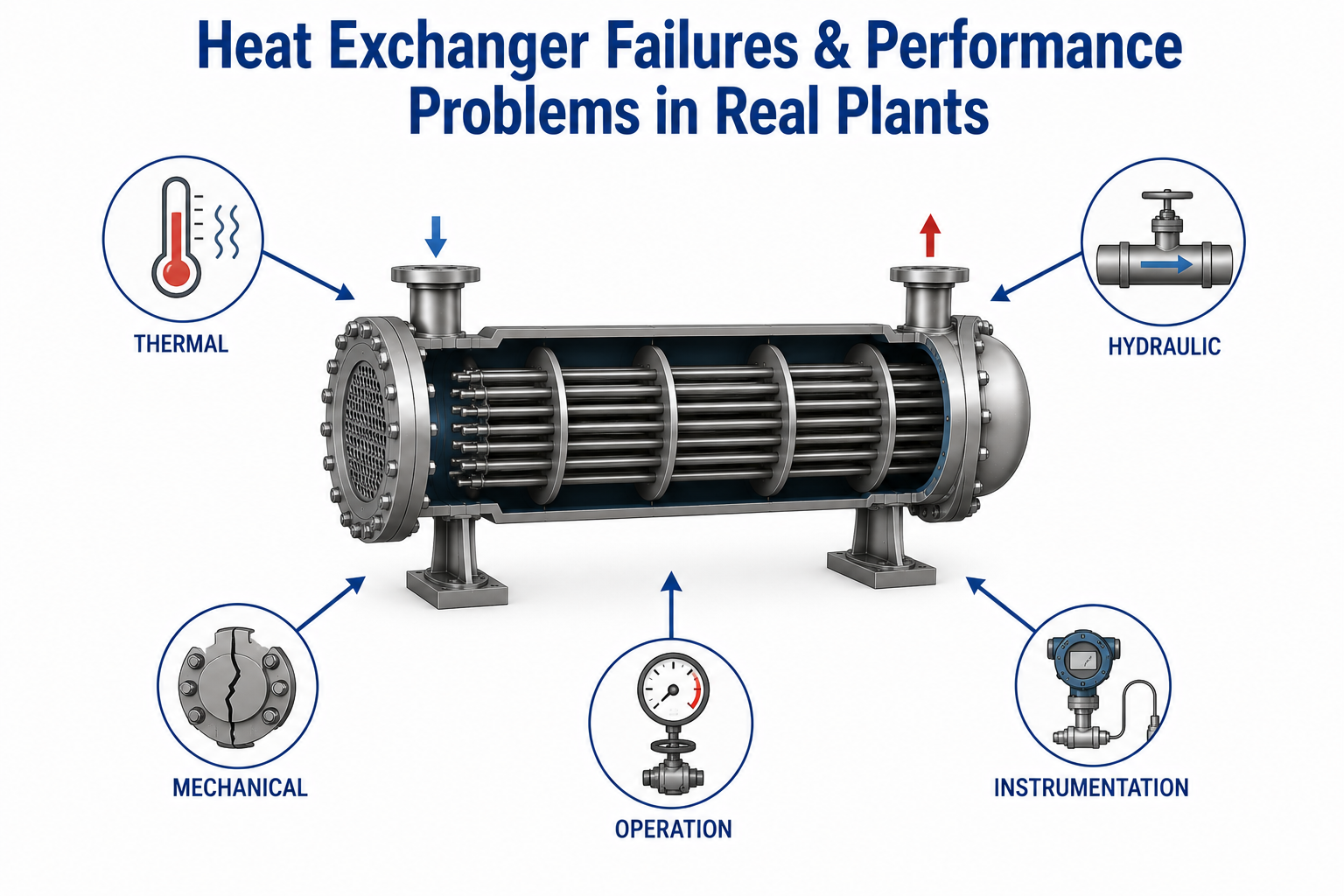
Most exchanger problems fall into a few broad engineering categories.
Thermal Performance Problems
These include:
- inadequate heating,
- insufficient cooling,
- reduced heat recovery,
- lower overall heat transfer coefficient,
- inability to achieve design duty.
Thermal problems often develop gradually and may initially be compensated by increased utility consumption.
Hydraulic Performance Problems
Hydraulic issues include:
- excessive pressure drop,
- reduced process flow,
- pump overloading,
- unstable flow distribution,
- restricted circulation.
In some plants, hydraulic limitations reduce production before thermal limitations become significant.
Mechanical Problems
Mechanical issues may include:
- tube leakage,
- gasket failure,
- thermal expansion damage,
- vibration-induced tube wear,
- corrosion,
- erosion.
Although less frequent than thermal deterioration, mechanical failures often require immediate maintenance.
Operational Problems
Operational practices strongly influence exchanger performance.
Examples include:
- incorrect startup procedures,
- poor shutdown practices,
- operation outside design limits,
- inadequate cleaning frequency,
- unstable operating conditions.
Many exchangers perform poorly because of operational decisions rather than design deficiencies.
Instrumentation and Control Problems
An exchanger may appear to be malfunctioning when the actual problem lies in the measurement system.
Examples include:
- faulty temperature sensors,
- incorrect pressure transmitters,
- inaccurate flow measurements,
- malfunctioning control valves,
- improper controller tuning.
Reliable troubleshooting always begins by confirming measurement accuracy.
Why Some Heat Exchangers Never Achieve Design Duty
A surprising number of exchangers underperform from the first day of operation.
Possible reasons include:
- incorrect process assumptions,
- changes made during procurement,
- fabrication tolerances,
- installation errors,
- unexpected fluid properties,
- process modifications before commissioning.
These issues demonstrate why field verification is just as important as design calculations.
The Importance of Looking Beyond the Heat Exchanger
Many apparent exchanger problems actually originate elsewhere in the process.
For example:
A cooling problem may actually result from:
- insufficient cooling tower performance,
- reduced utility flow,
- pump problems,
- upstream process instability.
Similarly, excessive pressure drop may originate from:
- clogged strainers,
- partially closed valves,
- downstream restrictions,
- piping modifications.
Effective troubleshooting therefore considers the entire process system rather than focusing exclusively on the exchanger.
Performance Monitoring Prevents Major Failures
Most exchanger failures provide warning signs long before production is affected.
Useful monitoring parameters include:
- inlet and outlet temperatures,
- differential pressure,
- utility consumption,
- process flow rates,
- heat duty,
- exchanger effectiveness.
Trend analysis allows engineers to identify gradual deterioration before major operational problems occur.
Predictive monitoring often reduces both maintenance cost and unplanned downtime.
Successful Plants Treat Failures as Learning Opportunities
Every performance problem improves future engineering knowledge.
After investigating exchanger problems, experienced organizations often update:
- design standards,
- fouling assumptions,
- operating procedures,
- maintenance strategies,
- instrumentation practices,
- equipment specifications.
Each operating experience contributes to better future projects.
This continuous improvement philosophy distinguishes high-performing engineering organizations.
What This Pillar Will Cover
This pillar explores the practical challenges engineers encounter after a heat exchanger leaves the drawing board and enters real plant service.
The following support articles examine these topics in detail:
- Common Heat Exchanger Design Mistakes in Industry — Engineering decisions that create long-term operating problems.
- Heat Exchanger Failure Case Studies – Lessons from Real Plants — Practical insights from actual plant failures and how they were resolved.
- Why Heat Exchangers Rarely Meet Design Duty in Operation — The gap between calculated performance and operating reality.
- Startup Problems in Heat Exchangers – What Goes Wrong — Common commissioning and startup issues affecting reliability.
- Shutdown & Transient Issues in Heat Exchangers — Thermal stresses and operational challenges during changing process conditions.
- Debottlenecking Failed Heat Exchangers – Practical Approach — Methods for restoring or improving exchanger performance without complete replacement.
- Instrumentation Errors Affecting Heat Exchanger Performance — How inaccurate measurements lead to incorrect engineering decisions.
- Why Heat Exchanger Troubleshooting Often Fails — Common mistakes made during diagnosis and how systematic troubleshooting improves success.
Together, these articles provide a practical guide for diagnosing, understanding, and solving heat exchanger performance problems encountered in operating plants.
Common Misunderstandings About Heat Exchanger Failures
Many operational problems persist because engineers misunderstand what “failure” actually means.
“A Heat Exchanger Has Failed Only If It Leaks”
Most exchangers first fail by losing performance rather than by developing mechanical damage.
Performance failure often occurs months or years before structural failure.
“The Original Design Must Have Been Wrong”
Many exchangers operate under conditions very different from those assumed during design.
Changing process conditions frequently explain poor performance more accurately than design errors.
“Cleaning Solves Most Heat Exchanger Problems”
Cleaning restores performance when fouling is the primary issue.
It cannot correct:
- incorrect process conditions,
- instrumentation errors,
- mechanical damage,
- hydraulic imbalance,
- operational deficiencies.
Accurate diagnosis must always precede maintenance.
“Heat Exchanger Problems Can Be Solved by Looking Only at the Exchanger”
The exchanger is one component within a larger process system.
Successful troubleshooting requires evaluating:
- utilities,
- pumps,
- control systems,
- piping,
- upstream equipment,
- downstream equipment.
System thinking consistently produces better engineering decisions.
Operator Perspective
Operators are often the first to recognize that exchanger performance is changing.
Gradual increases in:
- steam consumption,
- cooling water demand,
- pressure drop,
- process adjustments,
usually indicate developing operational problems long before equipment failure occurs.
Consistent operating records and early reporting allow maintenance to be planned rather than forced by declining production.
Owner Perspective
For plant owners, the cost of poor heat exchanger performance extends far beyond maintenance expenditure.
Performance deterioration may lead to:
- increased energy consumption,
- lower production capacity,
- higher operating cost,
- reduced equipment reliability,
- shorter maintenance intervals,
- lower return on capital investment.
Investing in performance monitoring, disciplined operation, and systematic troubleshooting often produces greater long-term value than simply replacing underperforming equipment.
Final Perspective
No heat exchanger operates forever under the ideal conditions assumed during design.
As operating conditions evolve, equipment ages, production requirements change, and maintenance decisions accumulate, every exchanger begins to tell the story of its operating history.
Some problems arise from design assumptions.
Others result from process changes, operational practices, instrumentation errors, or maintenance decisions made years after commissioning.
The most successful engineers recognize that troubleshooting is not about finding a single defective component—it is about understanding how thermal, hydraulic, mechanical, and operational factors interact throughout the entire process system.
Ultimately, reliable heat exchanger performance is achieved not through perfect design alone, but through continuous observation, disciplined operation, informed maintenance, and a willingness to learn from every challenge encountered in real plant operation.
Explore the complete series in the Heat Exchanger Engineering Hub.

A practicing chemical engineer with 17+ years of experience in process design, project execution, commissioning, and plant operations. Focused on practical engineering judgment beyond textbook explanations.