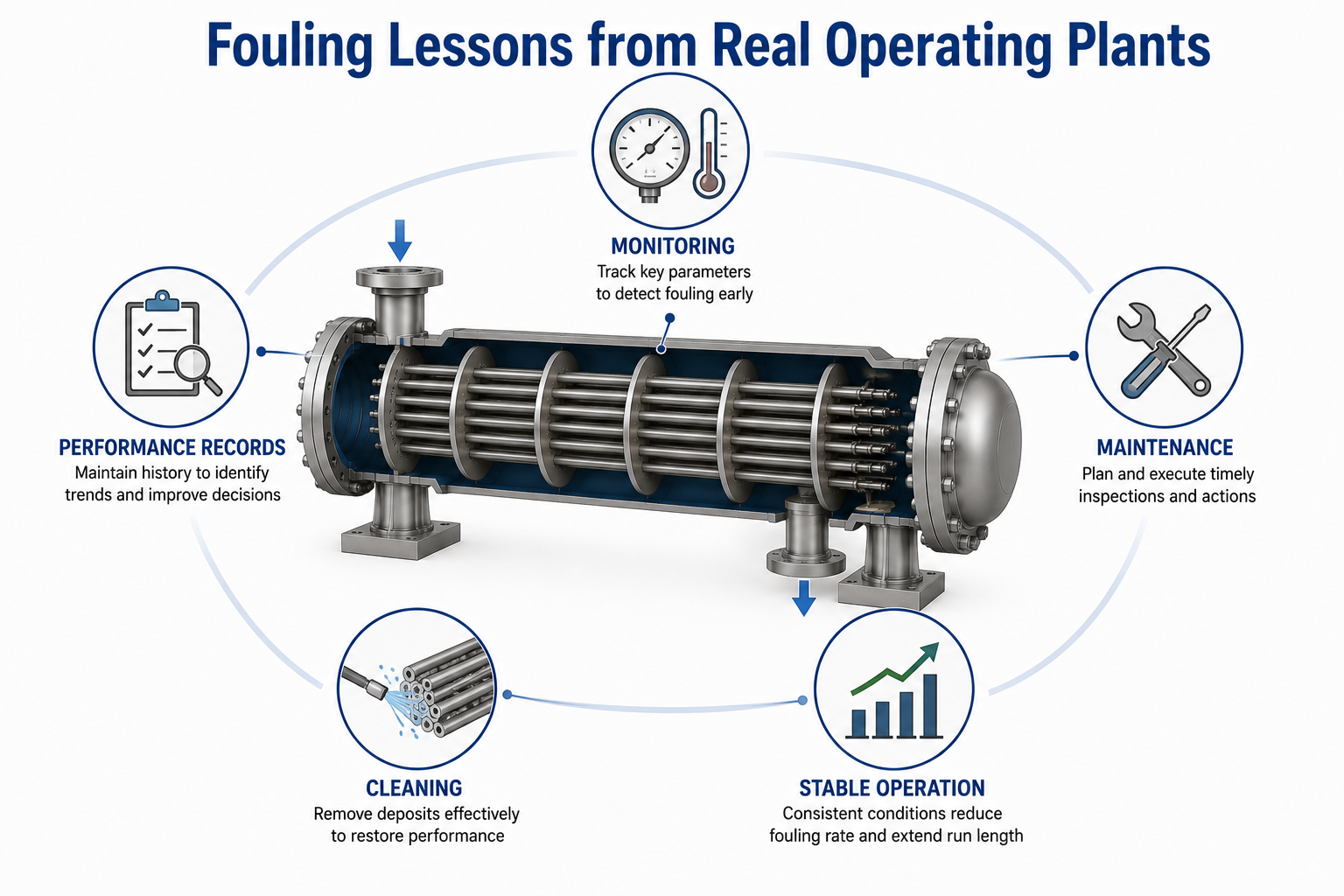
Heat exchanger fouling is often taught using equations, fouling factors, and thermal calculations, but the most valuable lessons come from operating plants. Over years of continuous service, engineers discover that fouling is influenced as much by operating practices, maintenance discipline, and process variability as by equipment design. Plants that successfully manage fouling rarely eliminate it completely. Instead, they recognize early warning signs, monitor exchanger performance, schedule maintenance strategically, and continuously improve their operating practices. These practical lessons help transform theoretical design into reliable long-term plant performance.
Every process engineer eventually learns an important truth.
The exchanger installed in the plant is not the same exchanger described in the design calculations.
The design represents:
- clean equipment,
- stable operating conditions,
- expected process properties.
The operating plant experiences:
- fluctuating feed quality,
- changing production demands,
- equipment ageing,
- unexpected shutdowns,
- operator interventions.
As years pass, practical experience teaches lessons that no design handbook can fully explain.
These lessons have been learned repeatedly across:
- refineries,
- API plants,
- chemical manufacturing,
- pharmaceutical facilities,
- utility systems.
Although every plant is different, the engineering principles remain remarkably consistent.
Table of Contents
Lesson 1: Fouling Begins Earlier Than Most Engineers Expect
Many engineers assume fouling becomes important only after long operating periods.
In reality, deposits often begin forming soon after commissioning.
Initially:
- thermal performance remains acceptable,
- pressure drop changes very little,
- operators notice no obvious problems.
Because the exchanger continues performing well, early fouling often goes unnoticed.
The lesson is simple:
Fouling should be expected from the beginning—not from the moment performance begins declining.
Lesson 2: Small Performance Changes Should Never Be Ignored
Major fouling problems usually begin as minor performance deviations.
Operators may notice:
- slightly higher steam demand,
- marginally lower outlet temperature,
- slowly increasing differential pressure,
- gradual increase in cooling water usage.
Each individual change appears insignificant.
Together, they often indicate the early stages of fouling.
Plants that investigate these trends early usually avoid much larger maintenance problems later.
Lesson 3: Operating Discipline Influences Fouling More Than Expected
The same exchanger can foul at dramatically different rates under different operating practices.
Experience shows that fouling often accelerates when:
- recommended flow velocities are reduced,
- water treatment deteriorates,
- filtration is neglected,
- startup procedures are rushed,
- process temperatures exceed design limits.
Conversely, disciplined operation frequently extends cleaning intervals without modifying the exchanger itself.
Lesson 4: Stable Operation Produces Better Long-Term Performance
Frequent process disturbances often accelerate fouling.
Repeated:
- startups,
- shutdowns,
- temperature cycling,
- flow fluctuations,
- production interruptions,
can encourage deposit formation.
Plants operating under steady conditions often experience:
- slower fouling,
- lower maintenance frequency,
- more predictable performance.
Consistency is often one of the simplest fouling-control strategies.
Lesson 5: Pressure Drop Often Reveals Fouling Before Temperature Does
Experienced operators monitor hydraulic performance as closely as thermal performance.
A gradual increase in:
- differential pressure,
- pump discharge pressure,
- compressor loading,
may appear before noticeable changes occur in outlet temperatures.
Waiting only for thermal performance to decline may delay maintenance unnecessarily.
Monitoring both parameters provides a much earlier warning.
Lesson 6: Cleaning Too Late Usually Costs More Than Cleaning Too Early
Plants often postpone maintenance to maximize production, but prolonged operation with severe fouling rarely reduces total cost.
Delayed cleaning frequently results in:
- higher utility consumption,
- increased pumping energy,
- lower production rates,
- more difficult cleaning,
- longer maintenance duration.
Well-planned preventive maintenance generally proves more economical than emergency intervention after severe fouling develops.
Lesson 7: Every Process Service Behaves Differently
Experience quickly demonstrates that no universal fouling strategy exists.
For example:
Refinery exchangers commonly struggle with:
- wax,
- coke,
- asphaltenes.
API plants frequently encounter:
- polymer deposits,
- crystallization,
- reaction residues.
Utility exchangers often experience:
- scale,
- corrosion products,
- biological fouling.
Successful plants adapt their maintenance strategy to each service instead of applying identical cleaning schedules throughout the facility.
Lesson 8: Design for Maintenance Is as Important as Design for Heat Transfer
Plants appreciate exchangers that are easy to inspect and clean.
Experience consistently favors designs that provide:
- removable bundles,
- adequate cleaning access,
- sufficient maintenance clearance,
- suitable tube layouts,
- effective isolation arrangements.
A thermally efficient exchanger that is difficult to clean often becomes an expensive asset over its lifetime.
Lesson 9: Good Records Become Valuable Engineering Knowledge
Historical operating data improve future exchanger design.
Experienced organizations record:
- cleaning intervals,
- pressure drop trends,
- outlet temperatures,
- utility consumption,
- fouling observations,
- maintenance findings.
Over time, these records help engineers:
- improve fouling estimates,
- optimize cleaning schedules,
- refine future thermal designs,
- reduce lifecycle costs.
Every maintenance campaign provides valuable information for future projects.
Lesson 10: Fouling Is a Lifecycle Issue, Not a Commissioning Issue
The real performance of a heat exchanger is measured over decades rather than during startup.
An exchanger that performs perfectly for the first month but requires excessive maintenance every year may not represent the best engineering solution.
Lifecycle success depends on balancing:
- thermal performance,
- hydraulic performance,
- cleanability,
- reliability,
- maintenance effort,
- operating cost.
This long-term perspective distinguishes experienced engineering organizations from those focused only on initial performance.
Common Misunderstandings About Practical Fouling Experience
Real operating plants often challenge assumptions made during design.
“Commissioning Performance Predicts Lifetime Performance”
Initial testing confirms that the exchanger meets design requirements.
It does not predict how fouling will develop over years of operation.
“Cleaning Solves Every Fouling Problem”
Cleaning restores performance but does not eliminate the conditions that caused fouling.
Long-term improvement often requires operational or process changes.
“One Successful Cleaning Strategy Works Everywhere”
Every exchanger operates under unique:
- fluids,
- temperatures,
- velocities,
- maintenance practices.
Successful plants tailor their fouling strategy to each application.
“Fouling Is the Responsibility of the Maintenance Team”
Managing fouling requires cooperation between:
- process engineers,
- operations,
- maintenance,
- utilities,
- inspection,
- reliability teams.
Effective fouling management is always multidisciplinary.
Operator Perspective
Operators accumulate practical knowledge that cannot be found in design manuals.
Daily observation of:
- temperature trends,
- pressure drop,
- utility consumption,
- process stability,
often provides the earliest indication that fouling behaviour is changing.
Their experience is invaluable when planning future maintenance and improving operating procedures.
Owner Perspective
For plant owners, the greatest value comes from learning continuously rather than repeating the same fouling problems.
Organizations that analyze operating history consistently achieve:
- lower lifecycle cost,
- higher energy efficiency,
- fewer emergency shutdowns,
- improved production reliability,
- longer equipment life,
- better return on capital investment.
Every maintenance activity should therefore be viewed as an opportunity to improve future performance.
Final Perspective
Heat exchanger fouling cannot be understood through calculations alone.
Its true nature becomes apparent only after years of observing how equipment behaves under real operating conditions.
Plants that manage fouling successfully do not rely on oversized exchangers or excessively conservative design margins.
Instead, they combine sound engineering with careful operation, continuous performance monitoring, timely maintenance, and a willingness to learn from experience.
Every fouled exchanger tells a story.
It reveals how the process has been operated, how maintenance has been performed, and how well design assumptions matched reality.
Engineers who pay attention to these lessons improve not only the performance of a single heat exchanger but also the quality of future designs across entire process plants.
Ultimately, the most valuable fouling lesson is that successful heat exchanger management is not achieved by preventing every deposit—it is achieved by understanding, anticipating, and managing fouling throughout the complete lifecycle of the equipment.
Explore the complete series in the Heat Exchanger Engineering Hub.
A practicing chemical engineer with 17+ years of experience in process design, project execution, commissioning, and plant operations. Focused on practical engineering judgment beyond textbook explanations.