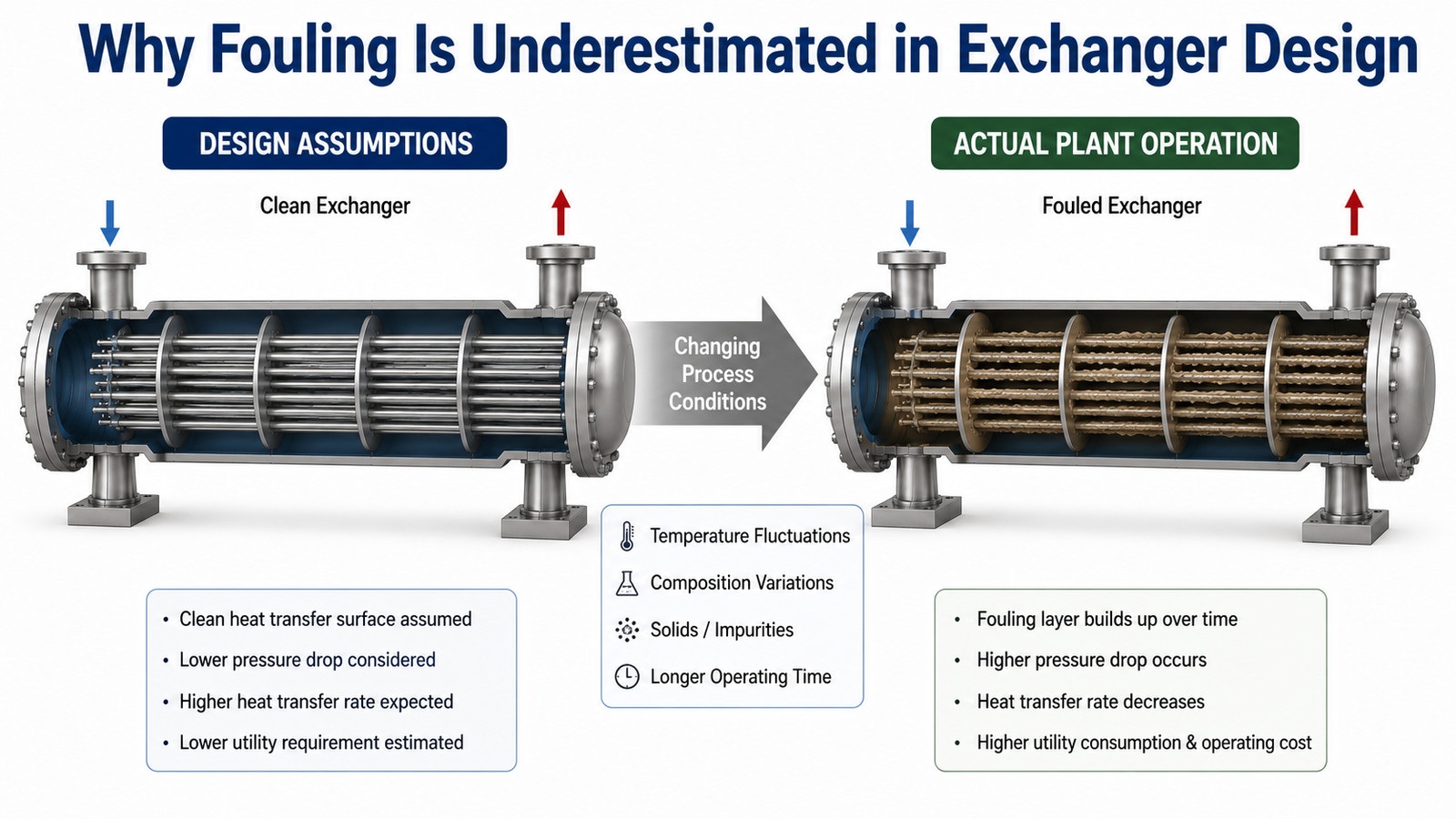
Heat exchanger fouling is universally acknowledged in engineering design, yet its long-term impact is often underestimated during both project execution and plant operation. While designers include fouling factors and fouling margins in thermal calculations, these allowances cannot fully capture the effects of changing process conditions, feedstock variability, operating practices, ageing equipment, and maintenance limitations. As a result, many exchangers perform exactly as designed during commissioning but gradually fall short of expectations over years of operation. Understanding why fouling is underestimated helps engineers design more reliable, maintainable, and economically efficient heat exchangers.
Every experienced process engineer has encountered a familiar situation.
An exchanger that met every design requirement during factory testing and commissioning gradually begins showing signs of deterioration.
The thermal calculations were correct.
The mechanical design complied with applicable codes.
The materials were appropriate.
Yet after several years of operation:
- steam consumption increases,
- cooling efficiency decreases,
- pressure drop rises,
- cleaning becomes more frequent.
The natural question is:
“If engineers knew fouling would occur, why did it still become a problem?”
The answer is not that engineers ignored fouling.
Instead, it is that fouling is influenced by far more variables than any design calculation can accurately predict.
Heat exchanger design represents the best estimate of future operating conditions.
Actual plant operation rarely follows those assumptions perfectly.
The gap between design assumptions and operating reality is where fouling is often underestimated.
Table of Contents
Design Assumptions Represent Average Conditions
Heat exchanger design is based on expected operating conditions rather than every possible operating scenario.
During thermal design, engineers define:
- process temperatures,
- flow rates,
- fluid properties,
- operating pressure,
- expected fouling resistance.
These values describe the anticipated operating envelope.
However, actual plants experience:
- feedstock variation,
- production changes,
- utility fluctuations,
- startup and shutdown cycles,
- operating disturbances.
Each deviation influences fouling behaviour in ways that cannot always be predicted during design.
Process Fluids Change Over Time
The process fluid used during design may differ significantly from the fluid encountered years later.
Examples include:
- crude oil from different suppliers,
- varying API intermediates,
- changing solvent purity,
- seasonal cooling water quality,
- catalyst ageing,
- recycled process streams.
Even small changes in fluid composition can alter:
- deposition rate,
- fouling mechanism,
- cleaning frequency,
- thermal performance.
Consequently, exchangers designed for one operating condition may experience much more severe fouling under another.
Fouling Mechanisms Are Often Complex
Several fouling mechanisms frequently occur simultaneously rather than independently.
A single exchanger may experience:
- particulate deposition,
- corrosion products,
- mineral scaling,
- biological growth,
- chemical polymerization.
These mechanisms may interact with one another.
For example:
Corrosion products create rough surfaces.
Rough surfaces encourage particulate deposition.
Deposits create stagnant regions.
Stagnant regions accelerate biological growth.
This interaction often produces fouling behaviour far more severe than individual mechanisms considered separately.
Laboratory Data Cannot Fully Represent Industrial Operation
Controlled testing rarely captures the complexity of real process plants.
Laboratory testing generally involves:
- controlled temperatures,
- stable flow rates,
- clean equipment,
- consistent fluid quality.
Industrial plants experience:
- process upsets,
- equipment ageing,
- transient operation,
- variable maintenance quality,
- changing environmental conditions.
Consequently, laboratory fouling data provide useful guidance but cannot completely predict plant performance over decades of operation.
Fouling Develops Gradually and Often Goes Unnoticed
Slow deterioration is psychologically easier to overlook than sudden failure.
Unlike equipment breakdowns, fouling usually develops:
- slowly,
- continuously,
- almost invisibly.
Operators gradually compensate by:
- increasing steam flow,
- adjusting cooling water,
- changing control valve positions,
- increasing pump output.
Because production continues, these adjustments often become normal operating practice.
The gradual loss of efficiency therefore receives less attention than sudden mechanical failures.
Economic Pressure Encourages Conservative Maintenance
Plants often postpone cleaning to maximize production availability.
Scheduled cleaning may be delayed because of:
- production commitments,
- maintenance budget limitations,
- turnaround schedules,
- manpower availability.
Although this approach maintains production in the short term, it often allows fouling to become more severe than originally assumed during design.
Eventually, both operating cost and maintenance complexity increase.
Designers Cannot Predict Future Operating Philosophy
Equipment design cannot anticipate every future operating decision.
For example, the original designer cannot know whether future operators will:
- exceed design throughput,
- reduce utility quality,
- extend maintenance intervals,
- modify process chemistry,
- change production campaigns.
Each operational decision influences fouling behaviour.
The exchanger therefore experiences conditions that may differ substantially from those assumed during design.
Fouling Factors Represent Experience—Not Guarantees
Standard fouling factors provide reasonable design guidance but cannot eliminate uncertainty.
Industry fouling factors are developed from:
- historical operating data,
- industry standards,
- previous plant experience,
- similar process services.
These values represent practical engineering judgement.
However, they cannot account for every possible operating condition over the entire service life of the exchanger.
They should therefore be viewed as informed estimates rather than precise predictions.
Mechanical Design Also Influences Fouling
Thermal design alone cannot determine long-term fouling behaviour.
Mechanical features affecting fouling include:
- tube diameter,
- baffle spacing,
- nozzle orientation,
- bundle accessibility,
- cleaning access,
- material selection.
An exchanger with excellent thermal design but poor cleanability may experience more severe long-term fouling than expected.
Successful fouling management therefore requires integration of both thermal and mechanical design.
Human Factors Play an Important Role
Operating practices often influence fouling as much as engineering design.
Examples include:
- inadequate water treatment,
- poor filtration maintenance,
- improper startup procedures,
- operating below recommended velocity,
- delayed cleaning,
- incomplete maintenance.
Even a well-designed exchanger can foul rapidly if operating discipline is poor.
Conversely, good operating practices often extend exchanger performance well beyond original expectations.
Modern Plants Focus Increasingly on Lifecycle Performance
Engineering success is measured over decades, not just at commissioning.
Today, many organizations evaluate exchangers using:
- lifecycle cost,
- energy efficiency,
- maintenance frequency,
- reliability,
- sustainability,
- production availability.
This broader perspective recognizes that fouling management continues throughout the entire operating life of the exchanger rather than ending with successful design.
Common Misunderstandings About Fouling During Design
Many misconceptions arise from confusing design assumptions with operating reality.
“Adding a Fouling Factor Solves the Problem”
A fouling factor provides only a design allowance.
It cannot prevent deposits from forming or eliminate the need for maintenance.
“If the Design Meets the Datasheet, Fouling Will Not Be Serious”
A datasheet reflects expected operating conditions.
Real process plants frequently operate outside those ideal assumptions.
“Designers Can Predict Future Fouling Precisely”
Fouling depends on many variables that change throughout the exchanger’s operating life.
Engineering judgement remains essential.
“Fouling Is Mainly a Maintenance Issue”
Fouling is influenced by:
- process design,
- thermal design,
- mechanical design,
- operations,
- utilities,
- maintenance.
Managing fouling requires collaboration across multiple engineering disciplines.
Operator Perspective
Operators observe the gap between design assumptions and plant reality every day.
Gradual increases in:
- pressure drop,
- utility consumption,
- cleaning frequency,
- temperature deviation,
often reveal that actual fouling behaviour differs from original design expectations.
Accurate operating records help engineers continuously improve future exchanger designs.
Owner Perspective
For plant owners, understanding why fouling is underestimated supports better long-term investment decisions.
Recognizing operational uncertainty encourages:
- improved maintenance planning,
- better water treatment,
- enhanced performance monitoring,
- appropriate cleaning strategies,
- lower lifecycle cost,
- higher equipment reliability.
The greatest value comes not from eliminating fouling but from managing it proactively throughout the exchanger’s service life.
Final Perspective
No heat exchanger is designed with the expectation of remaining perfectly clean forever.
Engineers recognize that fouling will occur and incorporate practical allowances into their thermal and mechanical designs.
However, no calculation can fully predict years of changing process conditions, evolving operating practices, or unexpected plant behaviour.
This uncertainty explains why fouling is often underestimated—not because designers overlook it, but because industrial reality is more complex than any design model can completely represent.
The most successful plants accept this reality.
They combine sound engineering design with disciplined operation, continuous performance monitoring, and timely maintenance to manage fouling throughout the equipment’s lifecycle.
Ultimately, the difference between an average heat exchanger and an outstanding one is not the absence of fouling—it is how effectively the design anticipates, accommodates, and manages it over decades of reliable industrial service.
Explore the complete series in the Heat Exchanger Engineering Hub.

A practicing chemical engineer with 17+ years of experience in process design, project execution, commissioning, and plant operations. Focused on practical engineering judgment beyond textbook explanations.