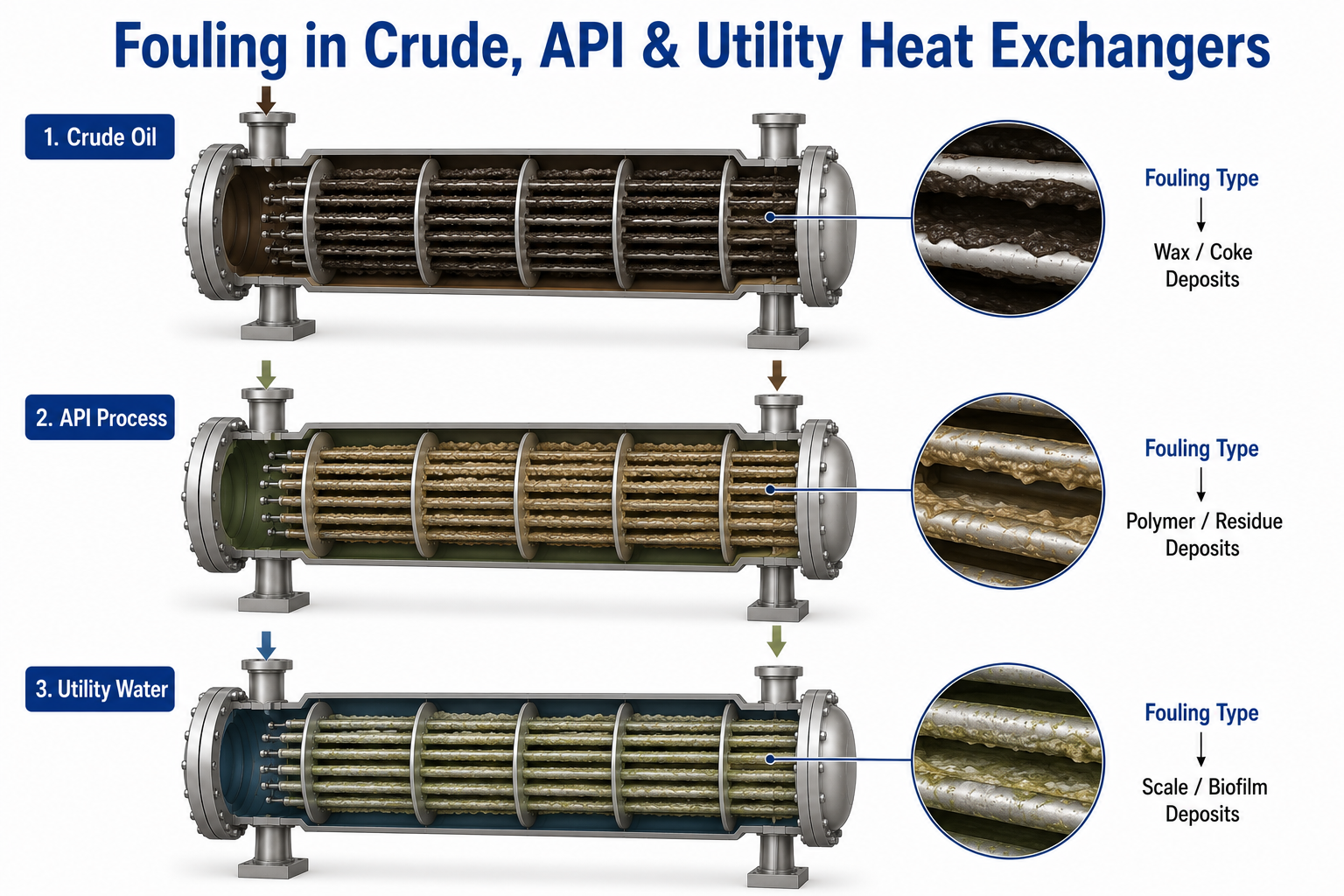
Although every heat exchanger experiences fouling, the type, rate, and consequences of fouling vary significantly depending on the process service. A crude oil preheater may suffer from wax and coke deposits, an API plant exchanger may experience polymerization or reaction-product fouling, while a cooling water exchanger often struggles with scale, corrosion products, and biological growth. Because each service has different fouling mechanisms, successful heat exchanger design and maintenance require service-specific engineering rather than a universal fouling strategy.
One of the most common mistakes made by inexperienced engineers is assuming that fouling behaves similarly in every heat exchanger.
In reality, the fouling seen in:
- an oil refinery,
- an API manufacturing plant,
- a pharmaceutical utility system,
- a food processing facility,
can be completely different.
The deposits may look different.
They form for different reasons.
They affect performance differently.
They also require different cleaning methods.
For this reason, experienced process engineers rarely ask:
“Does this exchanger foul?”
Instead, they ask:
“What type of fouling should we expect in this service?”
Answering that question correctly influences:
- thermal design,
- material selection,
- allowable velocity,
- maintenance planning,
- cleaning method,
- operating philosophy.
Understanding the characteristics of different services allows engineers to design exchangers that remain reliable throughout their operating life.
Table of Contents
Why Fouling Depends on Process Service
Fouling is governed by the characteristics of the fluid flowing through the exchanger rather than by the exchanger itself.
Important factors include:
- fluid composition,
- suspended solids,
- dissolved salts,
- temperature,
- chemical reactions,
- biological activity,
- operating pressure,
- fluid velocity.
Since these conditions vary between industries, fouling behaviour also varies significantly.
Consequently, two identical shell-and-tube exchangers operating in different services may experience completely different fouling rates.
Fouling in Crude Oil Heat Exchangers
Crude oil exchangers operate under some of the most demanding fouling conditions in industry.
Crude oil contains numerous components capable of forming deposits, including:
- wax,
- asphaltenes,
- coke precursors,
- inorganic solids,
- corrosion products.
As crude is heated:
- heavier hydrocarbons may precipitate,
- unstable compounds may polymerize,
- coke may form on hot surfaces.
These deposits gradually reduce:
- heat transfer,
- flow area,
- exchanger reliability.
Because refinery heat recovery systems often operate continuously for long periods, fouling management becomes essential for maintaining plant efficiency.
Typical Fouling Mechanisms in Crude Service
Common causes include:
- wax deposition at lower temperatures,
- asphaltene precipitation,
- thermal cracking,
- coke formation,
- particulate deposition,
- corrosion products.
The dominant mechanism often depends on crude composition and operating temperature.
Fouling in API Heat Exchangers
API manufacturing introduces fouling mechanisms that differ significantly from refinery services.
Unlike crude oil processing, API plants frequently handle:
- batch operations,
- complex organic chemicals,
- solvents,
- intermediates,
- reaction products,
- slurries.
Common fouling sources include:
- polymer formation,
- product crystallization,
- reaction residues,
- catalyst particles,
- salt precipitation,
- decomposition products.
Because many API processes involve batch production, exchangers may experience changing fluids throughout the production campaign.
This makes fouling behaviour less predictable than in continuous refinery operation.
Batch Operation Creates Additional Fouling Challenges
Frequent product changes increase fouling complexity.
During campaign changes:
- different products pass through the same exchanger,
- cleaning effectiveness varies,
- residues from previous batches may remain,
- operating temperatures change frequently.
These variations increase the importance of:
- cleaning validation,
- maintenance planning,
- careful process changeover procedures.
In pharmaceutical manufacturing, product quality considerations may become just as important as thermal performance.
Fouling in Utility Heat Exchangers
Utility exchangers usually experience inorganic or biological fouling rather than process-product fouling.
Typical utility services include:
- cooling water,
- chilled water,
- boiler feed water,
- condensate,
- hot water,
- glycol systems.
Common deposits include:
- calcium carbonate scale,
- magnesium salts,
- silica,
- corrosion products,
- suspended solids,
- algae,
- bacterial biofilms.
Unlike process fouling, utility fouling is often strongly influenced by water quality and treatment practices.
Cooling Water Fouling Is Often Continuous
Cooling water systems provide ideal conditions for several fouling mechanisms to occur simultaneously.
A cooling water exchanger may experience:
- mineral scaling,
- biological growth,
- mud deposition,
- corrosion products.
Seasonal water quality changes can also alter fouling behaviour.
Good water treatment therefore becomes one of the most effective methods of controlling exchanger fouling.
Steam and Condensate Exchangers Experience Different Problems
Even relatively clean utility systems are not completely free from fouling.
Common deposits include:
- iron oxide,
- corrosion products,
- boiler carryover,
- water-side scale.
Although these exchangers generally foul more slowly than cooling water systems, poor water treatment can still significantly reduce performance over time.
Fouling Rate Differs Between Services
Not every exchanger requires the same maintenance interval.
For example:
Crude oil preheaters may require cleaning based on:
- feed quality,
- crude blending,
- operating temperature.
API exchangers may require cleaning after:
- product campaigns,
- batch changes,
- process contamination.
Cooling water exchangers often follow maintenance schedules based on:
- seasonal fouling,
- water quality,
- pressure drop trends.
Each service therefore requires its own maintenance philosophy.
Cleaning Methods Depend on Fouling Type
The most effective cleaning method depends entirely on the deposit being removed.
Examples include:
Mechanical cleaning for:
- hard scale,
- particulate deposits.
Chemical cleaning for:
- mineral scale,
- chemical residues.
Hydrojet cleaning for:
- sludge,
- biological fouling,
- soft deposits.
Specialized solvent cleaning for:
- wax,
- polymers,
- organic deposits.
Selecting an inappropriate cleaning method may damage the exchanger or fail to remove the fouling effectively.
Design Should Reflect Expected Fouling Behaviour
Good exchanger design begins by understanding the expected service.
Engineers may modify the design by selecting:
- removable tube bundles,
- larger tube diameters,
- higher flow velocities,
- appropriate materials,
- improved cleaning access,
- suitable fouling allowances.
These decisions vary according to the expected fouling mechanism rather than following a standard design for every exchanger.
Lessons Across Different Industries
Despite different fouling mechanisms, the engineering philosophy remains the same.
Whether operating in:
- refineries,
- API plants,
- chemical plants,
- pharmaceutical facilities,
- utility systems,
successful fouling management always requires:
- understanding the fluid,
- monitoring exchanger performance,
- planning maintenance,
- designing for cleanability.
The deposits may differ, but the engineering approach remains consistent.
Common Misunderstandings About Fouling in Different Services
Understanding the service is more important than memorizing fouling types.
“Every Heat Exchanger Fouls the Same Way”
Each service develops different deposits under different operating conditions.
Successful fouling management always begins with understanding the process fluid.
“Utility Exchangers Do Not Require Much Attention”
Cooling water systems frequently experience severe fouling because of:
- minerals,
- microorganisms,
- suspended solids.
Utility exchangers often require as much attention as process exchangers.
“API Plants Experience Less Fouling Than Refineries”
API fouling is often less predictable because of:
- batch operation,
- changing products,
- chemical reactions,
- crystallization.
Lower throughput does not necessarily mean lower fouling.
“One Cleaning Method Works for Every Deposit”
Effective cleaning depends entirely on:
- deposit composition,
- exchanger construction,
- process compatibility,
- material limitations.
Cleaning strategy should always match the fouling mechanism.
Operator Perspective
Operators are usually the first to recognize how different services foul in different ways.
Changes in:
- pressure drop,
- outlet temperatures,
- cleaning frequency,
- utility demand,
often provide valuable clues about the type of fouling developing inside the exchanger.
Consistent operating records help identify recurring fouling patterns for each service.
Owner Perspective
Different services require different maintenance investments to achieve optimum lifecycle performance.
Understanding service-specific fouling enables plant owners to:
- reduce unnecessary cleaning,
- improve energy efficiency,
- minimize production losses,
- extend equipment life,
- optimize maintenance budgets.
Applying the same fouling strategy to every exchanger rarely produces the lowest lifecycle cost.
Final Perspective
Fouling is not a single engineering problem with a single solution.
A refinery exchanger fouls differently from an API reactor cooler, and both behave differently from a cooling water exchanger.
Each service introduces unique fluids, operating conditions, deposit mechanisms, and maintenance requirements.
Successful heat exchanger design therefore begins with understanding the process itself rather than simply selecting a standard fouling allowance.
Engineers who recognize these service-specific differences can design exchangers that are easier to maintain, more energy efficient, and better suited to the realities of long-term industrial operation.
Ultimately, the most effective fouling strategy is not the one applied to every heat exchanger—it is the one tailored to the service in which that exchanger operates.
Explore the complete series in the Heat Exchanger Engineering Hub.

A practicing chemical engineer with 17+ years of experience in process design, project execution, commissioning, and plant operations. Focused on practical engineering judgment beyond textbook explanations.