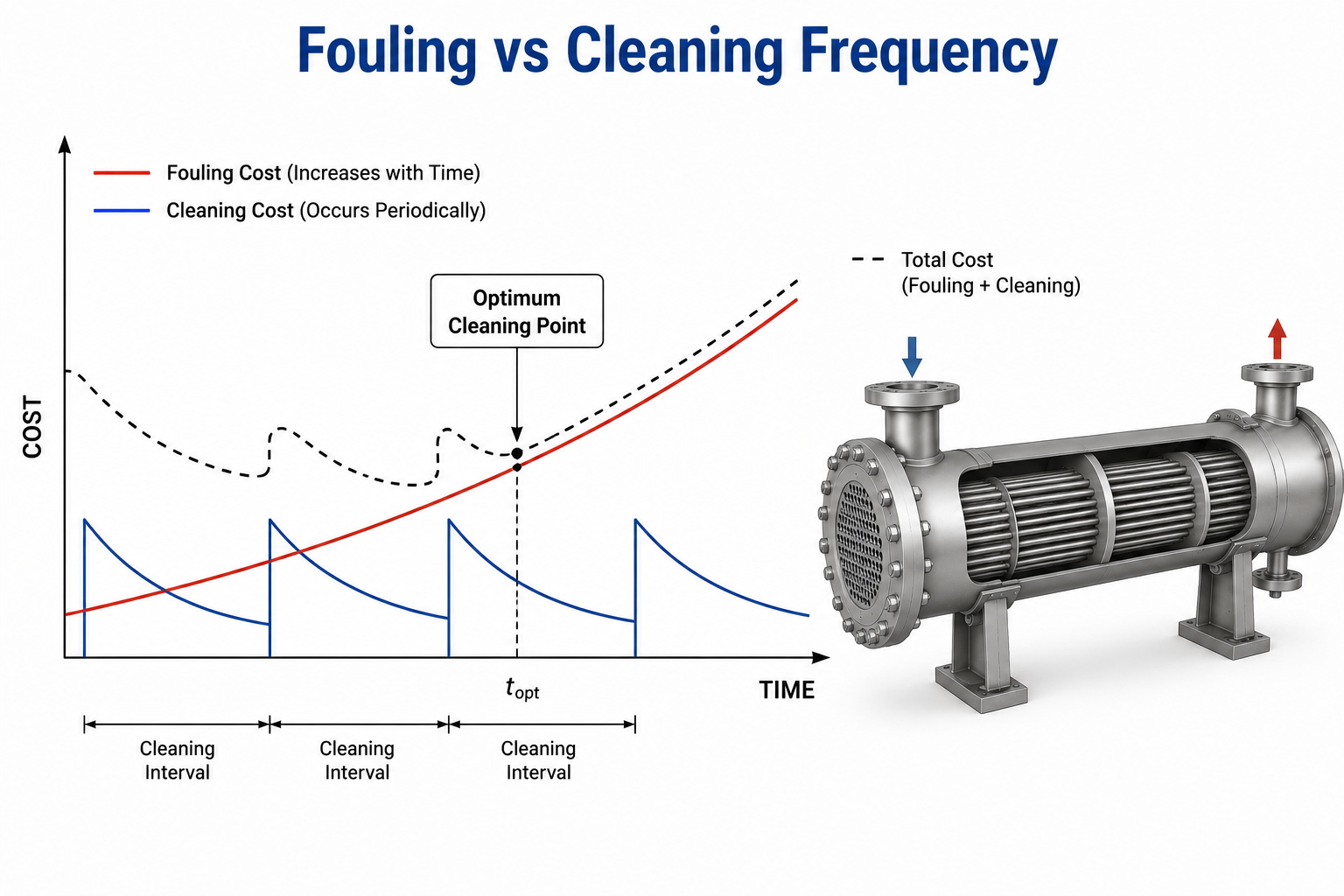
Every heat exchanger gradually accumulates fouling, but cleaning it too frequently can be just as uneconomical as cleaning it too late. Every shutdown incurs labour costs, production losses, and maintenance expenses, while every additional day of fouled operation increases energy consumption and reduces process efficiency. The challenge for engineers is not to eliminate fouling completely, but to determine the most economical point at which cleaning should be performed. This balance between operating efficiency and maintenance cost is one of the most important lifecycle decisions in heat exchanger management.
One of the most common questions asked during plant operation is:
“Should we clean the exchanger now or wait until the next shutdown?”
At first glance, the answer appears simple.
If fouling reduces performance, cleaning should always improve it.
In reality, the decision is much more complex.
Cleaning involves:
- plant downtime,
- maintenance labour,
- replacement gaskets,
- inspection activities,
- utility isolation,
- production interruption.
Operating with fouling also has consequences:
- increasing steam consumption,
- higher cooling water demand,
- rising pressure drop,
- lower heat recovery,
- declining production efficiency.
Cleaning too early wastes maintenance resources.
Cleaning too late wastes energy and may reduce production.
Successful heat exchanger management therefore depends on identifying the point where the total operating cost is minimized rather than focusing on only maintenance or only thermal performance.
Table of Contents
Fouling Begins Immediately, but Cleaning Does Not
The presence of fouling does not automatically mean that cleaning is necessary.
Soon after commissioning, small deposits begin forming on the heat transfer surfaces.
Initially:
- heat transfer remains close to design,
- pressure drop changes very little,
- process temperatures remain acceptable.
At this stage, cleaning provides little economic benefit because the exchanger still performs almost as intended.
Minor fouling is therefore considered a normal part of industrial operation.
Cleaning Too Frequently Increases Operating Cost
Every maintenance shutdown carries direct and indirect costs.
Each cleaning activity may involve:
- labour,
- scaffolding,
- lifting equipment,
- chemical cleaning agents,
- hydrojet equipment,
- replacement gaskets,
- inspection,
- startup activities.
In addition, many plants experience:
- lost production,
- reduced equipment availability,
- utility disruptions,
- scheduling complications.
If cleaning is performed before fouling significantly affects performance, these costs may exceed the energy savings achieved.
Delaying Cleaning Also Has Consequences
Allowing fouling to continue indefinitely gradually increases operating losses.
As deposits become thicker:
- heat duty decreases,
- pressure drop rises,
- utility consumption increases,
- pumping energy rises,
- production efficiency declines.
Eventually, the cost of operating a fouled exchanger exceeds the cost of cleaning it.
This is the point engineers attempt to identify through performance monitoring.
The Most Economical Cleaning Time Is Rarely the Earliest
Engineering optimization seeks the lowest total lifecycle cost rather than the cleanest equipment.
An exchanger does not need to operate under perfectly clean conditions to remain economically efficient.
Instead, engineers balance:
- maintenance expenditure,
- production losses,
- utility costs,
- cleaning frequency,
- shutdown scheduling.
The objective is to maximize overall plant profitability rather than maximize exchanger cleanliness.
Planned Shutdowns Often Influence Cleaning Decisions
Maintenance opportunities frequently determine when cleaning is performed.
Many process plants operate continuously for months before scheduled turnarounds.
Whenever possible, exchanger cleaning is coordinated with:
- annual shutdowns,
- catalyst replacement,
- statutory inspections,
- major maintenance campaigns.
Cleaning during planned outages avoids unnecessary production interruptions.
However, if fouling becomes severe before the scheduled shutdown, earlier maintenance may become economically justified.
Performance Monitoring Supports Better Decisions
Cleaning decisions should be based on measured performance rather than fixed operating time.
Engineers routinely monitor:
- outlet temperatures,
- heat duty,
- pressure drop,
- steam consumption,
- cooling water flow,
- utility demand.
Trend analysis often reveals gradual fouling long before operators notice process problems.
Performance-based maintenance generally provides better results than calendar-based maintenance.
Different Services Require Different Cleaning Frequencies
No universal cleaning schedule exists for every heat exchanger.
Cleaning frequency depends on:
- process fluid,
- fouling mechanism,
- operating temperature,
- water quality,
- maintenance philosophy,
- production criticality.
For example:
Cooling water exchangers may require relatively frequent cleaning due to:
- scale,
- biological growth,
- suspended solids.
Highly purified process streams may operate for years with minimal fouling.
Crude oil exchangers often require cleaning intervals determined by:
- wax deposition,
- coke formation,
- feedstock variability.
Each service demands its own maintenance strategy.
Cleaning Methods Also Influence the Trade-Off
Different cleaning techniques involve different costs and downtime.
Maintenance options include:
- mechanical tube cleaning,
- hydrojet cleaning,
- chemical cleaning,
- online cleaning systems,
- pigging systems where applicable.
Some methods require complete shutdown.
Others may allow partial operation.
The selected cleaning method influences both maintenance cost and production loss.
Operating Practices Can Extend Cleaning Intervals
Good operation slows fouling and postpones maintenance.
Engineers can often reduce fouling by:
- maintaining recommended flow velocities,
- improving water treatment,
- installing filtration,
- minimizing stagnant conditions,
- controlling operating temperatures,
- avoiding unnecessary process upsets.
Reducing fouling rate allows longer operating campaigns without sacrificing performance.
Cleaning Restores Performance but Not Always Completely
Repeated operation may permanently affect exchanger condition.
Cleaning removes most deposits.
However, long-term operation may also produce:
- corrosion,
- erosion,
- tube wall thinning,
- surface roughness,
- mechanical damage.
Consequently, an older exchanger may never fully recover its original thermal performance after cleaning.
Preventive maintenance therefore remains more valuable than corrective maintenance following severe deterioration.
Engineering Economics Drives the Decision
The optimum cleaning interval is an economic decision supported by engineering data.
Engineers evaluate:
- increasing utility costs,
- production value,
- maintenance expenditure,
- shutdown duration,
- equipment criticality,
- expected fouling rate.
The cleaning schedule is then selected to minimize the combined cost of:
- operating with fouling,
- performing maintenance.
This lifecycle perspective provides the greatest long-term value.
Common Misunderstandings About Cleaning Frequency
Maintenance decisions should balance engineering performance with economic reality.
“Clean the Exchanger Whenever Fouling Appears”
Minor fouling is expected.
Cleaning should occur when the benefits outweigh the maintenance cost.
“Waiting Longer Always Saves Money”
Delayed cleaning increases:
- utility costs,
- production losses,
- pressure drop,
- maintenance complexity.
Eventually, operating losses exceed the savings from postponing maintenance.
“Every Exchanger Should Be Cleaned on the Same Schedule”
Cleaning frequency depends entirely on:
- service conditions,
- process fluid,
- fouling behaviour,
- maintenance philosophy.
Each exchanger should be evaluated individually.
“Cleaning Restores the Exchanger to Brand-New Condition”
Cleaning removes deposits but cannot reverse:
- corrosion,
- erosion,
- fatigue,
- mechanical ageing.
Long-term equipment condition still requires regular inspection and maintenance.
Operator Perspective
Operators play a critical role in identifying the right time for cleaning.
Gradual increases in:
- steam demand,
- cooling water usage,
- pressure drop,
- outlet temperature deviation,
often indicate that fouling has reached the point where cleaning should be considered.
Consistent monitoring helps avoid both premature and delayed maintenance.
Owner Perspective
The objective is not the cleanest exchanger—it is the most profitable operating strategy.
For plant owners, selecting the appropriate cleaning interval results in:
- lower lifecycle cost,
- improved production availability,
- reduced utility expenditure,
- fewer unnecessary shutdowns,
- longer equipment life,
- better return on maintenance investment.
A well-planned maintenance strategy maximizes plant profitability rather than simply minimizing fouling.
Final Perspective
Every heat exchanger gradually moves along two competing curves during operation.
One curve represents the increasing cost of fouling through higher energy consumption, greater pressure drop, and declining process efficiency.
The other represents the cost of cleaning through labour, maintenance, downtime, and production interruption.
Good engineering does not attempt to eliminate either cost completely.
Instead, it identifies the point where the combined cost is lowest.
That point defines the optimum cleaning interval.
Ultimately, successful fouling management is not measured by how often an exchanger is cleaned, but by how effectively cleaning decisions balance thermal performance, maintenance effort, and long-term plant profitability.
Explore the complete series in the Heat Exchanger Engineering Hub.
A practicing chemical engineer with 17+ years of experience in process design, project execution, commissioning, and plant operations. Focused on practical engineering judgment beyond textbook explanations.