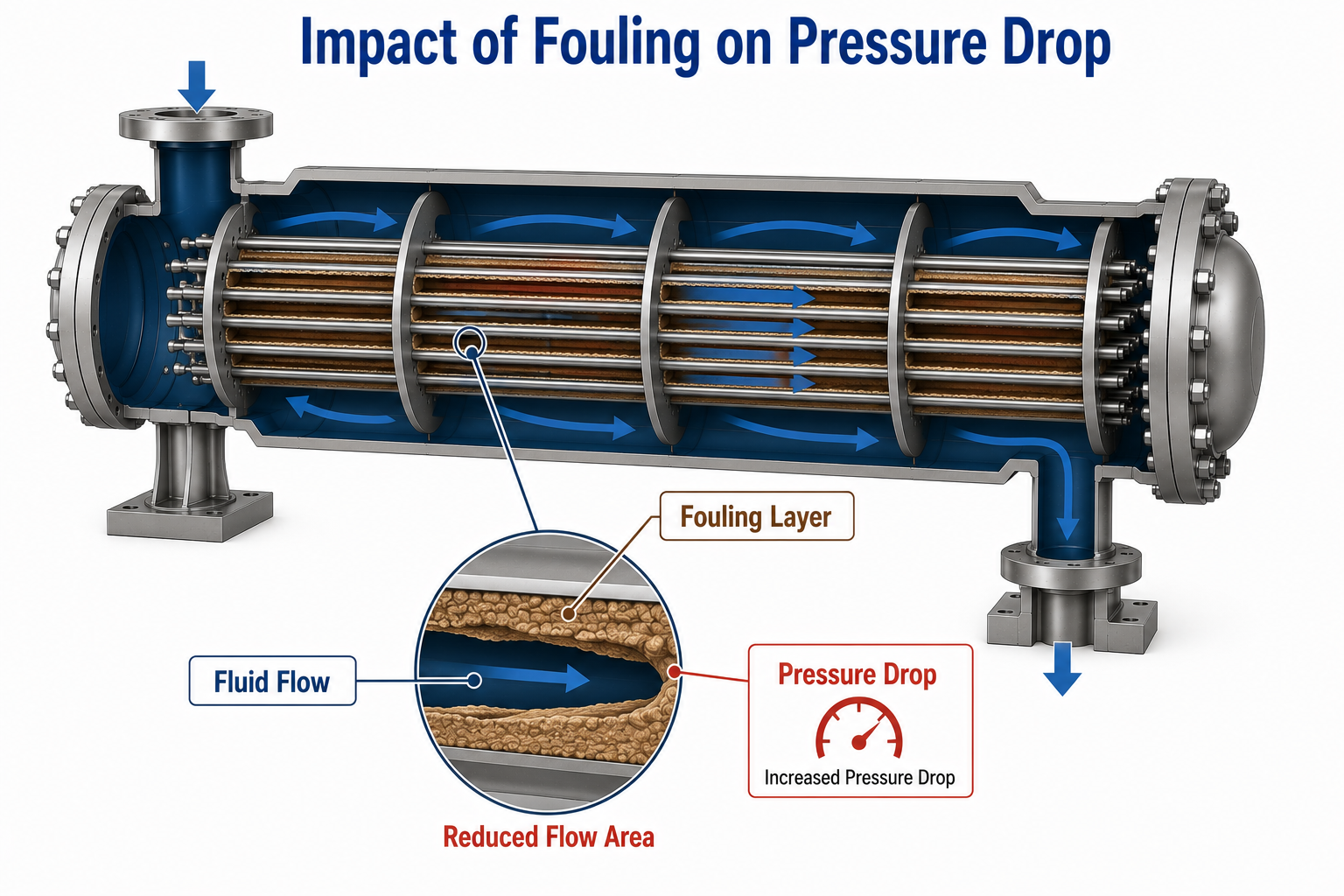
When engineers discuss fouling in heat exchangers, the conversation often focuses on reduced heat transfer. However, fouling also has an equally important hydraulic consequence—it increases pressure drop. As deposits accumulate inside tubes or on shell-side flow passages, the available flow area decreases and fluid encounters greater resistance. The result is higher pumping energy, reduced flow rates, lower plant throughput, and, in many cases, production limitations before thermal performance becomes critical. Understanding the hydraulic impact of fouling is therefore essential for designing, operating, and maintaining efficient heat exchangers.
A heat exchanger has two primary responsibilities:
- transfer heat efficiently,
- allow fluid to flow with acceptable pressure loss.
Most engineers immediately notice when an exchanger fails to meet its thermal duty.
A cooling process may become ineffective.
A heating process may require additional steam.
These problems are easy to associate with fouling.
Pressure drop, however, often receives much less attention.
Yet in many operating plants, increasing pressure drop becomes the first indication that fouling is developing.
Long before outlet temperatures begin drifting away from design values, pumps may already be working harder, compressors may consume more energy, and process flow rates may begin declining.
This gradual increase in hydraulic resistance is one of the hidden costs of exchanger fouling.
Ignoring it can reduce production capacity even when the exchanger still appears capable of transferring sufficient heat.
Table of Contents
What Is Pressure Drop in a Heat Exchanger?
Pressure drop is the reduction in fluid pressure caused by flow resistance inside the exchanger.
As fluid passes through:
- tubes,
- shell-side flow paths,
- baffles,
- nozzles,
- return channels,
it experiences friction.
This friction causes pressure to decrease from inlet to outlet.
Every exchanger is designed with an allowable pressure drop that balances:
- heat transfer,
- pumping power,
- process requirements.
Exceeding this design limit affects both equipment performance and plant operation.
How Fouling Increases Pressure Drop
Deposits gradually reduce the effective flow area available to the process fluid.
As fouling accumulates:
- tube diameter decreases,
- shell-side passages narrow,
- surface roughness increases,
- local flow restrictions develop.
The fluid must therefore pass through smaller passages while overcoming greater friction.
Consequently:
- hydraulic resistance increases,
- pressure drop rises,
- pumping energy increases.
Unlike thermal degradation, which depends mainly on insulating effects, hydraulic degradation results from restricted flow.
Tube-Side Fouling Creates Direct Flow Restriction
Even relatively thin deposits significantly affect tube-side hydraulics.
Inside tubes, fouling reduces the internal diameter available for flow.
As the flow area decreases:
- fluid velocity changes,
- wall friction increases,
- pressure loss rises.
In severe cases:
- tubes may become partially blocked,
- individual tubes may plug completely,
- flow redistributes unevenly across the bundle.
This uneven flow can also reduce thermal performance while accelerating fouling in other tubes.
Shell-Side Fouling Restricts Complex Flow Paths
Shell-side fouling affects pressure drop differently from tube-side fouling.
The shell side already contains:
- baffles,
- support plates,
- tube bundles,
- leakage paths,
- crossflow regions.
Deposits forming on:
- tube surfaces,
- baffles,
- shell walls,
reduce the available flow passages.
Since shell-side flow is already complex, even moderate fouling may significantly alter flow distribution and increase pressure losses.
Increased Pressure Drop Requires More Pumping Energy
Higher hydraulic resistance forces pumps to work harder.
As pressure drop increases:
- pump discharge pressure rises,
- motor power increases,
- electricity consumption increases.
For systems operating with fixed-speed pumps, this may simply increase energy costs.
For systems operating near pump capacity, additional pressure losses may reduce flow instead of increasing pump load.
Both situations increase operating cost.
Reduced Flow Can Lower Heat Transfer
Hydraulic and thermal performance are closely connected.
When pressure drop becomes excessive:
- flow rate may decrease,
- fluid velocity falls,
- convective heat transfer coefficient decreases.
The exchanger now suffers from two simultaneous problems:
- insulating deposits,
- reduced heat transfer due to lower flow.
Thermal performance therefore deteriorates even faster.
Pressure Drop May Limit Production Before Heat Duty Does
Many plants encounter hydraulic limitations before thermal limitations.
Consider a reactor feed preheater.
The exchanger may still provide nearly adequate heating.
However, increasing pressure drop may restrict feed flow.
If pumps cannot overcome the additional resistance:
- reactor throughput decreases,
- production capacity falls,
- plant output declines.
In this situation, fouling limits production through hydraulics rather than insufficient heat transfer.
Pressure Drop Can Accelerate Equipment Wear
Hydraulic consequences extend beyond energy consumption.
Higher pressure losses may contribute to:
- increased pump loading,
- seal wear,
- bearing stress,
- compressor loading,
- control valve instability.
Equipment throughout the process system experiences greater operating stress because of fouling inside a single exchanger.
The impact therefore extends well beyond the exchanger itself.
Monitoring Pressure Drop Helps Detect Fouling Early
Pressure drop is one of the most valuable indicators of exchanger condition.
Engineers routinely monitor:
- inlet pressure,
- outlet pressure,
- differential pressure,
- flow rate,
- outlet temperatures.
A gradual increase in differential pressure often indicates fouling before significant thermal degradation becomes apparent.
Trend monitoring enables maintenance to be scheduled proactively rather than reactively.
Different Fouling Mechanisms Affect Pressure Drop Differently
Not every type of fouling produces the same hydraulic behaviour.
For example:
Mineral scale often forms relatively uniform deposits that steadily reduce flow area.
Biological fouling may create irregular flow restrictions.
Wax deposition can gradually narrow passages before suddenly causing severe blockage.
Particulate fouling may accumulate preferentially in low-velocity regions, producing localized plugging.
Understanding the fouling mechanism helps engineers predict how rapidly pressure drop is likely to increase.
Good Design Helps Minimize Hydraulic Fouling Problems
Design decisions strongly influence long-term pressure drop behaviour.
Engineers reduce hydraulic fouling risk by considering:
- appropriate tube diameter,
- recommended fluid velocity,
- adequate baffle spacing,
- removable tube bundles,
- effective filtration,
- suitable material selection,
- cleaning accessibility.
Proper design cannot eliminate fouling, but it can reduce how severely fouling affects pressure loss throughout the exchanger’s operating life.
Balancing Heat Transfer Against Pressure Drop
Higher velocity improves heat transfer but also increases pressure drop.
One of the most important design compromises involves fluid velocity.
Higher velocity generally:
- improves heat transfer,
- reduces fouling tendency,
- promotes turbulence.
However, it also:
- increases clean pressure drop,
- raises pumping energy,
- increases erosion risk.
Lower velocity reduces pumping cost but may encourage fouling and increase long-term pressure losses.
Successful exchanger design balances both thermal and hydraulic objectives rather than optimizing either independently.
Common Misunderstandings About Fouling and Pressure Drop
Hydraulic performance deserves as much attention as thermal performance during exchanger operation.
“Fouling Only Reduces Heat Transfer”
Fouling simultaneously:
- reduces heat transfer,
- increases pressure drop,
- raises pumping energy,
- affects production capacity.
Both thermal and hydraulic performance deteriorate together.
“Pressure Drop Only Matters to Pumps”
Higher pressure losses influence:
- pumps,
- compressors,
- process flow,
- control stability,
- production rate.
Its impact extends throughout the entire process system.
“If Temperatures Are Acceptable, Fouling Is Not Serious”
An exchanger may still achieve acceptable temperatures while consuming significantly more pumping energy because of increased hydraulic resistance.
Thermal performance alone does not reveal the full impact of fouling.
“Cleaning Should Be Based Only on Heat Duty”
Pressure drop is often the parameter that determines the most economical cleaning interval.
Both hydraulic and thermal performance should guide maintenance decisions.
Operator Perspective
Operators frequently notice hydraulic symptoms before thermal symptoms.
Common warning signs include:
- rising differential pressure,
- increasing pump discharge pressure,
- declining process flow,
- unstable control valves,
- increasing energy consumption.
Recognizing these trends allows maintenance to be planned before production is affected.
Owner Perspective
For plant owners, increased pressure drop represents a continuous operating cost that is often hidden within utility consumption.
Managing hydraulic fouling provides:
- lower electricity costs,
- reduced equipment wear,
- improved production capacity,
- fewer unexpected shutdowns,
- longer equipment life,
- lower lifecycle operating cost.
Maintaining acceptable pressure drop is therefore just as important as maintaining thermal efficiency.
Final Perspective
Heat exchanger fouling is often viewed as a thermal problem, but its hydraulic consequences can be equally significant.
As deposits gradually restrict flow passages, pressure drop increases, pumps consume more energy, process flow declines, and equipment throughout the plant experiences additional operating stress.
In many facilities, these hydraulic penalties become economically important long before heat transfer losses threaten production.
Successful heat exchanger management therefore requires engineers to monitor both thermal and hydraulic performance with equal attention.
By recognizing rising pressure drop as an early indicator of fouling, plants can schedule cleaning at the optimum time, minimize energy consumption, protect rotating equipment, and maintain reliable production throughout the exchanger’s operating life.
Explore the complete series in the Heat Exchanger Engineering Hub.
A practicing chemical engineer with 17+ years of experience in process design, project execution, commissioning, and plant operations. Focused on practical engineering judgment beyond textbook explanations.