
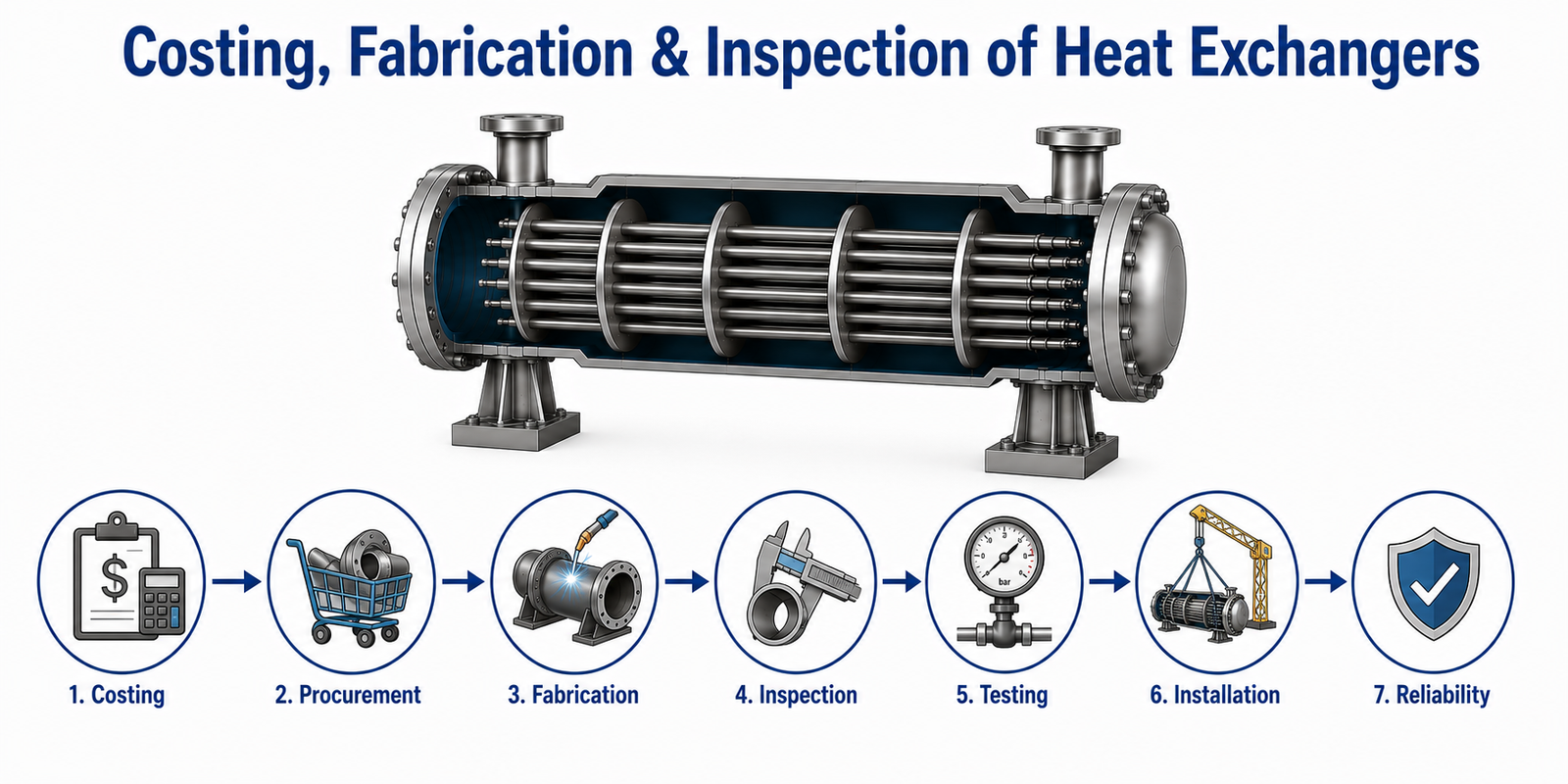
A heat exchanger’s reliability is determined long before it enters service. While thermal and mechanical design establish the equipment’s intended performance, its actual operating life depends heavily on procurement decisions, fabrication quality, inspection practices, transportation, installation, and acceptance testing. A perfectly designed heat exchanger can suffer from premature failures if manufacturing defects go undetected, inspection is inadequate, or cost-saving decisions compromise quality. Understanding how these project stages influence long-term reliability enables engineers to make better technical decisions, minimize lifecycle costs, and ensure dependable plant operation.
By the time a heat exchanger arrives at a process plant, months of engineering work have already been completed.
The equipment has been:
- thermally designed,
- mechanically designed,
- specified,
- quoted by vendors,
- fabricated,
- inspected,
- tested,
- transported,
- delivered to site.
To many engineers, this marks the end of the procurement phase and the beginning of installation.
In reality, it represents the beginning of the exchanger’s operational life.
Many of the failures encountered years later can be traced back to decisions made during these earlier stages.
Examples include:
- selecting unsuitable materials,
- accepting poor fabrication quality,
- overlooking inspection findings,
- inadequate welding procedures,
- transportation damage,
- improper storage,
- installation errors.
These issues may remain hidden during commissioning yet gradually reduce equipment reliability throughout its operating life.
Experienced engineers therefore recognize that reliability is not created during operation alone.
It is built through disciplined engineering, quality manufacturing, thorough inspection, and careful project execution.
This pillar explores how each of these stages contributes to the long-term performance of industrial heat exchangers.
Table of Contents
Reliability Begins Long Before Startup
Many engineers associate reliability with maintenance, but it actually begins during equipment specification and procurement.
Every important decision made before fabrication influences future performance.
Examples include:
- material selection,
- design pressure,
- corrosion allowance,
- fabrication standards,
- inspection requirements,
- testing procedures,
- quality documentation.
A well-maintained exchanger cannot fully compensate for poor manufacturing quality or incorrect procurement decisions.
Likewise, an exchanger built with high-quality materials and sound fabrication practices often delivers reliable service for decades when operated correctly.
Procurement Decisions Influence More Than Purchase Price
The lowest quotation rarely represents the lowest long-term cost.
When selecting a heat exchanger, engineers must balance:
- capital cost,
- operating efficiency,
- maintenance requirements,
- inspection accessibility,
- expected service life,
- spare part availability,
- fabrication quality.
Reducing the initial purchase price may result in:
- higher utility consumption,
- increased maintenance,
- shorter equipment life,
- more frequent shutdowns,
- higher lifecycle costs.
Successful procurement therefore evaluates technical suitability alongside commercial considerations.
Fabrication Quality Determines Structural Reliability
Even an excellent design depends on equally good workmanship.
Heat exchanger fabrication includes critical activities such as:
- shell fabrication,
- tube manufacturing,
- tube-to-tubesheet joining,
- welding,
- machining,
- baffle installation,
- dimensional verification,
- assembly.
Errors during fabrication may introduce:
- leakage,
- vibration problems,
- stress concentration,
- flow maldistribution,
- premature failure.
Many of these defects are difficult—or impossible—to correct after the exchanger enters service.
Inspection Prevents Hidden Defects from Reaching the Plant
Inspection verifies that fabrication complies with design requirements rather than assuming quality has been achieved.
Typical inspection activities include:
- dimensional inspection,
- visual examination,
- weld inspection,
- non-destructive testing,
- material verification,
- hydrostatic testing,
- documentation review.
Inspection is not intended to criticize the manufacturer.
Its purpose is to identify deviations while corrective action remains practical.
Early detection is almost always less expensive than repairing defects after installation.
Testing Confirms Readiness for Service
Testing demonstrates that the completed exchanger performs safely before shipment and operation.
Depending on project requirements, testing may include:
- hydrostatic testing,
- pneumatic leak testing,
- pressure holding tests,
- material identification,
- dimensional verification,
- functional checks.
Although testing cannot guarantee future reliability, it significantly reduces the risk of hidden manufacturing defects entering plant service.
Transportation and Installation Affect Equipment Integrity
Properly manufactured equipment can still be damaged before commissioning.
Common risks include:
- lifting damage,
- impact during transportation,
- inadequate preservation,
- moisture ingress,
- improper storage,
- nozzle distortion,
- support misalignment.
Without careful handling, equipment quality achieved during fabrication may be compromised before startup.
Project teams should therefore treat transportation and installation as extensions of the quality assurance process.
Documentation Is Part of Equipment Quality
A heat exchanger is delivered with more than steel—it is delivered with engineering information.
Important documentation includes:
- fabrication drawings,
- inspection reports,
- material certificates,
- welding records,
- pressure test certificates,
- quality dossiers,
- operating recommendations.
Accurate documentation supports:
- commissioning,
- maintenance,
- future modifications,
- regulatory compliance,
- failure investigations.
Incomplete documentation often creates challenges many years after project completion.
Reliability Requires Collaboration Across Disciplines
Long-term exchanger performance depends on coordinated effort rather than isolated engineering activities.
Successful projects involve collaboration between:
- process engineers,
- mechanical engineers,
- fabrication teams,
- quality inspectors,
- procurement specialists,
- project engineers,
- construction teams,
- plant operations.
Each discipline influences equipment reliability in different ways.
When information is shared effectively, the risk of overlooked problems is significantly reduced.
What This Pillar Will Cover
This pillar examines the engineering activities that influence heat exchanger reliability before the equipment begins normal operation.
The following support articles explore these topics in detail:
- Heat Exchanger Cost Drivers Explained Clearly — Understanding the technical and commercial factors that determine equipment cost.
- Fabrication of Heat Exchangers – What Goes Wrong in Practice — Common manufacturing issues and how they affect long-term performance.
- Inspection & Testing of Heat Exchangers – What Matters — Inspection methods, testing requirements, and quality assurance practices.
- Why FAT & SAT Matter for Heat Exchangers — The importance of factory and site acceptance testing before commissioning.
- Vendor Drawing Review Checklist for Heat Exchangers — Practical guidance for reviewing vendor drawings before approval.
- Delivery & Erection Issues in Heat Exchanger Projects — How transportation, storage, lifting, and installation influence reliability.
- Why the Cheapest Heat Exchanger Often Becomes the Most Expensive — Understanding lifecycle cost beyond the purchase price.
- Inspection Failures Seen on Heat Exchanger Sites — Practical lessons from quality issues discovered during fabrication and site inspection.
Together, these articles provide a practical understanding of how engineering, manufacturing, quality assurance, and project execution combine to determine the long-term reliability of industrial heat exchangers.
Common Misunderstandings About Heat Exchanger Reliability
Many reliability problems originate from misconceptions during procurement and project execution rather than from equipment operation.
“Good Design Alone Guarantees Reliable Performance”
A technically sound design still depends on proper fabrication, inspection, transportation, installation, and operation.
Reliability is achieved through the entire project lifecycle.
“Inspection Only Confirms Compliance”
Inspection is an opportunity to detect and correct problems before they become expensive operational failures.
Its value lies in preventing defects rather than documenting them.
“Testing Eliminates All Future Risks”
Hydrotests, leak tests, and inspection verify current equipment condition.
They cannot prevent failures caused by poor operation, changing process conditions, corrosion, or inadequate maintenance.
“The Lowest Purchase Price Is the Best Procurement Decision”
A lower purchase price may result in higher maintenance costs, reduced efficiency, shorter service life, and greater production losses.
Lifecycle performance should always be considered alongside capital cost.
Operator Perspective
Operators inherit the quality of every engineering and fabrication decision made before startup.
Reliable equipment enables operators to maintain:
- stable temperatures,
- predictable pressure drop,
- efficient utility consumption,
- longer operating campaigns,
- fewer unexpected shutdowns.
Well-executed projects simplify operation throughout the exchanger’s service life.
Owner Perspective
For plant owners, reliability begins as a project decision rather than a maintenance activity.
Investing in sound procurement, disciplined fabrication, comprehensive inspection, and careful installation helps achieve:
- longer equipment life,
- lower maintenance costs,
- improved energy efficiency,
- higher production availability,
- reduced lifecycle expenditure,
- stronger return on capital investment.
Quality established before commissioning often produces benefits for decades.
Final Perspective
The reliability of a heat exchanger is not determined on the day it begins operating.
It is shaped by hundreds of engineering decisions made long before the first process fluid enters the equipment.
Material selection, fabrication quality, inspection discipline, vendor review, transportation practices, installation methods, and procurement philosophy all influence how the exchanger will perform years into its service life.
Successful organizations recognize that reliability is not created through maintenance alone.
It is built progressively—from specification and design, through fabrication and inspection, to commissioning and operation.
Ultimately, the most reliable heat exchangers are those supported by a project culture that values engineering judgement, quality workmanship, rigorous inspection, and lifecycle thinking at every stage of the equipment’s journey.
Explore the complete series in the Heat Exchanger Engineering Hub.

A practicing chemical engineer with 17+ years of experience in process design, project execution, commissioning, and plant operations. Focused on practical engineering judgment beyond textbook explanations.