
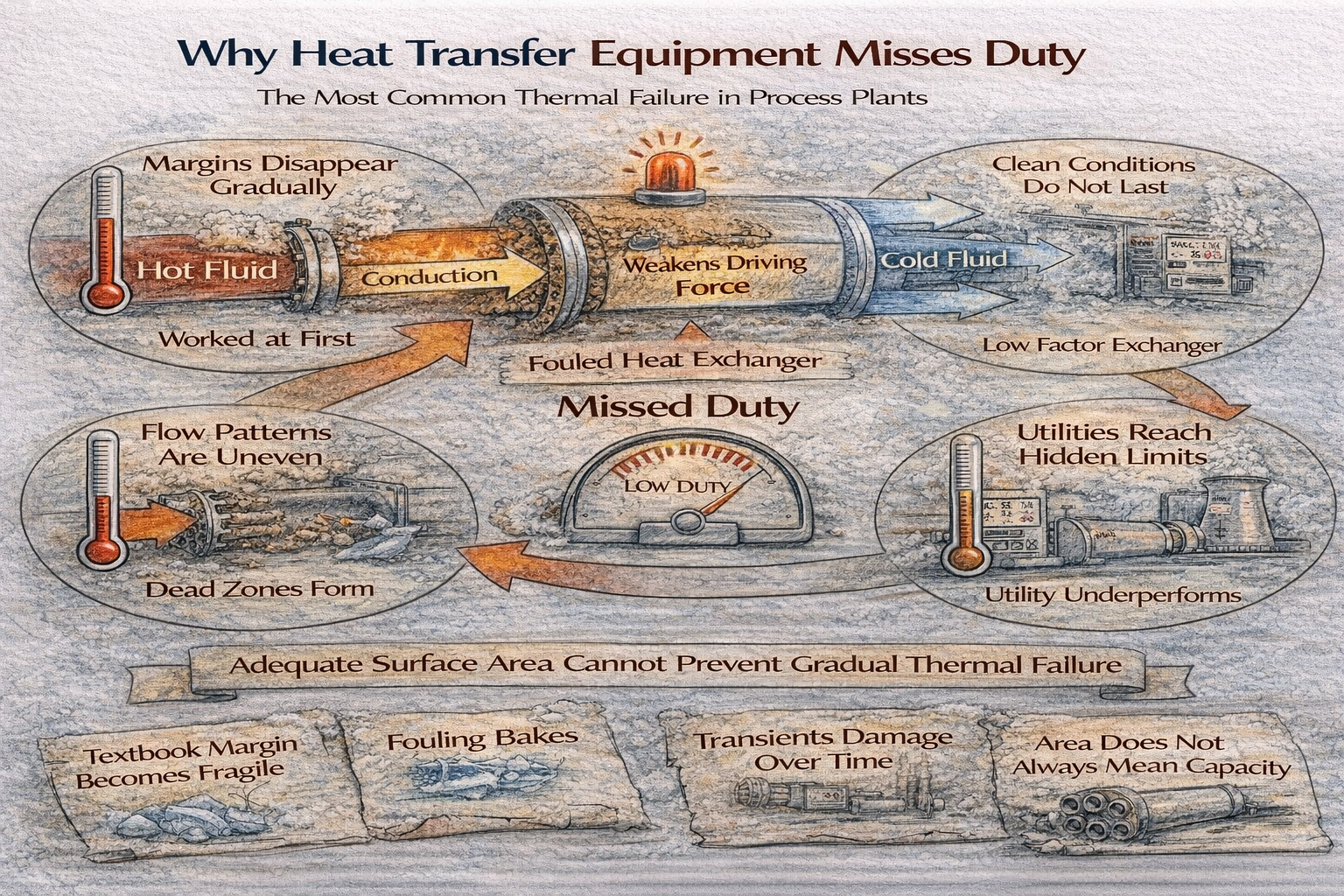
When heat transfer equipment fails, the most frequent complaint is simple:
“The exchanger is not giving the required duty.”
Outlet temperatures are missed.
Reboilers struggle.
Coolers underperform in summer.
Yet in many of these cases:
- the exchanger is mechanically intact,
- utilities are available,
- flow rates are close to design,
- no obvious damage is visible.
This article explains why heat transfer equipment misses duty, not as an exception, but as a predictable outcome of how real plants operate and how thermal systems are designed.
Table of Contents
Why a Heat Exchanger Misses Duty (Margin, Not Size)
The first assumption when duty is missed is undersizing.
In reality, many exchangers that miss duty:
- were sized correctly,
- met duty at startup,
- passed design review.
What they lack is margin.
Margin absorbs:
- fouling,
- maldistribution,
- operating variability,
- degradation over time.
When margin disappears, duty is missed — even if the exchanger area is technically adequate on paper.
Clean Design Conditions Do Not Last
Most exchangers meet duty when:
- surfaces are clean,
- flow distribution is ideal,
- utilities are at design condition.
These conditions exist briefly.
As operation continues:
- fouling develops,
- U declines,
- effective driving force shrinks.
If the exchanger was sized close to the limit at clean conditions, duty loss is inevitable.
The failure is not fouling itself — it is insufficient allowance for fouling.
Fouling Consumes Driving Force Before Reducing Duty
A critical reason duty loss appears “sudden” is the way fouling acts.
Early fouling:
- consumes temperature driving force,
- increases utility demand,
- tightens approach temperatures.
Duty is maintained — at a cost.
Only when driving force margin is exhausted does duty drop.
By then, recovery options are limited.
Low Correction Factor Designs Are Fragile
Exchangers with:
- multiple passes,
- crossflow components,
- mixing effects,
often rely on correction factors significantly below ideal.
These designs:
- look acceptable in calculations,
- use surface area inefficiently,
- are highly sensitive to fouling.
As fouling grows:
- effective LMTD collapses faster,
- duty loss accelerates.
Low correction factor exchangers miss duty earlier than expected.
Flow Maldistribution Reduces Effective Area
Design assumes uniform flow.
Reality delivers:
- bypassing,
- dead zones,
- uneven velocity.
As a result:
- some surface contributes little heat transfer,
- fouling concentrates in low-flow regions,
- effective area is much smaller than installed area.
The exchanger is physically large — but thermally small.
This is a common, under-recognized cause of duty shortfall.
Utility Limitations Are Often Hidden
Many exchangers miss duty not because the process side is wrong — but because utilities are constrained.
Examples include:
- cooling water temperature higher than design,
- limited steam pressure during peak demand,
- fouled utility exchangers upstream,
- seasonal variation ignored in design.
Utilities rarely fail completely.
They quietly degrade.
Thermal systems fail when utility margin is exhausted.
Temperature Approach Was Too Optimistic
Designs often target:
- tight approach temperatures,
- high energy efficiency,
- minimal utility consumption.
These targets reduce margin.
As soon as fouling, maldistribution, or seasonal variation appears:
- approach temperatures collapse,
- pinch conditions develop,
- duty becomes unattainable.
Optimistic approach temperatures are one of the most common root causes of missed duty.
Startup and Transients Damage Long-Term Performance
Many exchangers are designed for steady operation but experience:
- frequent startups,
- load changes,
- thermal cycling.
During transients:
- fouling accelerates,
- deposits bake onto surfaces,
- maldistribution worsens.
The exchanger never fully recovers its design performance.
Duty loss months later is often traced back to early operating history, not steady-state design.
Control Compensation Masks the Problem Until It Is Too Late
Control systems are designed to maintain temperature.
As heat transfer degrades:
- control valves open further,
- utilities increase,
- operators intervene manually.
The system compensates — until it cannot.
When valves saturate:
- duty loss appears suddenly,
- options are limited,
- emergency action is required.
Control success delays recognition of thermal failure.
Why Adding Area Later Often Fails to Restore Duty
When duty is missed, revamps often add area.
This fails when:
- pinch points remain,
- maldistribution is unchanged,
- utilities are already limited,
- fouling drivers persist.
Area alone cannot fix a system-level thermal mismatch.
Understanding why duty was missed is essential before fixing it.
Why “It Used to Work” Is a Dangerous Argument
Plants often say:
“It worked earlier.”
This statement hides the real issue.
Earlier operation benefited from:
- cleaner surfaces,
- unused margin,
- more forgiving conditions.
The exchanger did not change.
The operating envelope did.
Designs that depend on ideal history cannot survive real futures.
Owner Perspective: Missed Duty Is a Business Risk
From an ownership standpoint, missed duty leads to:
- reduced throughput,
- higher energy cost,
- emergency interventions,
- unreliable planning.
Because causes are gradual and distributed, the cost accumulates silently.
Understanding why equipment misses duty helps:
- prevent repeat failures,
- design better revamps,
- protect long-term production.
Final Perspective
Heat transfer equipment rarely misses duty because it was badly designed.
It misses duty because:
- margin was underestimated,
- degradation was ignored,
- variability was not tolerated.
Plants that accept missed duty as “bad luck” repeat it.
Plants that understand why duty is missed design systems that keep working.
Missing duty is not a mystery.
It is a message.
And learning to read that message is one of the most valuable skills in real process plant engineering.
Explore the complete series in the Heat Transfer Engineering Hub.

A practicing chemical engineer with 17+ years of experience in process design, project execution, commissioning, and plant operations. Focused on practical engineering judgment beyond textbook explanations.