
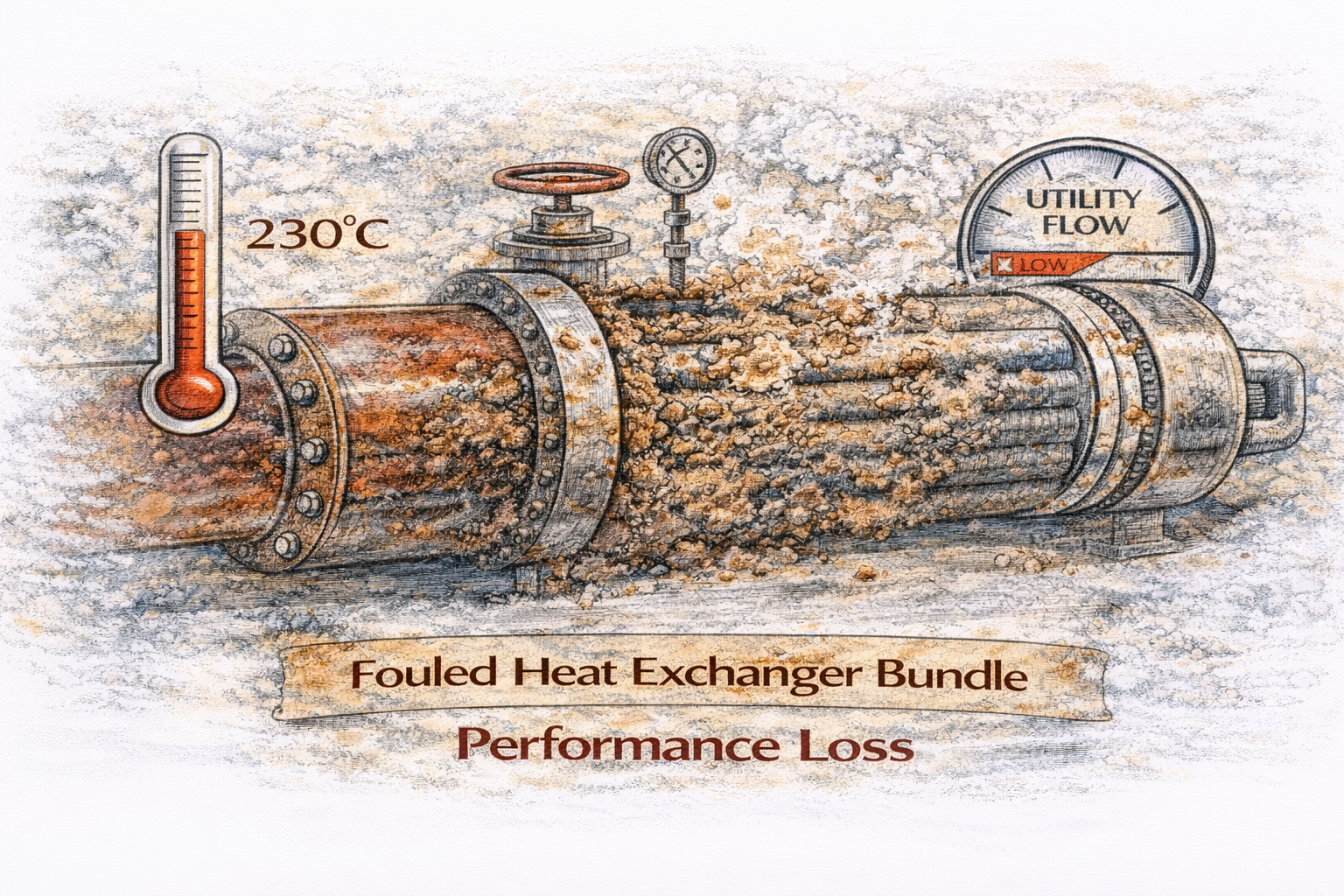
Heat transfer failures are uncomfortable.
They are rarely celebrated, rarely documented well, and often explained away as:
- bad operation,
- unexpected fouling,
- unusual feed conditions,
- poor maintenance.
Yet when examined carefully, most heat transfer failures teach the same lessons again and again — across industries, plant sizes, and technologies.
Heat transfer failures are among the most common performance problems in real process plants.
This article explains what heat exchanger failures teach beyond design calculations.
This article distills the recurring lessons from real heat transfer failures, not as isolated mistakes, but as patterns that experienced plants learn to recognize and avoid.
Table of Contents
Lesson 1: Heat Transfer Failures Begin with Wrong Assumptions
One of the most common findings after a failure is this:
The calculation itself was not incorrect.
Heat duties balance.
LMTD was applied correctly.
U values were reasonable.
What failed were the assumptions:
- clean conditions lasting too long,
- uniform flow distribution,
- stable operating points,
- slow fouling rates,
- generous utility availability.
Failures rarely come from bad math.
They come from optimistic assumptions.
Lesson 2: Margin Is More Important Than Precision
Many failed exchangers were:
- tightly sized,
- highly optimized,
- beautifully efficient on paper.
They lacked margin.
Margin absorbs:
- fouling variability,
- seasonal changes,
- maldistribution,
- operator response time,
- aging effects.
Precise designs without margin fail faster than approximate designs with tolerance.
Plants do not reward elegance.
They reward resilience.
Lesson 3: Fouling Was Known — But Not Respected
In post-failure reviews, fouling is often described as:
- “more severe than expected,”
- “unusually fast,”
- “worse than design.”
In most cases:
- fouling was expected,
- allowances existed,
- margins were minimal.
Fouling did not surprise the plant.
Its impact did.
The lesson is not “fouling is unpredictable.”
The lesson is “fouling consumes margin faster than assumed.”
Lesson 4: Low Correction Factor Designs Age Poorly
Many heat exchangers that fail early:
- rely heavily on correction factors,
- use multiple passes or crossflow,
- operate near pinch.
These designs:
- perform adequately when clean,
- lose effectiveness rapidly as fouling grows,
- collapse suddenly near limits.
They do not degrade gracefully.
The lesson is not to avoid complex designs — but to understand how they age.
Lesson 5: Utilities Are Part of the Thermal System
Failures are often blamed on process equipment when the real constraint lies in utilities.
Common overlooked realities:
- cooling water temperature increases over time,
- steam pressure drops at peak demand,
- upstream utility exchangers foul too,
- shared utility networks create interaction.
An exchanger that “misses duty” may be telling the plant:
The utility system has no margin left.
Thermal failures are often network failures, not component failures.
Lesson 6: Startup and Shutdown Do More Damage Than Steady Operation
Post-failure analysis often focuses on normal operation.
But many failures originate during:
- early startup,
- frequent shutdowns,
- load ramping,
- upset recovery.
During these periods:
- fouling accelerates,
- deposits harden,
- maldistribution increases,
- surfaces are stressed.
The exchanger never returns to its original condition.
The lesson:
transients shape long-term performance more than steady operation.
Lesson 7: Control Systems Hide Thermal Degradation
One reason failures feel sudden is because:
- control systems compensate successfully for a long time.
As heat transfer degrades:
- valves open wider,
- utilities increase,
- operators intervene manually.
Everything still “works.”
When compensation limits are reached:
- failure appears abrupt,
- options are limited.
The exchanger did not fail suddenly.
The control system stopped hiding the failure.
Lesson 8: Adding Area Alone Rarely Fixes a Failed System
Many post-failure fixes involve:
- adding surface area,
- installing parallel exchangers,
- increasing exchanger size.
These fixes fail when:
- pinch points remain,
- flow maldistribution persists,
- utilities are constrained,
- fouling drivers are unchanged.
The lesson is clear:
Fixing heat transfer failures requires fixing the thermal system, not just the equipment.
Lesson 9: Failures Are Often Repeats — Not First Occurrences
In many plants, the same thermal failure appears:
- in different units,
- in later projects,
- under new teams.
The technical details differ.
The root causes repeat.
This happens because:
- failures are treated as isolated events,
- lessons are not structured or transferred,
- design teams change faster than equipment lifecycles.
Plants repeat what they do not document.
Lesson 10: Experience Changes What Engineers Look For
After repeated failures, experienced engineers stop asking:
- “Does the calculation close?”
They start asking:
- “Where will margin be consumed first?”
- “What happens after fouling?”
- “How does this behave at turndown?”
- “What does startup do to this exchanger?”
- “Where will control struggle?”
The lesson is not more theory.
It is different questions.
Why These Lessons Are Often Learned Too Late
These lessons are learned late because:
- failures develop slowly,
- responsibility is distributed,
- symptoms are indirect,
- fixes are reactive.
By the time the lesson is obvious:
- money has been spent,
- availability has been lost,
- confidence has eroded.
Early learning is cheaper than late correction.
Owner Perspective: Failures Teach Business Lessons Too
From an ownership standpoint, heat transfer failures teach that:
- lifecycle cost dominates capital cost,
- availability matters more than peak efficiency,
- robustness outperforms optimization,
- repeated small losses exceed rare big ones.
Plants that learn from failures reduce:
- emergency spending,
- unplanned downtime,
- repeated redesign.
Plants that do not keep paying tuition.
Final Perspective
Heat transfer failures are not signs of incompetence.
They are signals that:
- assumptions were optimistic,
- margin was thin,
- degradation was underestimated,
- systems were less forgiving than expected.
Plants that ignore these lessons repeat failures.
Plants that absorb them design differently, operate calmly, and spend less over time.
Learning from heat transfer failures is not about avoiding mistakes.
It is about recognizing that real plants always teach — and deciding whether to listen early or pay later.
Explore the complete series in the Heat Transfer Engineering Hub.

A practicing chemical engineer with 17+ years of experience in process design, project execution, commissioning, and plant operations. Focused on practical engineering judgment beyond textbook explanations.