Debottlenecking projects are usually driven by a clear business goal:
Increase throughput with minimal capital and downtime.
Yet many debottlenecking efforts fail to deliver expected gains — even after adding:
- new heat exchangers,
- extra surface area,
- parallel equipment,
- higher utility supply.
The missing piece is often thermal review.
This article explains why debottlenecking frequently fails when thermal behavior is not reviewed holistically, and why heat transfer is usually the hidden constraint.
Table of Contents
Debottlenecking Targets the Visible Constraint
Most debottlenecking starts with what is visible:
- a compressor at limit,
- a column flooding,
- a pump at maximum capacity.
Heat transfer constraints are less obvious.
Exchangers:
- rarely trip,
- degrade gradually,
- are compensated by control systems.
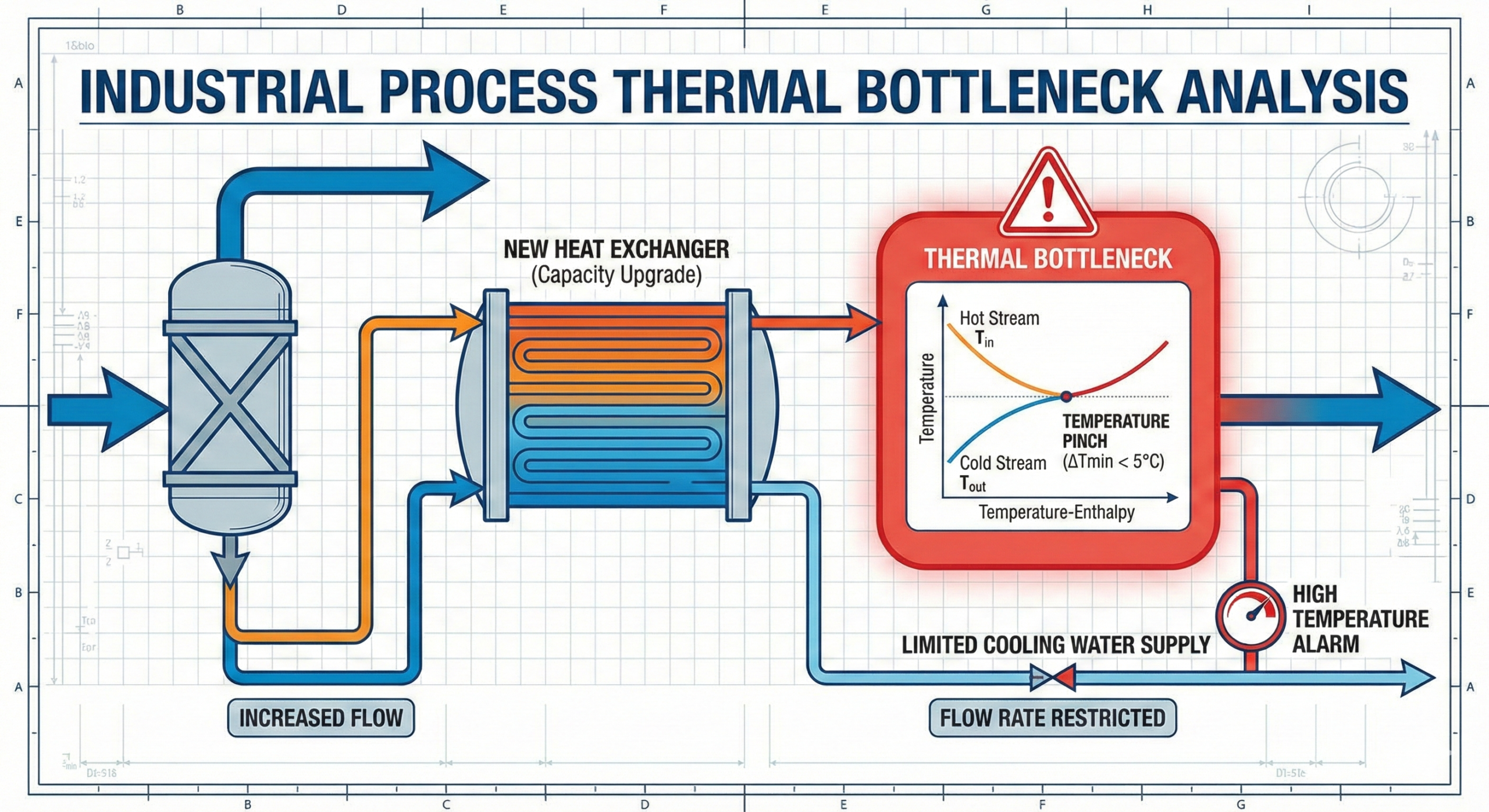
As a result, thermal bottlenecks remain hidden until throughput is increased — and then they dominate.
Heat Transfer Limits Scale Nonlinearly With Throughput
A common assumption in debottlenecking is:
If flow increases by 10%, heat transfer requirement increases by 10%.
In reality:
- duty often increases faster than flow,
- temperature approaches tighten,
- fouling accelerates,
- correction factors worsen.
Small throughput increases can push exchangers past their thermal limits.
Without review, added capacity exposes thermal fragility.
Added Area Does Not Guarantee Added Capacity
Debottlenecking often involves adding:
- parallel exchangers,
- extra bundles,
- extended surface.
These measures fail when:
- pinch points remain unchanged,
- utilities are already constrained,
- flow maldistribution persists,
- fouling drivers are untouched.
Area added in the wrong place has little effect.
Thermal systems behave as networks, not isolated components.
Utility Systems Are Often the True Bottleneck
In many plants:
- cooling water systems,
- steam networks,
- condensate return,
- heat recovery systems,
are already operating near limits.
Increasing throughput:
- raises heat rejection,
- increases utility demand,
- reduces available temperature driving force.
Debottlenecking without utility thermal review often shifts the bottleneck upstream — without increasing net capacity.
Temperature Pinch Points Are Commonly Missed
Thermal pinch points:
- do not appear as mechanical limits,
- emerge only at higher load,
- collapse approach temperatures.
When throughput increases:
- minimum temperature differences shrink,
- exchangers lose effectiveness rapidly.
Without reviewing temperature profiles, debottlenecking moves the system closer to pinch — and sometimes past it.
Fouling Becomes Critical After Debottlenecking
Higher throughput:
- increases velocity,
- raises heat flux,
- elevates wall temperatures.
These conditions:
- accelerate fouling,
- consume fouling margin faster,
- shorten cleaning intervals.
An exchanger that tolerated fouling at original load may fail quickly after debottlenecking.
Thermal review must include post-debottleneck fouling behavior.
Control Systems Reach Their Limits
As thermal margins shrink:
- control valves saturate,
- utility flexibility disappears,
- temperature stability degrades.
Operators lose the ability to compensate.
Debottlenecking often exposes limits that were previously hidden by control action.
Design Assumptions Break Under New Operating Points
Debottlenecking changes:
- flow regimes,
- Reynolds numbers,
- phase behavior,
- maldistribution patterns.
Design assumptions made for original operation no longer apply.
Without thermal re-evaluation, equipment operates in regimes it was never intended for.
Why Debottlenecking Appears to “Work” at First
Many debottlenecking projects appear successful initially.
Reasons include:
- clean surfaces,
- temporary utility availability,
- operator vigilance.
As fouling develops:
- margins disappear,
- energy consumption rises,
- instability appears.
What looked like success becomes disappointment months later.
Why Thermal Review Is Often Skipped
Thermal review is skipped because:
- it is complex,
- it requires system-level thinking,
- benefits are not immediately visible,
- pressure exists to move quickly.
Yet skipping it often guarantees underperformance.
What an Effective Thermal Review Includes
A proper thermal review examines:
- heat and mass balance at new loads,
- temperature profiles and pinch points,
- utility availability under peak conditions,
- fouling rate changes,
- control margin and valve authority,
- startup and transient behavior.
It looks beyond exchanger sizing to system behavior.
Owner Perspective: Failed Debottlenecking Is Expensive
From an ownership standpoint, failed debottlenecking means:
- capital spent without return,
- continued throughput limitation,
- additional revamp cycles,
- erosion of confidence.
Thermal review costs a fraction of these outcomes.
Final Perspective
Debottlenecking fails not because plants lack equipment — but because they misunderstand thermal limits.
Heat transfer constraints hide behind control systems, degrade quietly, and surface only when margins are exhausted.
Plants that integrate thermal review into debottlenecking:
- increase capacity reliably,
- protect availability,
- avoid repeat projects.
Plants that skip it often spend twice — once on equipment, and again on disappointment.
Understanding why debottlenecking often fails without thermal review turns expansion from gamble into strategy.
Explore the complete series in the Heat Transfer Engineering Hub.

A practicing chemical engineer with 17+ years of experience in process design, project execution, commissioning, and plant operations. Focused on practical engineering judgment beyond textbook explanations.