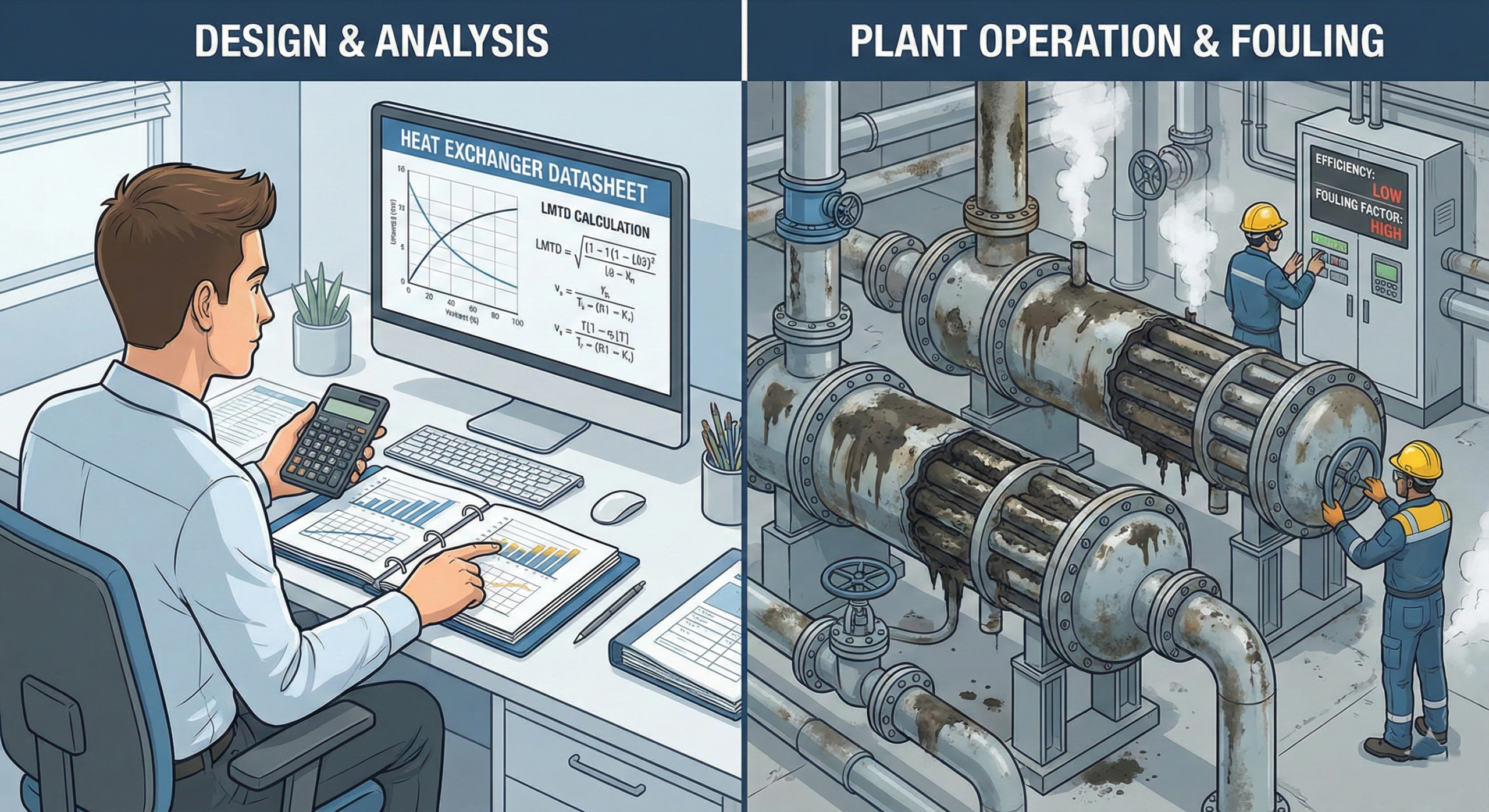
Young engineers approach thermal design reviews with sincerity and effort.
They check:
- heat duties,
- LMTD calculations,
- U values,
- fouling factors,
- pressure drops,
- datasheet completeness.
Most of the time, they do everything they were taught.
And yet, many exchangers reviewed this way later:
- miss duty,
- foul aggressively,
- struggle in summer,
- destabilize control,
- require early revamps.
The issue is not lack of intelligence or effort.
It is what thermal reviews emphasize — and what they overlook.
This article explains what young engineers commonly miss in thermal design reviews, and how experience gradually reshapes what really matters.
Table of Contents
Mistake 1: Treating the Design Point as Reality
Young engineers focus heavily on:
- design inlet temperatures,
- design flow rates,
- design utility conditions.
They review calculations as if:
- the plant will operate at this point,
- deviations will be small,
- conditions will return quickly.
In real plants:
- design conditions are brief,
- operation spans a wide envelope,
- margins are consumed continuously.
Experienced reviewers ask:
What happens away from the design point?
Young engineers often do not.
Mistake 2: Believing Fouling Is “Handled” by a Fouling Factor
Seeing a fouling factor included, young engineers often assume:
- fouling has been addressed,
- performance degradation is covered.
They rarely ask:
- how fouling distributes,
- where it concentrates,
- how fast it grows,
- how it interacts with flow maldistribution.
Fouling factor is treated as a checkbox.
Experienced engineers treat fouling as a behavior, not a number.
Mistake 3: Focusing on U Instead of Margin
Young engineers often debate:
- whether U is realistic,
- whether it is conservative,
- whether it matches literature.
They focus less on:
- how much margin exists,
- how quickly margin is consumed,
- how sensitive duty is to U degradation.
They try to “get U right.”
Experienced engineers ask:
What happens when U drops — which it will?
That question is often missing.
Mistake 4: Ignoring Correction Factor Sensitivity
If the correction factor is above the minimum acceptable value, many reviews stop there.
What is missed:
- how close the exchanger operates to pinch,
- how rapidly effectiveness drops with fouling,
- how non-linear degradation becomes near limits.
Correction factor is treated as a compliance check.
In reality, it is a fragility indicator.
Mistake 5: Assuming Flow Distribution Is Uniform
Young engineers assume:
- equal pass flow,
- effective baffle performance,
- no bypassing.
They rarely challenge:
- channeling,
- dead zones,
- maldistribution amplification with fouling.
Because maldistribution is hard to calculate, it is often ignored.
Experienced engineers assume maldistribution exists — and design accordingly.
Mistake 6: Reviewing Equipment, Not the Thermal System
Young engineers often review exchangers in isolation.
They ask:
- Does this exchanger meet duty?
They rarely ask:
- What happens upstream?
- What happens downstream?
- Where is the real pinch?
- How does utility availability change seasonally?
Heat exchangers do not fail alone.
They fail as part of systems.
Mistake 7: Underestimating Startup and Shutdown Impact
Most thermal reviews assume steady operation.
Young engineers rarely ask:
- how the exchanger is heated initially,
- what flow exists during warm-up,
- how shutdown condensation is handled,
- how many cycles per year occur.
Startup and shutdown shape surface condition early.
Ignoring them means reviewing a design that will never truly exist.
Mistake 8: Trusting Control to “Handle It”
Young engineers assume:
- control valves will compensate,
- controllers will maintain temperature,
- operators will manage deviations.
They forget that:
- control only works while margin exists,
- control hides degradation,
- control failure is a late symptom.
Experienced engineers treat control behavior as a diagnostic, not a safety net.
Mistake 9: Optimizing Capital Without Seeing Lifecycle Cost
Young engineers are often pressured to:
- reduce exchanger size,
- tighten approach temperatures,
- accept lower margins.
They focus on:
- capital efficiency,
- project approval metrics.
They rarely calculate:
- energy penalty over years,
- cleaning frequency cost,
- availability loss,
- early revamp risk.
Experienced engineers think in years, not line items.
Mistake 10: Asking “Is It Correct?” Instead of “Is It Forgiving?”
This is the most important difference.
Young engineers ask:
Is the design correct?
Experienced engineers ask:
How will this behave when things go wrong — because they will?
Forgiving designs:
- tolerate fouling,
- absorb variability,
- degrade gradually,
- give operators room to respond.
Correct but unforgiving designs fail quietly.
Why These Gaps Exist
These gaps exist because:
- textbooks focus on steady state,
- software solves idealized cases,
- failures are learned years later,
- reviews reward correctness, not resilience.
Experience teaches patterns that formal education does not emphasize.
This article exists to transfer those patterns explicitly.
How Young Engineers Can Improve Their Reviews
Young engineers do not need more equations.
They need better questions:
- Where is margin consumed first?
- What hides degradation initially?
- What worsens during startup?
- What happens at peak summer conditions?
- What will operators struggle with?
Asking these questions changes review quality immediately.
Owner Perspective: Reviews Shape Years of Cost
From an ownership standpoint:
- a missed issue in review becomes years of cost,
- a little extra margin becomes long-term stability.
The difference between a good and great thermal review is often invisible at startup — but very visible five years later.
Final Perspective
Young engineers are not wrong.
They are incomplete — temporarily.
Thermal design reviews improve not when engineers know more formulas, but when they:
- think in margins,
- expect degradation,
- anticipate variability,
- design for forgiveness.
What young engineers miss today becomes their strongest instinct tomorrow — often after a few painful plant lessons.
This article shortens that learning curve.
Understanding what young engineers miss in thermal design reviews is not about criticism.
It is about turning experience into shared knowledge — so plants work better, earlier, and for longer.
Explore the complete series in the Heat Transfer Engineering Hub.

A practicing chemical engineer with 17+ years of experience in process design, project execution, commissioning, and plant operations. Focused on practical engineering judgment beyond textbook explanations.