
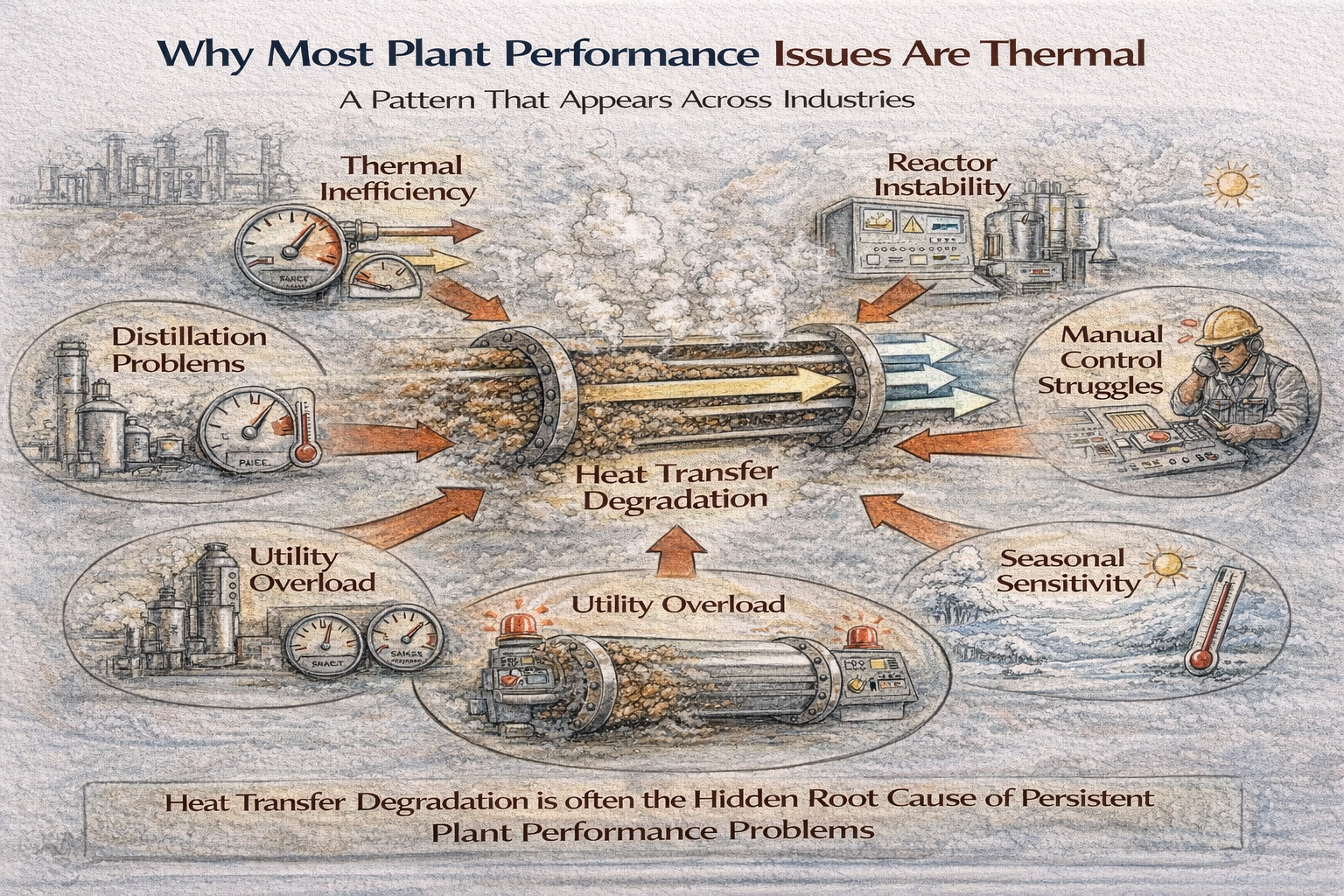
Across refineries, chemical plants, pharmaceutical facilities, food processing units, and energy systems, plant performance problems tend to repeat in familiar forms.
Capacity slowly reduces.
Energy consumption rises without obvious reason.
Control becomes unstable.
Maintenance frequency increases.
Operators rely more on manual intervention.
These issues are often treated as separate problems.
In reality, they usually share a common root.
Most persistent plant performance issues are thermal in nature.
They originate from how heat moves, accumulates, resists transfer, or escapes inside the plant. This behavior follows the fundamental reality that heat always flows when a temperature difference exists — a principle explained in why heat transfer always occurs.
Thermal problems in process plants are responsible for most long-term performance degradation, even when symptoms appear mechanical or control-related.
Table of Contents
Why Thermal Problems Rarely Look Like Thermal Problems
One reason thermal issues persist is that they rarely announce themselves clearly.
A plant does not alarm with “heat transfer degraded.”
Instead, it shows indirect symptoms.
Typical symptoms include:
- exchangers failing to meet duty,
- reactors struggling to hold temperature,
- columns losing separation efficiency,
- pumps drawing more power,
- utilities reaching limits earlier than expected.
Because the symptoms appear mechanical, hydraulic, or control-related, thermal causes are often overlooked.
Heat Transfer Governs Reaction Performance
In reactors, temperature is not just a condition.
It determines reaction rate, selectivity, and safety.
But temperature alone does not reflect the rate at which heat is being removed or accumulated — a distinction clarified in heat versus temperature in process plants.
When heat removal is insufficient:
- reaction heat accumulates,
- temperature control tightens,
- selectivity drifts,
- side reactions increase.
When heat input is uneven:
- hot spots develop,
- catalyst life reduces,
- product quality varies.
Many reactors that appear “hard to control” are actually limited by heat transfer, not chemistry.
Distillation Performance Is a Heat Balance Problem
Distillation is often treated as a mass transfer problem.
In operation, it is equally a heat transfer problem.
Reboiler heat input determines:
- vapor generation,
- internal flows,
- tray loading.
Condenser performance determines:
- reflux stability,
- overhead pressure,
- column capacity.
When heat transfer degrades:
- columns flood or weep,
- energy consumption increases,
- product purity fluctuates.
Mechanical internals may be intact.
The limitation lies in thermal behavior.
Heat Exchangers Age Thermally, Not Mechanically
Heat exchangers rarely fail structurally first.
They fail thermally.
Over time:
- fouling builds,
- flow distribution worsens,
- effective surface area reduces.
Design margins disappear gradually.
The exchanger still operates, but:
- requires higher utility flow,
- delivers smaller approach temperature,
- limits downstream performance.
Plants often compensate operationally rather than addressing the root thermal cause.
Utilities Reveal Thermal Limitations Early
Utility systems are the first to feel thermal stress.
Common signs include:
- cooling water temperature rising year after year,
- steam demand increasing for same production,
- hot oil circuits operating near limits.
Utilities do not create product.
They enable heat transfer.
When utilities reach capacity:
- plant throughput is constrained,
- operating flexibility reduces,
- energy cost increases.
These are not utility problems.
They are process heat transfer problems reflected in utilities.
Fouling Is a Thermal Disease
Fouling is often treated as a maintenance issue.
In reality, it is a thermal issue.
Fouling:
- increases heat transfer resistance,
- reduces effective driving force,
- shifts temperature profiles,
- increases energy demand.
Because fouling develops slowly, its impact is rarely dramatic.
Instead, it creates long-term inefficiency.
Plants that clean exchangers only when duty fails are reacting late.
Why Control Systems Struggle When Heat Transfer Degrades
Control systems act on temperature signals.
Processes respond to heat flow.
When heat transfer degrades:
- control actions become less effective,
- loops oscillate,
- operators intervene manually.
This often leads to:
- aggressive tuning,
- bypass usage,
- reduced stability.
The controller is not at fault.
The thermal response of the process has changed.
Seasonal Variations Expose Thermal Weaknesses
Plants often perform well in one season and struggle in another.
This is rarely coincidence.
Ambient temperature affects:
- cooling efficiency,
- heat losses,
- condensation behavior,
- utility margins.
Plants with tight thermal margins:
- hit limits in summer,
- operate comfortably in winter.
Seasonal behavior is a diagnostic indicator of thermal constraint.
Thermal Stress Creates Mechanical Problems
Thermal issues often lead to mechanical symptoms.
Examples:
- expansion-induced leaks,
- gasket failures,
- tube sheet stress,
- fatigue cracking.
The mechanical failure is visible.
The thermal cause is often ignored.
Managing heat transfer reduces not only energy cost but also mechanical damage.
Startups and Shutdowns Are Thermal Events
Many incidents occur during transient conditions.
This is because:
- temperatures change rapidly,
- heat flows are unsteady,
- thermal stresses develop.
Plants designed only for steady operation often struggle during transitions.
Understanding heat transfer behavior during startups and shutdowns is critical for safety and reliability.
Why Performance Degrades Slowly, Not Suddenly
Thermal problems accumulate.
- Fouling builds layer by layer.
- Insulation degrades gradually.
- Flow distribution worsens over time.
- Margins erode silently.
Because the change is slow, it becomes normalized.
By the time performance loss is visible, recovery requires significant intervention.
Why Experienced Plants Focus on Thermal Health
Well-performing plants monitor:
- approach temperatures,
- utility intensity,
- heat exchanger effectiveness,
- seasonal trends.
They treat thermal performance as a health indicator.
Rather than reacting to failures, they:
- plan cleaning,
- reassess margins,
- adjust operating envelopes.
This proactive approach separates reliable plants from struggling ones.
Owner Perspective: Why Thermal Issues Affect Profitability
From an ownership viewpoint, thermal inefficiency leads to:
- higher fuel consumption,
- higher electricity cost,
- reduced throughput,
- increased maintenance.
Thermal losses are continuous expenses.
Improving heat transfer often delivers:
- immediate savings,
- long-term stability,
- improved asset life.
Few improvements offer such broad impact.
Why This Understanding Changes Engineering Judgment
Engineers who recognize thermal roots:
- diagnose problems faster,
- avoid superficial fixes,
- design more robust systems.
They ask different questions:
- where is heat going?
- how has resistance changed?
- what margins remain?
These questions reflect the broader framework of heat transfer in process plants, where energy movement governs performance, reliability, and capacity.
This mindset is more valuable than any single calculation method.
Final Perspective
Most plant performance problems are not mysterious.
They are misunderstood.
Heat transfer operates quietly, continuously, and persistently.
Plants that respect this reality:
- operate predictably,
- age gracefully,
- remain profitable.
Plants that ignore it:
- fight recurring issues,
- accept inefficiency,
- normalize poor performance.
Recognizing thermal roots is not advanced engineering.
It is practical engineering.
And it is one of the most valuable perspectives a plant can develop.
Explore the complete series in the
Heat Transfer Engineering Hub
.

A practicing chemical engineer with 17+ years of experience in process design, project execution, commissioning, and plant operations. Focused on practical engineering judgment beyond textbook explanations.