
LMTD is one of the most useful tools in heat exchanger design. Under the right conditions, it provides a compact and effective way to represent temperature driving force.
However, LMTD is not universally valid.
There are specific situations where LMTD no longer represents real heat transfer behavior accurately. In these cases, relying on LMTD can lead to exchanger underperformance, unstable operation, or complete design failure.
The two most important conditions where LMTD fails are:
- phase change, and
- pinch points.
This article explains why LMTD breaks down in these situations and how to recognize the warning signs early.
Table of Contents
Why LMTD Depends on Smooth Temperature Profiles
LMTD assumes that:
- temperature changes smoothly along the exchanger,
- both fluids experience continuous temperature variation,
- no abrupt plateaus or collapses exist.
Under these assumptions:
- the logarithmic averaging correctly weights local driving force,
- total heat transfer is preserved.
Phase change and pinch points violate these assumptions.
When they appear, LMTD stops representing reality.
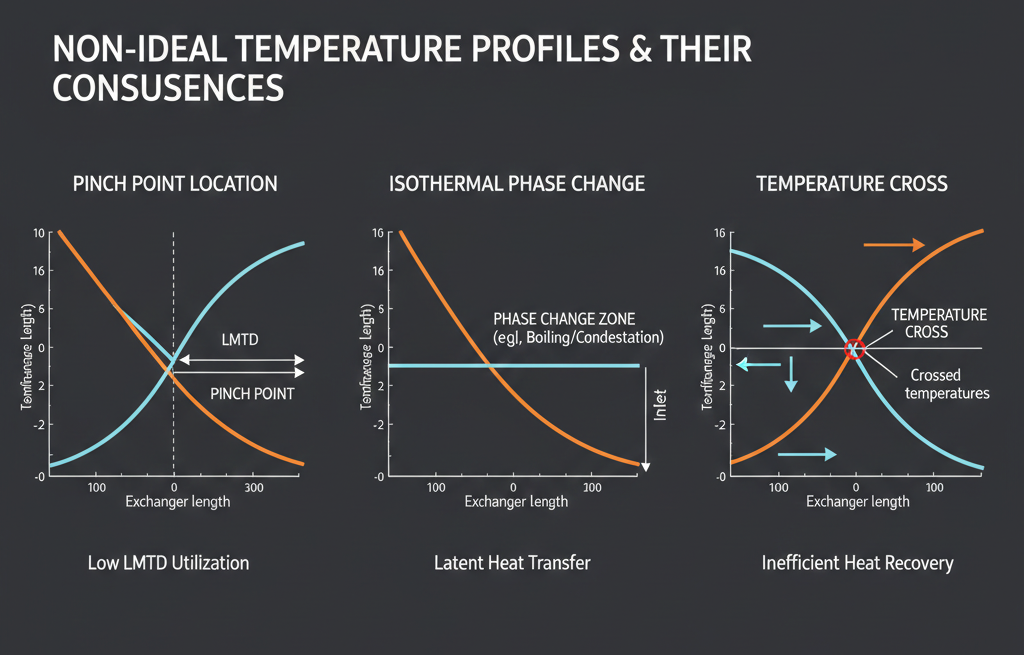
Phase Change Breaks LMTD’s Core Assumption
During phase change:
- temperature remains nearly constant,
- large amounts of heat are transferred at that constant temperature,
- local temperature difference does not change smoothly.
Examples include:
- condensation in condensers,
- boiling in reboilers,
- partial vaporization or condensation zones.
In these cases, temperature difference is no longer the variable that governs heat transfer.
Heat transfer is governed by:
- latent heat,
- phase equilibrium,
- heat flux limits.
LMTD, which relies on temperature variation, loses physical meaning.
Why Constant Temperature Zones Confuse LMTD
When one fluid undergoes phase change:
- inlet and outlet temperatures may be nearly identical,
- yet massive heat transfer occurs.
LMTD interprets this as:
- minimal temperature change,
- misleadingly small driving force.
This leads to:
- unrealistic area estimates,
- false conclusions about exchanger size,
- confusion during troubleshooting.
The exchanger is working exactly as intended — but LMTD cannot describe it properly.
Partial Phase Change Is Even More Dangerous
The most problematic cases are partial phase change:
- condensing vapor followed by subcooling,
- boiling liquid followed by superheating,
- mixed two-phase regions.
In these cases:
- part of the exchanger follows phase-change behavior,
- part follows sensible heat transfer,
- temperature profiles are discontinuous.
A single LMTD value cannot represent this mixed behavior reliably.
Designing such exchangers using one overall LMTD often produces fragile systems.
Pinch Points: Where Driving Force Collapses Locally
A pinch point occurs where:
- hot and cold stream temperatures approach each other closely,
- local temperature difference becomes very small,
- heat transfer resistance spikes.
Pinch points are not averages.
They are local phenomena.
LMTD averages over the entire exchanger and:
- hides the exact location of the pinch,
- understates its severity,
- delays recognition of capacity limits.
Exchangers fail at pinch points, not at average conditions.
Why Pinch Points Control Capacity
Near a pinch:
- enormous area is required to transfer small additional heat,
- fouling sensitivity increases dramatically,
- control stability deteriorates.
This explains why:
- small fouling causes sudden capacity loss,
- increasing utility flow gives little benefit,
- performance collapses abruptly rather than gradually.
LMTD smooths this collapse into a benign-looking number.
Reality is harsher.
Temperature Cross: The Ultimate LMTD Breakdown
A temperature cross occurs when:
- the cold stream outlet becomes hotter than the hot stream outlet,
- local driving force reverses sign.
At this point:
- LMTD becomes mathematically undefined,
- physical heat transfer becomes impossible without phase change or external work.
Designs that predict temperature cross based on LMTD are fundamentally flawed.
This is not a calculation issue.
It is a thermodynamic impossibility.
Why LMTD Masks Approaching Failure
As exchangers approach pinch or phase boundaries:
- LMTD declines slowly at first,
- performance appears acceptable,
- margin seems intact.
Then, suddenly:
- capacity disappears,
- temperatures stick,
- operation becomes unstable.
This non-linear collapse surprises plants that rely solely on LMTD.
The failure was always coming — LMTD simply hid it.
Why Correction Factor Cannot Fix This
Correction factors adjust for geometry.
They do not fix fundamental assumption violations.
When phase change or pinch dominates:
- correction factor remains mathematically valid,
- physical meaning still collapses.
Applying correction factors to a failing LMTD model only adds false confidence.
What Engineers Should Do Instead
When phase change or pinch dominates, engineers should:
- segment exchangers into zones,
- analyze phase-change sections separately,
- track minimum local temperature difference,
- consider ε-NTU methods where appropriate,
- design explicitly around pinch constraints.
The solution is not abandoning LMTD entirely — it is knowing when to stop trusting it.
Operational Symptoms of LMTD Failure
In real plants, LMTD failure often appears as:
- outlet temperatures stuck despite increased utility,
- strong sensitivity to fouling,
- large exchanger size with poor performance,
- control loops operating near saturation,
- repeated cleaning with minimal improvement.
These are not operational mistakes.
They are modeling failures.
Owner Perspective: Why This Failure Is Expensive
From an ownership standpoint, ignoring LMTD failure leads to:
- exchangers that never meet expectation,
- repeated debottlenecking attempts,
- unnecessary capital spending,
- production loss blamed on operations.
Recognizing where LMTD fails:
- prevents misdirected investment,
- improves reliability,
- aligns design with reality.
Final Perspective
LMTD is a powerful tool — within its limits.
Phase change and pinch points violate the assumptions that make LMTD valid. When that happens, LMTD stops being conservative and starts being misleading.
Engineers who recognize these boundaries:
- design more robust exchangers,
- troubleshoot faster,
- avoid repeated failures.
Those who do not often learn about LMTD’s limits only after startup.
Understanding when LMTD fails is as important as understanding how it works.

A practicing chemical engineer with 17+ years of experience in process design, project execution, commissioning, and plant operations. Focused on practical engineering judgment beyond textbook explanations.