
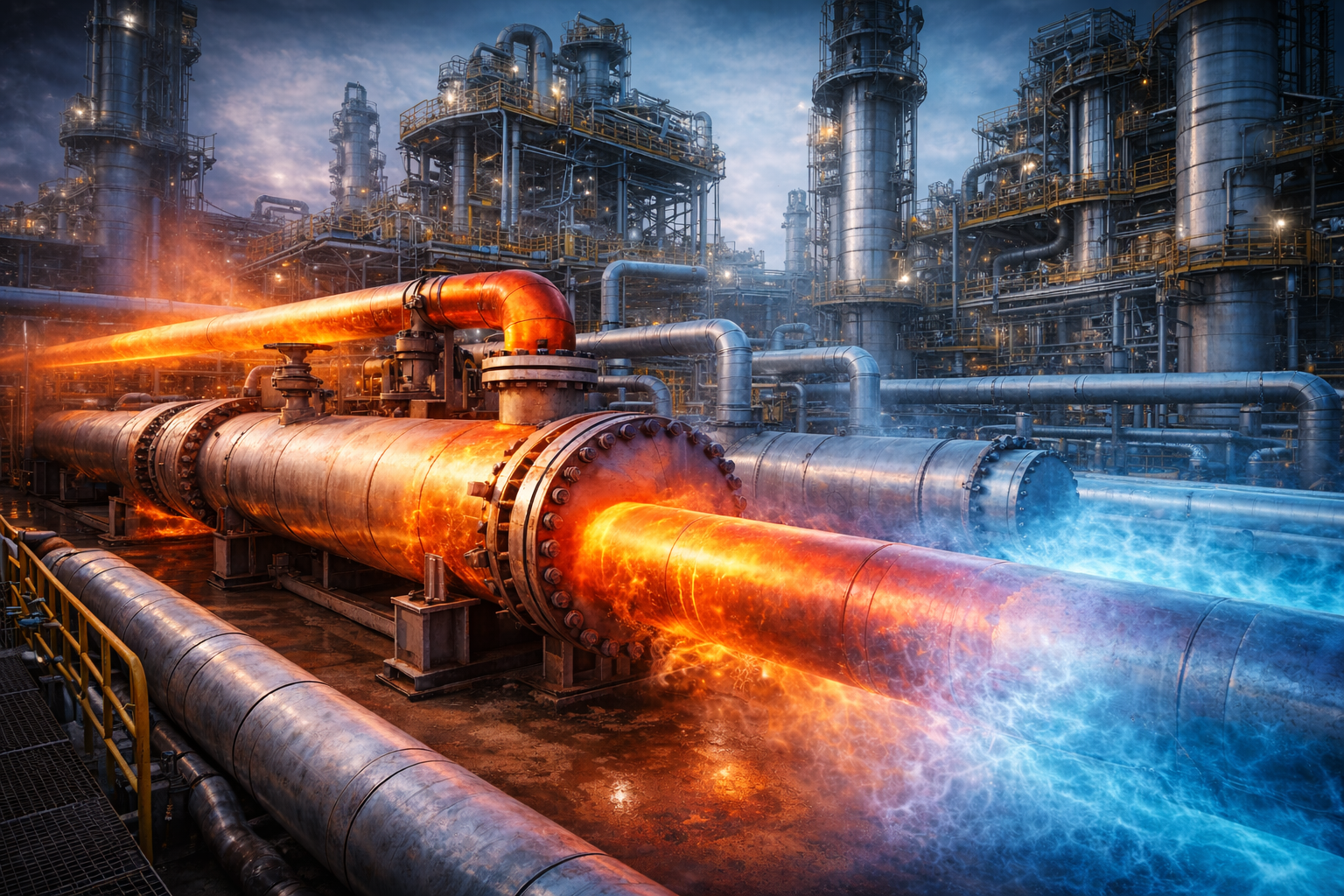
Heat transfer is not something that process plants choose to include.
It is something they inherit by existing.
The moment a plant contains:
- materials at different temperatures,
- equipment exposed to ambient conditions,
- fluids that move, react, or are stored,
heat transfer begins — continuously and automatically.
This article explains why heat transfer always occurs, even when it is not designed for, not calculated, and not wanted — a principle that forms the foundation of heat transfer in process plants. Understanding this principle is essential before attempting design, operation, troubleshooting, or optimization of any process plant.
Table of Contents
Temperature Difference Is Enough
No machinery is required for heat transfer to begin.
The only requirement is temperature difference.
If two regions have different temperatures, energy will move from the higher temperature region to the lower temperature region. This movement continues until equilibrium is reached or until something resists the transfer.
Understanding the distinction between heat and temperature clarifies why energy moves automatically whenever a difference exists.
In process plants, temperature differences exist everywhere:
- between process fluids and metal walls,
- between hot equipment and surrounding air,
- between products and utilities,
- between day and night ambient conditions.
As long as these differences exist, heat transfer cannot be stopped.
Why Heat Transfer Is Independent of Design Intent
A common misconception is that heat transfer occurs only where engineers design for it — such as in heat exchangers or heaters.
In reality, heat transfer does not depend on design intent.
It depends on physical laws.
Examples from real plants:
- A pipeline cools down even though no cooler was installed.
- A vessel heats up due to nearby hot equipment.
- A shutdown line gains heat through connected metal.
- A storage tank breathes vapor because of daily heating.
None of these effects require a heat exchanger to exist.
They occur because temperature differences exist and energy finds a path.
The Plant Is a Continuous Thermal Network
A process plant is not a collection of isolated equipment.
It is a continuous thermal system.
Metal connects vessels.
Pipes connect units.
Fluids carry energy across boundaries.
Structures conduct heat unintentionally.
Because of this connectivity:
- heat introduced at one point influences distant sections,
- temperature changes propagate gradually,
- unintended heat paths develop over time.
Ignoring these paths does not remove them.
It only makes their effects harder to predict.
Conduction Makes Heat Transfer Unavoidable
Conduction ensures that heat transfer continues even when fluids are stagnant.
Heat moves through:
- vessel shells,
- exchanger tubes,
- pipe walls,
- supports and nozzles,
- foundations and structures.
This explains why:
- insulated equipment still loses heat,
- idle piping does not remain at ambient temperature,
- shutdown equipment does not remain thermally isolated.
As long as solid material connects two regions of different temperature, heat will flow.
Convection Ensures Heat Transfer During Operation
When fluids move, heat transfer becomes even more unavoidable.
Flowing fluids:
- carry heat along their path,
- exchange heat with walls,
- change properties as temperature changes.
This is why:
- product temperature drifts along pipelines,
- exchanger performance changes with flow rate,
- reactors behave differently at part load,
- seasonal changes affect throughput.
Convection ensures that heat transfer is tied directly to operation — not just equipment design.
Radiation Adds an Invisible Path
At higher temperatures, radiation contributes significantly to heat transfer.
Unlike conduction and convection:
- radiation does not require contact,
- radiation does not require a medium.
Hot equipment radiates energy to:
- surrounding air,
- nearby structures,
- personnel areas,
- adjacent equipment.
This is why:
- insulation thickness matters more at high temperatures,
- equipment spacing affects safety,
- radiant heat loads cannot be ignored in fired systems.
Radiation ensures that even isolated equipment influences its surroundings.
Why Heat Transfer Cannot Be “Switched Off”
In plants, operators often attempt to isolate heat transfer by:
- stopping flow,
- closing valves,
- shutting down utilities.
While these actions reduce heat transfer, they never eliminate it completely.
Reasons include:
- residual temperature differences,
- metal-to-metal conduction,
- ambient heat exchange,
- stored thermal energy.
This is why:
- shutdown equipment continues to cool or heat,
- restart conditions differ from steady operation,
- thermal stresses develop during transitions.
Heat transfer does not stop when operations stop.
It only changes form and rate.
Everyday Plant Examples of Unavoidable Heat Transfer
Pipelines
Long pipelines exchange heat continuously with surroundings. This affects viscosity, pressure drop, and pump performance.
Storage Tanks
Day–night temperature cycles cause heat gain and loss, influencing vapor generation and emissions.
Reactors
Even when jackets are isolated, internal heat continues to redistribute through walls and internals.
Distillation Columns
Heat introduced at the reboiler influences trays far above through vapor flow and metal conduction.
Utilities
Cooling water return temperature changes even without process load due to ambient exposure.
These are not design flaws.
They are natural outcomes of heat transfer physics.
Why Ignoring Heat Transfer Creates Long-Term Problems
Plants that treat heat transfer as a one-time design calculation often face:
- gradual loss of performance,
- increasing energy consumption,
- frequent operator adjustments,
- unstable control behavior,
- unexpected seasonal limitations.
This happens because:
- fouling increases resistance,
- heat paths evolve over time,
- operating conditions drift,
- margins erode slowly.
Heat transfer effects accumulate quietly.
When problems become visible, the root cause often lies years in the past.
How Experienced Plants Deal with This Reality
Plants that perform reliably do not attempt to eliminate heat transfer.
They accept it and manage it.
This includes:
- realistic fouling assumptions,
- proper insulation maintenance,
- allowance for ambient effects,
- monitoring of thermal performance,
- periodic reassessment of heat balance.
The goal is not perfection.
The goal is predictability.
Why This Understanding Matters Before Any Calculation
Before discussing:
- heat exchanger design,
- coefficients,
- LMTD,
- simulation models,
one principle must be clear:
Heat transfer always occurs.
Calculations only attempt to quantify something that is already happening.
Without this understanding:
- equations feel abstract,
- software outputs mislead,
- troubleshooting becomes reactive.
With this understanding:
- numbers gain meaning,
- deviations become explainable,
- decisions improve.
Final Perspective
Heat transfer is not optional.
It is not limited to certain equipment.
It does not wait for engineering approval.
It occurs because plants exist in a physical world governed by energy balance.
Understanding this is not advanced knowledge.
It is essential knowledge.
Once this principle is accepted, everything else in process engineering begins to make sense.
If heat transfer always occurs, the next question becomes:
What exactly is the difference between heat and temperature in real plant behavior?
Explore the complete series in the
Heat Transfer Engineering Hub
.

A practicing chemical engineer with 17+ years of experience in process design, project execution, commissioning, and plant operations. Focused on practical engineering judgment beyond textbook explanations.