
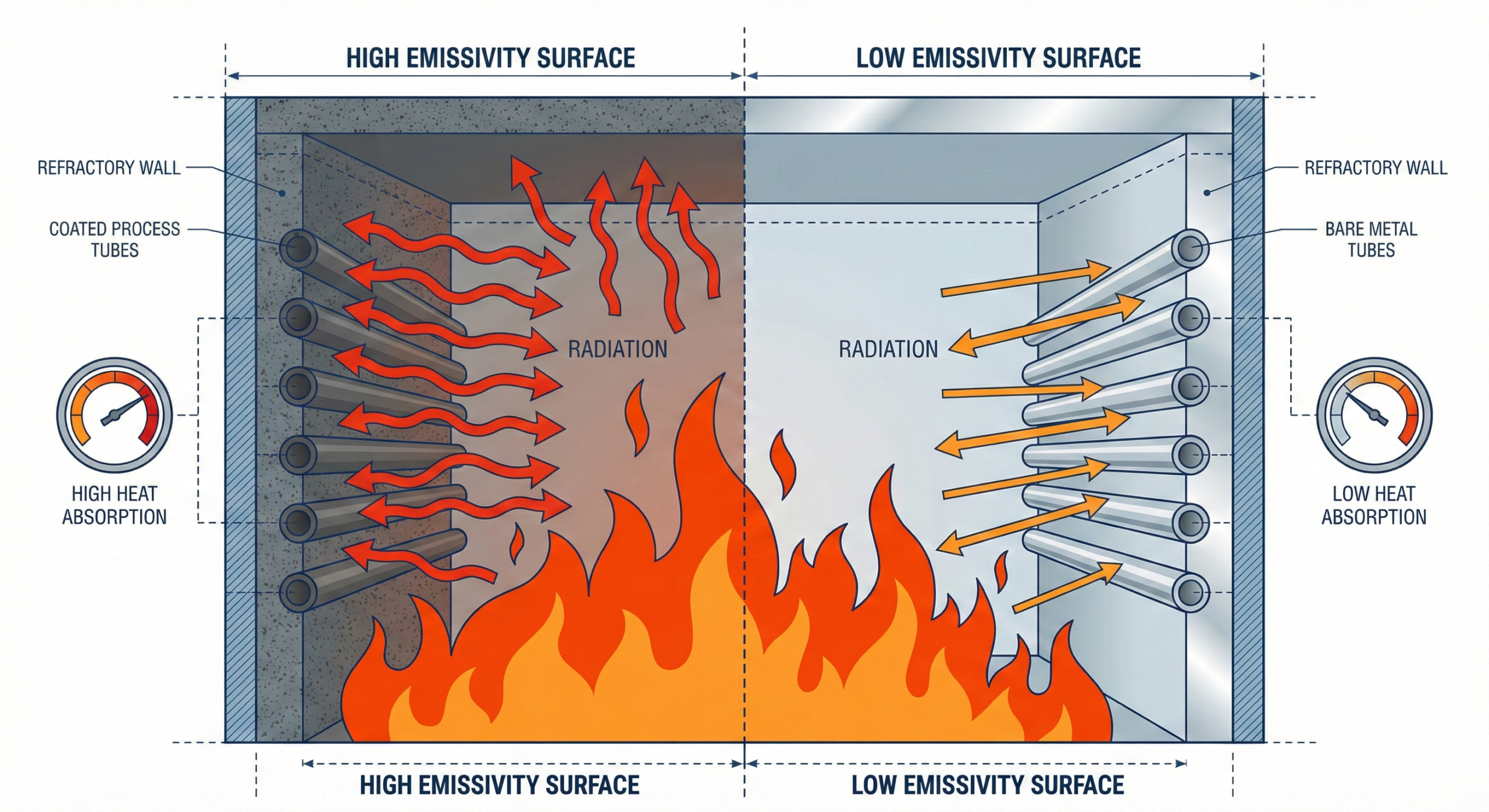
Inside a fired heater or furnace, most of the heat transfer in the high-temperature zone happens through radiation.
Flames radiate heat.
Hot refractory walls radiate heat.
Hot tubes absorb that heat.
But how much heat is actually radiated or absorbed depends on a surface property that is rarely visible and often ignored in daily operation:
Emissivity
It is not something you can easily see.
It is not something operators directly measure.
Yet it plays a major role in how effectively furnaces transfer heat.
This article explains what emissivity really means, how it affects heat transfer in real furnaces, and why surface condition can quietly change performance over time.
Table of Contents
What Is Emissivity in Simple Terms?
Every hot surface gives off thermal radiation.
But not all surfaces radiate equally.
Some surfaces release heat strongly.
Some release it weakly.
Emissivity is a measure of:
How effectively a surface emits or absorbs radiant heat.
A surface with:
- high emissivity radiates heat efficiently
- low emissivity radiates less heat
And the same rule applies to absorption:
- high-emissivity surfaces absorb radiation better
- low-emissivity surfaces reflect more and absorb less
Why Emissivity Matters in Furnaces
In the radiant section of a fired heater:
- flames produce intense radiant energy
- hot refractory walls also radiate energy
- process tubes absorb this radiation
So heat transfer depends on:
- flame temperature
- tube temperature
- and surface emissivity
If emissivity changes, the amount of heat transferred also changes. This is one reason radiation calculations become difficult to predict accurately in real furnace environments.
Even if fuel firing remains the same.
Dark Surfaces Radiate Better Than Shiny Ones
A simple everyday observation explains emissivity.
Dark, rough surfaces:
- absorb heat strongly
- emit heat strongly
Shiny, polished surfaces:
- reflect heat
- emit less heat
Inside furnaces, most surfaces are intentionally designed to have high emissivity so they can:
- radiate heat efficiently
- absorb radiation effectively
This helps improve overall heater performance.
Process Tubes Depend on Emissivity to Absorb Heat
Process tubes inside the radiant section are heated mainly by radiation.
For efficient heating, tube surfaces must:
- absorb radiant energy well
- transfer that heat to the fluid inside
If tube emissivity is high:
- more radiation is absorbed
- heating becomes more effective
If emissivity drops:
- more radiation is reflected
- less heat enters the tube
So the same flame can produce different heating results depending on tube surface condition.
How Surface Condition Changes Emissivity
In real furnaces, surfaces do not remain unchanged.
Over time, tubes and walls experience:
- oxidation
- scaling
- soot deposition
- corrosion
- surface roughening
Each of these affects emissivity.
Sometimes it increases.
Sometimes it decreases.
And that changes how radiation behaves inside the furnace.
Oxidation Can Increase Emissivity
When metal surfaces oxidize:
- a thin oxide layer forms
- the surface becomes rougher and darker
This often increases emissivity.
So mildly oxidized tubes may:
- absorb radiation better
- heat more effectively
This is one reason why performance sometimes improves slightly after initial operation.
Soot and Deposits Can Reduce Effective Heat Transfer
In some services, soot or deposits may build on surfaces.
This can have mixed effects:
- dark deposits may increase emissivity
- but thick layers act as insulation
So even if radiation absorption increases, heat may not pass easily into the metal.
This reduces overall performance.
So emissivity and thermal resistance must be seen together.
Refractory Walls Also Play a Major Role
Furnace walls are lined with refractory materials.
These surfaces:
- become extremely hot
- radiate heat toward process tubes
If refractory emissivity is high:
- it sends strong radiant energy toward tubes
- overall heat transfer improves
If surfaces become damaged, glazed, or covered:
- radiation intensity may reduce
This affects heating efficiency.
Why New Furnaces Behave Slightly Differently
When a furnace is new:
- metal surfaces are cleaner
- oxidation has not fully developed
- surface characteristics are still stabilizing
Over time:
- surfaces change
- emissivity adjusts
- heat absorption behavior shifts
So performance patterns in early months may differ from long-term operation.
Flame Visibility and Radiation
Flame characteristics also influence radiation.
A well-shaped, luminous flame:
- radiates strongly
- transfers heat efficiently
If combustion is poor:
- flame may become less radiant
- heat transfer reduces
So emissivity of surfaces works together with flame behavior to define furnace performance. This interaction is part of the broader balance between radiation and convection inside fired heaters.
Why Tube Overheating Can Be Linked to Emissivity
In some cases, tubes may overheat locally.
This can happen if:
- emissivity varies across surfaces
- some tubes absorb more radiation than others
Uneven absorption creates uneven heating. In severe cases, this can resemble the same overheating patterns seen in radiation-dominated furnace sections.
This is why maintaining uniform surface condition is important for stable operation.
Emissivity Changes Slowly but Matters Continuously
Unlike flow or temperature, emissivity does not change suddenly.
It changes gradually as surfaces age.
But because radiation is a major heat transfer mode, even gradual changes can:
- alter heat absorption
- affect temperature distribution
- change fuel demand
So the effect is subtle but long-lasting.
Why Emissivity Is Hard to Measure in Plants
In theory, emissivity can be measured.
In practice, inside operating furnaces:
- temperatures are high
- access is limited
- surfaces are not uniform
So it is rarely measured directly.
Instead, its effects are observed indirectly through:
- changes in heater efficiency
- variations in tube temperatures
- fuel consumption trends
Owner Perspective: Efficiency Is Influenced by Surface Condition
From an operational and cost point of view, emissivity affects:
- how efficiently fuel energy becomes process heat
- how evenly tubes are heated
- how stable furnace performance remains over time
A furnace with good radiant behavior:
- uses fuel more effectively
- transfers more heat to the process
- wastes less energy in flue gases
So surface condition has a real financial impact.
A Simple Way to Visualize Emissivity
Think of two hot objects:
- one dull and dark
- one shiny and polished
The dull surface feels hotter because it radiates heat more strongly.
Inside furnaces, similar effects happen:
- high-emissivity surfaces radiate and absorb better
- low-emissivity surfaces reflect more energy away
This directly influences heat transfer.
Final Perspective
In real furnaces, heat transfer is not controlled by temperature alone.
It is shaped by how surfaces behave.
Emissivity determines:
- how much heat walls radiate
- how much tubes absorb
- how effectively energy moves through the furnace
And since surface condition changes over time, emissivity quietly evolves with the life of the equipment.
Understanding the effect of surface emissivity helps explain why:
- two furnaces with similar firing rates may perform differently
- tube temperatures may vary
- efficiency may change without obvious mechanical problems
It is a hidden property — but one that plays a powerful role in how radiation actually works inside real process furnaces.
What Comes Next
Velocity can improve convection only when the fluid itself is capable of mixing effectively near the wall surface.
In viscous and fouling-prone services, fluid behavior creates additional resistance that limits how much convection can improve heat transfer.
Convection Limitations in Viscous & Fouling Fluids
This article explains why highly viscous and fouling fluids resist strong convection, why these services are difficult to heat or cool, and why they often become long-term plant bottlenecks.
Explore the complete series in the Heat Transfer Engineering Hub.

A practicing chemical engineer with 17+ years of experience in process design, project execution, commissioning, and plant operations. Focused on practical engineering judgment beyond textbook explanations.