
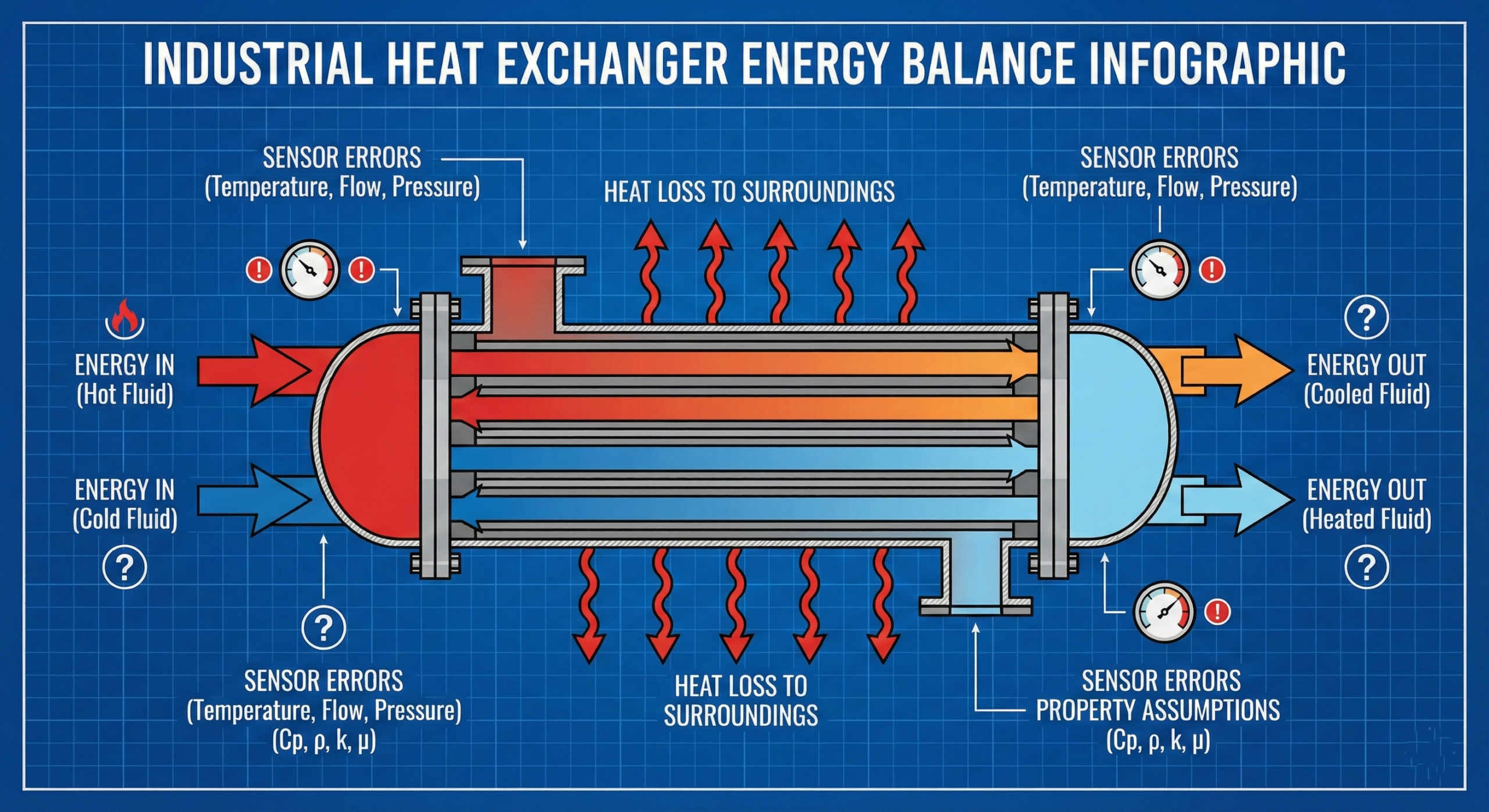
Energy balance is one of the first tools engineers learn.
It looks straightforward:
- energy in
- energy out
- difference equals loss or gain
In process plants, energy balances are used to:
- check exchanger performance
- estimate heat duty
- evaluate efficiency
- troubleshoot problems
On paper, the concept is simple and powerful.
But in real plant situations, energy balance calculations often lead to confusion, disagreement, or wrong conclusions.
Not because the method is wrong — but because small assumptions and oversights create large errors.
This article explains the most common mistakes engineers make while doing energy balances, why they happen, and how they affect real plant decisions.
Table of Contents
Mistake 1: Assuming Measurements Are Perfect
Energy balance depends heavily on:
- flow rates
- temperatures
- pressures
- fluid properties
Engineers often assume these numbers are exact.
In reality:
- instruments have tolerances
- sensors drift over time
- flow meters may be off by a few percent
Even small measurement errors can create large differences in calculated energy.
So when the balance does not close, it is often due to input uncertainty, not process failure.
Mistake 2: Ignoring Heat Loss to Surroundings
In calculations, engineers sometimes assume:
- all heat lost by one stream is gained by another.
But in real plants:
- pipes lose heat
- equipment radiates heat
- insulation is not perfect
This lost energy does not show up in process stream measurements.
So the balance appears incorrect.
The missing heat is simply going into the surroundings.
Mistake 3: Using Average Values Without Checking Variations
Energy balance often uses:
- average temperatures
- average flow rates
- assumed steady conditions
But real plants fluctuate constantly.
Feed composition may change.
Load may vary.
Temperatures may shift over time.
Using a single average value may hide real variations.
This leads to differences between expected and observed energy transfer. Average temperature difference calculations often hide these local variations.
Mistake 4: Forgetting the Heat Stored in Equipment
When conditions change, some energy goes into:
- heating metal surfaces
- warming insulation
- raising fluid inventory temperature
This stored energy is not part of the process stream.
But it affects the energy balance during:
- startup
- shutdown
- load changes
If not considered, the balance may look incorrect. This is especially noticeable when comparing transient operation against steady-state heat duty assumptions.
Mistake 5: Incorrect Property Assumptions
Energy calculations depend on fluid properties like:
- heat capacity
- density
- phase composition
Engineers sometimes use standard values.
But in real plants:
- composition may vary
- temperature changes affect properties
- impurities may be present
Even small property errors can lead to noticeable duty differences.
Mistake 6: Not Accounting for Phase Change Properly
In systems involving:
- condensation
- boiling
- evaporation
energy transfer includes latent heat.
If vapor fraction or phase behavior is not known exactly:
- calculated duty may be incorrect
- balance may appear off
Phase change services are especially sensitive to small assumption errors.
Mistake 7: Mixing Data from Different Time Periods
Sometimes data used in energy balance comes from:
- different instruments
- different time stamps
- different operating conditions
If readings are not taken at the same time:
- the system may not be at the same load
- values may not represent the same moment
This leads to mismatch in energy calculations.
Mistake 8: Ignoring Pressure Effects
Pressure influences:
- boiling temperature
- condensation behavior
- gas properties
If pressure changes but calculations assume constant values:
- energy balance may not match real performance
This is common in systems where pressure fluctuates.
Mistake 9: Assuming Perfect Mixing
Temperature sensors often measure at a single point.
But fluid inside pipes may not be fully mixed.
This can cause:
- local hot spots
- uneven temperature distribution
So the measured temperature may not represent the true average temperature of the stream.
Energy calculations based on that reading may be inaccurate. Actual temperature profiles inside the equipment may be far more uneven than the measured values suggest.
Mistake 10: Expecting Exact Agreement
Many engineers expect:
- hot-side energy loss = cold-side energy gain exactly.
In real plants, small differences always exist due to:
- measurement uncertainty
- heat loss
- property assumptions
- system dynamics
Trying to force exact agreement can lead to unnecessary adjustments or incorrect conclusions. Small instrument uncertainty alone can easily create noticeable thermal imbalance.
Why These Errors Are So Common
Energy balance seems simple.
So it is often done quickly.
But real plants are complex:
- flows change
- temperatures vary
- instruments have limits
- systems are not perfectly insulated
Small uncertainties accumulate.
And the final difference appears larger than expected.
How Operators See the Same Situation Differently
Operators focus on:
- actual temperatures
- real performance
- stable operation
If the process is running well, they may not worry about small energy balance gaps.
Engineers, however, often try to match numbers exactly.
Understanding the limits of measurement helps bridge this difference.
Owner Perspective: Focus on Useful Accuracy
From a plant management point of view, the goal is not perfect mathematical closure.
The goal is:
- reliable performance
- efficient energy use
- stable operation
Energy balances are most useful for:
- identifying large deviations
- tracking trends
- spotting performance decline
Not for chasing perfect equality.
A Practical Way to Approach Energy Balance
Instead of asking:
- “Why is the balance not exact?”
It is often better to ask:
- “Is the difference within reasonable limits?”
- “Is performance changing over time?”
- “Are trends improving or worsening?”
This makes the tool more practical and less frustrating.
Why Experience Changes How Engineers Use Energy Balance
Early in their careers, engineers often expect:
- precise agreement
- clean numbers
- perfect balance
Over time, they learn:
- small differences are normal
- measurement limits exist
- real systems are dynamic
So energy balance becomes a guide, not an absolute truth.
Final Perspective
Energy balance is one of the most powerful methods in process engineering.
But it works best when used with understanding.
Most errors do not come from wrong formulas.
They come from:
- imperfect measurements
- hidden losses
- changing conditions
- simplified assumptions
When these factors are recognized, energy balance becomes more meaningful. Not as a perfect calculation, but as a way to understand how energy is really moving through the plant. Experienced engineers therefore treat energy balance as a practical interpretation tool rather than an exact thermal truth.
Many apparent heat-balance problems originate not from the process itself, but from the limitations of the instruments used to measure it.
Even small sensor inaccuracies can create surprisingly large differences in calculated thermal performance when multiple measurements combine together.
Instrument Accuracy vs Heat Balance Accuracy – Why a Small Measurement Error Can Create a Big Thermal Confusion
This article explains why heat-balance calculations are far more sensitive than individual instrument accuracy and why perfect thermal agreement is rarely achieved in operating plants.
Explore the complete series in the Heat Transfer Engineering Hub.

A practicing chemical engineer with 17+ years of experience in process design, project execution, commissioning, and plant operations. Focused on practical engineering judgment beyond textbook explanations.